Short Game

How to Get Up and Down in Golf
The Scrambling Guide
April 4, 2026 · 10 min read · Stephen Pickering
The Scrambling Guide
April 4, 2026 · 10 min read · Stephen Pickering
Key takeaway: Getting up and down is the most valuable scoring skill in amateur golf. A 20-handicapper who improves their conversion from 15% to 30% saves roughly 2 strokes per round — without changing anything else. The secret: practise the chip-and-putt as one sequence, not separately.
You miss the green. The ball sits 15 yards from the pin in light rough. What happens next determines whether you walk off with a par or a bogey — and over 18 holes, that difference adds up to 5, 6, sometimes 8 strokes.
Getting up and down — chipping onto the green and holing the putt in one — is the most valuable scoring skill in amateur golf. A 20-handicapper who improves their up-and-down percentage from 15% to 30% saves roughly 2 strokes per round without changing anything else. Here’s how to make that happen with the right technique, smarter decisions, and performance-based practice.
Tour pros get up and down about 60% of the time. A 10-handicapper manages around 30%. A 20-handicapper sits at roughly 15%. The gap between those numbers across a round where you miss 10–12 greens is enormous.
If you miss 12 greens and convert 15% of up-and-downs, you save par on 2 holes. Improve to 30% and you save 4 pars. That’s 2 fewer bogeys on your card — from the same ball-striking, the same course, the same swing. Nothing changed except what you did from 30 yards in.
Here’s what most golfers get wrong about scrambling: they focus entirely on the chip and ignore the putt. A chip to 4 feet is worthless if you miss the putt. A chip to 10 feet followed by a confident make still saves par.
The up-and-down is a two-shot sequence. Practise it as one.
You don’t need five different chip shots. You need one reliable technique that works from most lies around the green.
Setup: Ball slightly back of centre, weight 60% on your front foot, hands ahead of the ball. Grip down on the club for control.
Stroke: A pendulum motion controlled by your shoulders and arms — not your wrists. The length of your backswing controls the distance, not the force of the hit. Think of it as a long putt with loft.
Club: A pitching wedge or 9-iron. These clubs produce enough loft to carry the fringe and enough roll to reach the hole. Save the lob wedge for when you have no green to work with.
Tour players don’t chip to the flag. They chip to a landing spot — a specific point on the green where the ball will first bounce. The landing spot determines the roll, and the roll determines where the ball finishes.
Pick a spot one-third of the way to the hole. Land the ball there. Let it release. This is more reliable than trying to fly it all the way to the pin, because landing spot errors are smaller than full-flight errors. A chip that lands 2 feet past your spot still finishes close. A chip that flies 2 feet past the flag finishes 10 feet past the hole.
The lie dictates the shot — not the other way around. Before choosing your club or visualising the trajectory, look at the ball:
Sitting up on short grass: Standard chip with a PW or 9-iron. Low, running shot.
Sitting down in rough: Open the face slightly and use a sand wedge. Commit to a slightly longer swing — deceleration through thick grass is how you duff it.
Tight lie on bare ground: Use a putter or a low-lofted chip with a 7- or 8-iron. Less loft means less chance of skulling it across the green.
Match the shot to the lie and your conversion rate goes up immediately.
A solid chip usually finishes 3–8 feet from the hole. That’s not tap-in range. It’s the distance where amateurs miss the most — and where the up-and-down lives or dies.
A 15-handicapper makes about 45% from 5 feet. A tour player makes 78%. That gap costs you 2–3 pars per round on putts you should be holing. The fix isn’t complicated: practise the 3–6 foot range with pressure and scoring.
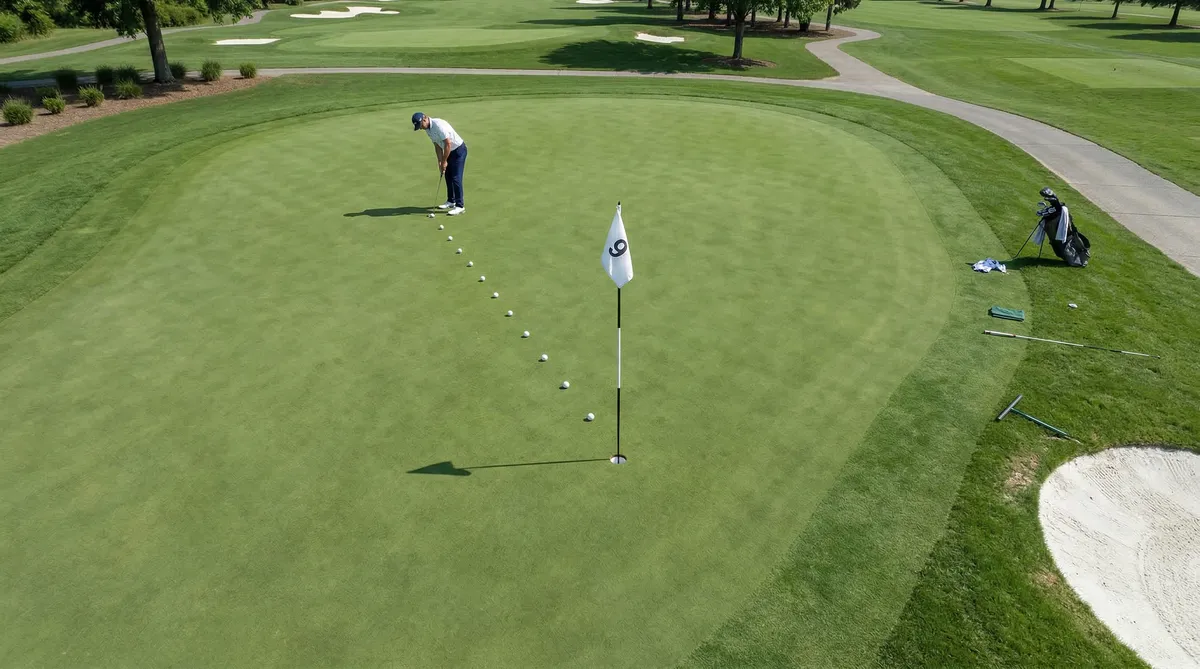
Place a ball at 3, 4, 5, and 6 feet — one at each distance. Make all four in sequence. Miss any putt and restart from 3 feet. When you can complete the sequence three times in a row without a miss, your confidence on these putts will be genuinely different.
This isn’t about technique. It’s about training your nervous system to execute under the mild pressure of a streak. On the course, you’ll have stood over enough 5-footers in practice that the ones after your chips feel familiar, not threatening.
Set up 9 different chip shots around the green — different distances, angles, and lies. For each one, try to hole out in 2 strokes or fewer: one chip and one putt. Even if the chip finishes close, you must putt from at least a putter length away — no gimmies.
Count how many pars you score out of 9. This is the closest drill to real on-course scrambling because it forces you to execute the full two-shot sequence. A score of 4 out of 9 is solid for a mid-handicapper. 6 or more means your up-and-down game is genuinely sharp.
Chip to a target with this scoring system: hole out = 5 points, inside 1 foot = 3 points, inside 3 feet = 1 point, outside 3 feet = 0 points. Chip until you reach exactly 21 — go over and you bust, like blackjack. Record how many chips it takes to reach 21.
This drill builds touch and precision simultaneously. The bust mechanic forces you to think about proximity, not just “get it on the green.” Fewer chips to reach 21 means your chipping is getting tighter.
Chip 10 balls from just off the green to a hole 10 yards away. Count how many finish inside 3 feet. Use any club you prefer. This is pure proximity work from the most common chipping distance — the bread-and-butter shot you’ll face 6–8 times per round.
Target: 7 out of 10 inside 3 feet. When you hit that consistently, tighten the zone to 2 feet.
Scoring Zone’s chipping drills — Par 2, 21 Points, and The Ten Yarder — score every rep automatically and track your results over time. You get a clear picture of whether your chipping proximity and up-and-down conversion are actually improving, not just whether the last session felt good.
Scored chipping challenges with automatic tracking and benchmarks.
Chipping Drills →Set up 6 chip shots from different spots around the green. For each one: chip the ball, then walk up and putt it out. Record whether you got up and down (2 strokes or fewer) or not. Your score is the number of successful up-and-downs out of 6.
This is the most realistic drill on this list because it mirrors exactly what happens on the course — variable chip shots followed by the pressure of holing a short putt. A score of 3 out of 6 is a 50% scrambling rate, which would be exceptional for most amateurs.
After every round, count two numbers: how many greens you missed, and how many times you saved par (or better) after missing. Divide the saves by the misses. That’s your up-and-down percentage.
Track this over 10 rounds. If it’s trending up, your practice is working. If it’s flat, you need to change what you’re practising — not practise more of the same.
When your up-and-down percentage stalls, the question is: which part is failing? Are your chips finishing too far from the hole? Or are you chipping it close and missing the putt?
Track average proximity after your chip (estimate in feet). If you’re averaging inside 6 feet but your up-and-down rate is still low, your putting is the problem. If you’re averaging 10+ feet, your chipping needs work first. The data tells you where to aim your practice — without it, you’re guessing.
Scoring Zone’s Performance Hub runs a full 60-shot short game assessment and generates your Short Game Handicap. It breaks down your chipping and putting separately, so you know exactly which half of the up-and-down sequence needs attention — and the PDF report gives you a baseline to measure against.
Take the full short game assessment and get your Short Game Handicap.
Performance Hub →If you’re on the fringe or just off the green with a clean lie and flat terrain between you and the hole — putt it. A bad putt from off the green almost always finishes closer than a bad chip. The putter is the safest club around the green, and most amateurs don’t use it enough.
Save the chip for when there’s rough, a slope, or a bunker between you and the hole. If you can putt, putt.
An uphill putt is easier than a downhill putt — every time. When you’re chipping, aim to leave the ball below the hole. This means sometimes aiming slightly short or to the low side rather than at the flag. The extra foot you might gain from an aggressive chip isn’t worth the downhill 4-footer it leaves you.
This single decision — below the hole, always — will improve your conversion rate without any technique change.
See how your scrambling stats trend over time with round-by-round tracking.
Round Stats →Three sessions per week of 20 minutes each — split between chipping and short putting. Focus on the chip-and-putt sequence, not just isolated chipping. Scored practice with benchmarks tracks your conversion rate over time so you know it’s working.
Two things: leaving chips too far from the hole (outside 6 feet), and missing the short putt that follows. Most amateurs focus on the chip and neglect the putt. A chip to 8 feet followed by a miss is the same result as a duffed chip — both are failed up-and-downs. You need both shots to be reliable.
You can practise the putting half at home on a mat — especially 3–6 foot putts, which are the distances you’ll face after a decent chip. For chipping, a garden with a net or target works well. The key is simulating the chip-then-putt sequence, even if the surfaces aren’t identical to a real green.
Master one chip shot and one club around the green. Most amateurs try too many different shots and execute none of them well. Pick a standard chip with a pitching wedge, practise until it’s automatic, then build a reliable 3–6 foot putting stroke. Track your up-and-down percentage across rounds — the data shows whether your practice is working.
Stephen Pickering
3-handicap golfer with 25 years on the course. Built Scoring Zone to bring structure and pressure to short game practice. Writes about what actually works from the practice green, not the press box.
Join golfers already saving more pars with scored chipping challenges, short game assessments, and automatic performance tracking. It takes one session to feel the difference.
Download Scoring Zone Free →Full access to all drills, stats, and features. No credit card required — then from $4.99/month.
Get Scoring Zone Free →