Practice & Improvement

How to Improve Your Golf Short Game
March 17, 2026 · 6 min read · Stephen Pickering
March 17, 2026 · 6 min read · Stephen Pickering
Key takeaway: To improve your golf short game, switch from unstructured practice to performance-based drills with scoring, targets, and measurable benchmarks. Start with a short game assessment to identify your weakest areas, then use scored drills 2–3 times per week for 20–30 minutes. Track your Short Game Handicap and Putting Handicap to measure real progress.
The short game is where most rounds are won and lost. Not on the tee. Not on the fairway. In that 50-yard radius around the green where a smart, well-practised golfer saves par — and everyone else drops shots they didn’t need to.
If you want to know how to improve your golf short game — and genuinely how to lower your golf scores — the honest answer is: practise it differently. Not more. Differently.
Most golfers chip and putt without a plan. They hit a few balls toward a hole, make some, miss some, and move on. It feels productive. It isn’t.
The problem is feedback — or rather, the absence of it. Without a target score, a benchmark, or any way to measure whether today was better than last week, there’s no signal telling you whether your practice is working. You’re just burning time.
Most golfers practise the shots they’re already decent at and avoid the ones that make them uncomfortable. The result is a short game with obvious blind spots that show up every time it matters.
Without a scoring system, every session exists in isolation. You can’t tell whether you’re improving or going in circles. Genuinely improving your short game means practising with a purpose — and having a way to know if it’s working.
There’s a well-established body of research on what makes practice effective — in golf and in sport more broadly. The findings point consistently in one direction: performance-based practice, where you’re hitting to targets, varying your shots, and measuring outcomes, produces better results than technical repetition alone.
The reason is transfer. Skills built under pressure and in varied conditions carry over to the course. Skills built through mindless repetition in a comfortable environment often don’t.
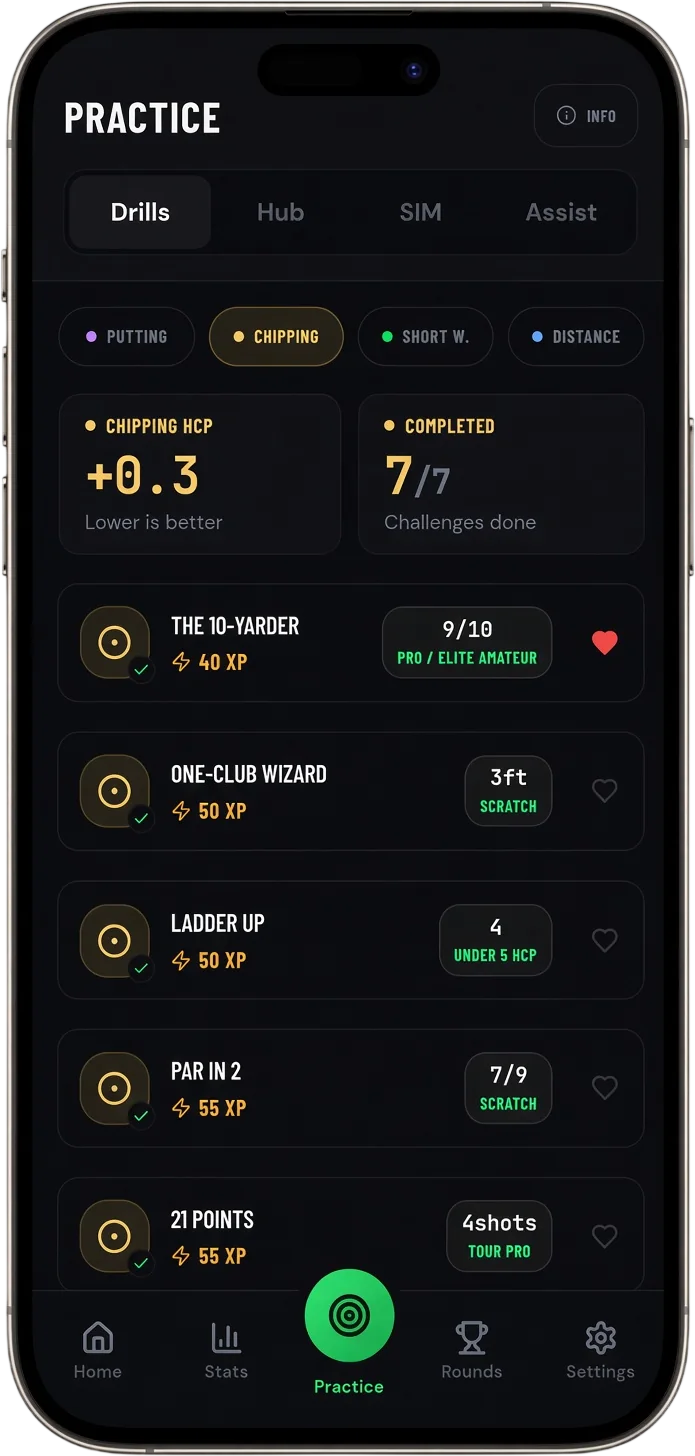
Set up drills with a scoring system — make 7 out of 10 from this distance, get three chips within three feet in a row, complete the putting ladder from 10 to 30 feet without missing. The target gives your nervous system something to respond to. The score tells you whether you’re improving.
Harvey Penick, one of the most respected coaches in golf history, summed it up simply: “Practice puts brains in your muscles.” That only happens when the practice is purposeful.
Scoring Zone includes scored versions of all these drills — with benchmarks so you know if you’re actually improving.
See Chipping Drills →Before you change what you practise, it’s worth knowing where you actually stand. Most golfers have a general sense — “my bunker play is bad”, “I three-putt too often” — but a vague sense is very different from data.
Consider two golfers, both 14-handicaps. One loses most of his shots from inside 30 yards. The other leaks shots from lag putting and tee-to-green. Both think their short game is “the problem.” But the work they need to do is almost entirely different.
Without a proper assessment, you can spend months working on the wrong thing.
A useful assessment evaluates your chipping, pitching, and putting across a range of scenarios — not just one distance, one lie, one situation. It should give you specific data: distance control from 40 yards, short putts under pressure, proximity from tight lies. Not just “good” or “bad”, but numbers you can act on.
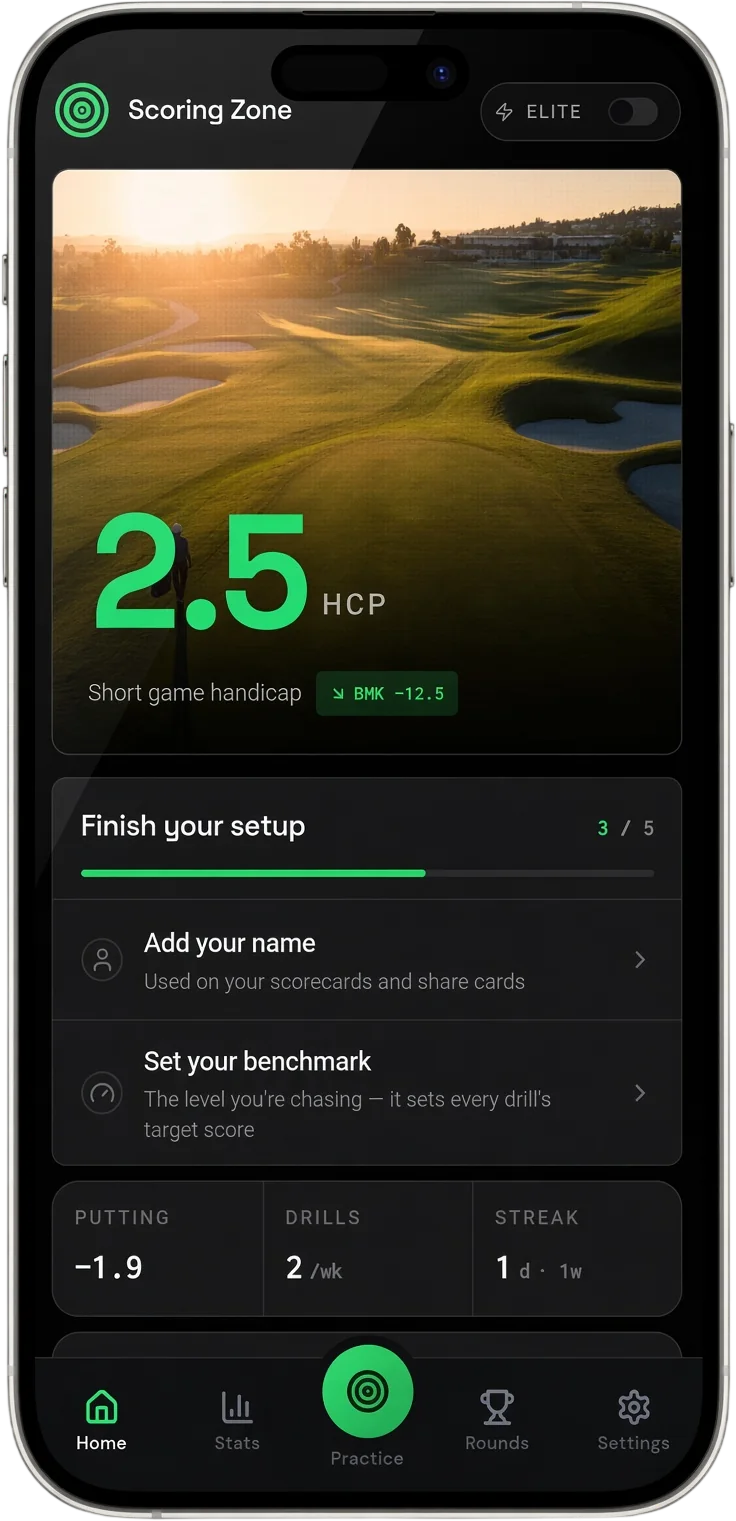
One of the most useful tools for golfers serious about improving is the short game handicap — a calculated number based on your actual performance, that reflects where your chipping and pitching sits relative to other levels of golfer.
It works the same way your full handicap does: the better you perform across a standardised set of challenges, the lower the number. A short game handicap of 8 tells you something very different from a short game handicap of 18 — and tells you more specifically where the gap is.
The same principle applies to putting. A separate putting handicap, calculated from a structured assessment across different distances and conditions, gives you a standalone baseline to improve against. You might find your chipping is two levels better than your putting — or the reverse. Either way, it directs your practice.
These aren’t vanity metrics. Once you know your short game handicap, you know which areas pulled it up — and those areas become your practice priorities.
Build a putting routine that actually lowers your putting handicap — scored ladder drills, gate challenges, and pressure putts.
See Putting Drills →Track your up-and-down percentage over time and watch your short game handicap drop.
Round Stats →The Performance Hub inside Scoring Zone is built around exactly this idea. It runs you through a full short game assessment — chipping and pitching in one test, putting in another — and calculates both a Short Game Handicap and a Putting Handicap based on your scored performance.
The tests aren’t just scored totals. They break down your performance by category — distance control, proximity, shot variety, pressure situations — so you can see precisely where you’re strong and where the shots are leaking.
When the tests are complete, the app generates a PDF report summarising your results. It’s something you can keep as a personal benchmark to retest against in a month, or hand to your coach at the start of a lesson. Instead of spending the first ten minutes explaining what you think is wrong, you arrive with data that shows exactly what needs work.
An assessment is only useful if you act on it. Once you have your short game and putting handicaps, the job is simple: focus your practice time on the categories the test flagged as weaknesses.
If your proximity from 40 yards is poor, that’s where your wedge sessions should go. If your three-putt rate is high but your short putting is solid, lag putting drills are the priority. If your bunker play is pulling your short game handicap up, that’s where the next block of practice should be pointed.
Retest every four to six weeks. If the work is going in the right places, the numbers will move. If they’re not moving, that’s useful information too — it means the approach needs to change. This is the shift from aimless practice to purposeful practice. Not practising more — practising the right things.
A short game handicap is a calculated number based on your performance across a structured set of chipping, pitching, and short game challenges. Like your full handicap, it reflects your current level — a lower number means a stronger short game. It gives you a specific benchmark to improve against, separate from your overall course handicap.
Even two or three focused sessions per week of 20–30 minutes will produce more improvement than longer, unstructured sessions. The key is purposeful practice — drills with targets, scoring, and feedback — rather than just hitting balls without a plan.
Yes. The most important thing is structured, scored practice that gives you feedback after every session. A coach is valuable for technique, but data-driven practice tools can identify what to work on and track whether it’s improving — which is the part most golfers miss entirely.
Improving your short game. Shots inside 100 yards — chips, pitches, bunker shots, and putts — make up the majority of strokes in an average round. Even a modest improvement in up-and-down percentage and three-putt rate will drop your score faster than gaining distance off the tee.
Struggling to break 100 or 90? See how Scoring Zone helps high handicappers improve.
Scoring Zone for High Handicappers →Read the complete guide to improving your short game.
The Complete Short Game Guide →7 days free
Then from $4.99/month · Cancel anytime
Start your 7-day free trial
35+ drills & tests · Short Game Handicap · Performance tracking