Scoring & Strategy

How to Improve Golf Scores Without Changing Your Swing
5 Strategies That Drop Strokes Fast
April 4, 2026 · 9 min read · Stephen Pickering
5 Strategies That Drop Strokes Fast
April 4, 2026 · 9 min read · Stephen Pickering
Key takeaway: You don’t need a new swing to shoot lower scores. The fastest path to better scores is course management, short game practice, and smarter decisions from 100 yards in. Most golfers lose 4–7 strokes per round to poor choices and a neglected short game — fix those and your scores drop within weeks.
You don’t need a new swing to shoot lower scores. That’s not a motivational line — it’s a statistical fact. The average 90-shooter loses more strokes from poor decisions, sloppy short game, and careless putting than from bad ball-striking. Your swing gets you to the green. Everything else determines your score.
If you’ve been grinding on the range trying to find two more yards or a straighter ball flight, pause. The fastest path to lower scores doesn’t start with your backswing. It starts with what you do from 100 yards in — and the choices you make before you even pull a club.
Here are five strategies that improve golf scores without touching your swing mechanics.
Most amateurs aim at the pin on every approach shot. Professionals don’t. When the pin is tucked behind a bunker or cut tight to the edge, tour players aim at the centre of the green. The miss still leaves a putt. Your miss leaves a bunker shot, a chunk from thick rough, or worse.
Next round, try this: on every approach, aim at the widest part of the green. Ignore the flag unless it’s centre-cut. You’ll hit more greens in regulation with the exact same swing — the only thing that changes is your target.
If you estimate a 60% chance or better of pulling off the shot, go for it. Below that, take the safer play. This simple filter eliminates the hero shots that blow up your scorecard. A bogey from the centre of the green is better than a double from the bunker. Every time.
A round with 14 bogeys and 4 pars is an 86. A round with 10 pars, 6 bogeys, and 2 doubles is also an 86. But the second golfer feels like they played better — and they’re wrong. The golfer who avoids big numbers has a lower ceiling and a more consistent floor.
Track your doubles and triples for the next five rounds. You’ll notice a pattern: most come from penalty strokes, aggressive plays that didn’t come off, or short game breakdowns after a missed green. Fix the decisions and the big numbers disappear.
Count every penalty stroke you take over five rounds. OB, water, lost balls, unplayable lies. For most golfers, that number is 4–8 strokes per round. Now imagine keeping every other part of your game identical but cutting those penalties in half. That’s 2–4 strokes off your score. No swing change required.
The fix is almost always the same: hit less club off the tee when the miss is penal, and lay up short of trouble instead of flirting with it.
You don’t need a coach to improve your chipping and putting. You need a plan. The difference between productive short game practice and wasted time is structure — specific drills, targets, and scoring systems that force you to concentrate.
Twenty minutes of scored chipping practice three times a week will do more for your handicap than an hour of mindless range balls. The key is keeping score. When there’s a target and a consequence, your brain engages differently.
Your up-and-down percentage is the single best predictor of scoring ability for amateur golfers. A 20-handicapper converts about 15% of up-and-downs. A 10-handicapper converts around 30%. The difference between those two numbers across a round where you miss 12 greens is roughly 2 strokes.
To improve it, practise the shots you actually face: 10–30 yard chips to a variety of pins, with one club you trust. Consistency from a repeatable setup beats creativity from a different club every time.
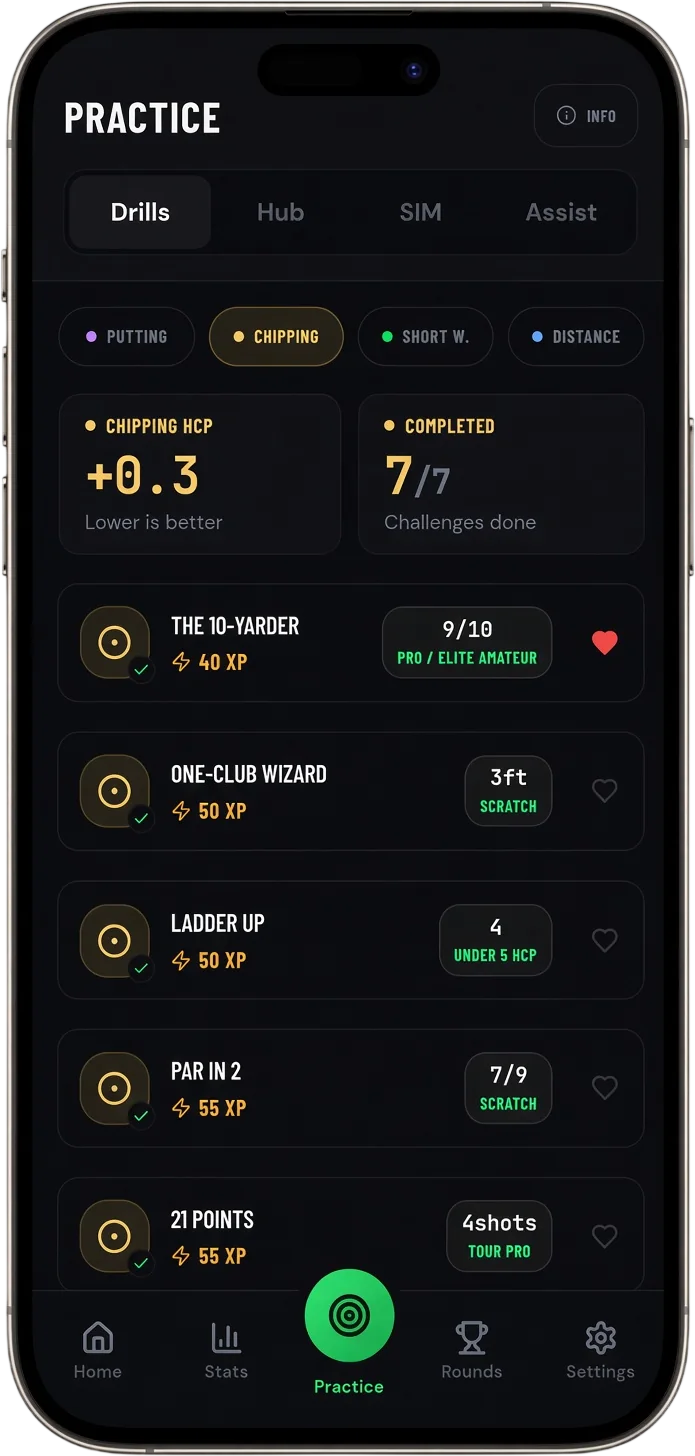
Scoring Zone’s chipping challenges — like Par 2 and 21 Points — are built around this principle. Every chip is scored, every session is tracked, and the benchmarks tell you exactly where you stand compared to your handicap.
Try scored chipping drills with automatic tracking and benchmarks.
Chipping Drills →Most golfers think they have a lag putting problem. Some do. But the real damage happens from 3–6 feet — the makeable putts you lip out, pull, or push because you never practise them with any pressure.
Tour players make 96% from 3 feet, 78% from 5 feet, and 55% from 8 feet. A 15-handicapper makes around 80% from 3 feet, 45% from 5 feet, and 25% from 8 feet. That gap from 3–6 feet alone costs you 3–4 putts per round.
Place a ball 4 feet from the hole. Make 10 in a row. Miss one and restart. It sounds easy — until you’re on putt number 8 and your hands tighten. That feeling is the point. You’re training your nervous system to execute when it matters.
Once you can consistently complete 10 in a row from 4 feet, move to 5 feet. Then 6. The progression builds real confidence because it’s earned, not assumed.
The Scoring Zone app takes this further with the Five-Foot Circle challenge and the Deathstar Drill — pressure putting tests that score every session and track your improvement over time.
Pressure putting drills that score every session automatically.
Putting Drills →Most golfers have a vague sense of their weaknesses. “I’m a bad putter.” “My driving is inconsistent.” But vague feelings lead to vague practice. You end up spending time on the part of your game that’s most fun, not the part that costs you the most strokes.
Three stats tell you everything: greens in regulation, up-and-down percentage, and putts per round. Track them for five rounds. The one that’s furthest from the average for your handicap is where your practice time should go.
When you track your rounds, patterns emerge. You might discover you’re losing more strokes on approach shots than on the green. Or that your three-putt rate spikes on the back nine when fatigue sets in. Or that you convert 40% of up-and-downs from the right side of the green but only 10% from the left.
That’s not information you get from hitting balls on the range. It comes from tracking rounds and reviewing the data — then adjusting your practice to target the actual leaks.
Track every round, see your trends, and find where you’re losing strokes.
Round Stats →Most golfers see a 3–5 stroke improvement within 2–4 weeks by focusing on course management and short game practice. The fastest gains come from eliminating three putts and improving up-and-down percentage — both respond quickly to structured, scored practice.
Fix your short game. Over 60% of shots in a round happen within 100 yards. Most golfers spend 80% of practice time hitting full shots on the range. Flip that ratio and your scores will drop faster than any swing change could deliver.
Yes. Recreational golfers lose 4–7 strokes per round to poor decisions alone — aiming at tucked pins, going for par 5s in two when the miss is a penalty area, choosing driver when a 3-wood keeps them in play. Smarter targets with the same swing produce lower scores immediately.
Track your stats for 3–5 rounds. Count fairways hit, greens in regulation, up-and-down conversions, and putts per round. The category furthest from average for your handicap is where you’re bleeding strokes — and where focused practice delivers the biggest return.
7 days free
Then from $4.99/month · Cancel anytime
Start your 7-day free trial
35+ drills & tests · Short Game Handicap · Performance tracking