Practice & Improvement

How to Break 90 in Golf: A Short Game Plan That Works
March 18, 2026 · 9 min read · Stephen Pickering
March 18, 2026 · 9 min read · Stephen Pickering
Key takeaway: The fastest way to break 90 in golf is to focus on short game practice, not the driving range. A golfer shooting 100 takes roughly 60 shots inside 100 yards per round. Structured putting drills (especially inside 6 feet) and scored chipping practice can cut 5–10 strokes within 2–3 months.
You want to break 90. So you buy a new driver, watch a YouTube swing video, and pound balls at the range. Nothing changes. Here’s why: if you’re shooting around 100, roughly 60–65 of those shots happen inside 100 yards. That’s chips, pitches, bunker shots, and putts. More than half your round is played in the scoring zone — and almost none of your practice time is spent there.
Breaking 90 isn’t about hitting longer drives or flushing more irons. It’s about getting up and down more often, two-putting instead of three-putting, and turning bogeys into pars with a sharp short game. The good news is that this is the fastest area of the game to improve — if you practise with structure instead of just rolling balls on the putting green.
Dave Pelz spent decades studying amateur scoring patterns. His research found that the average golfer spends roughly 60–65% of their total strokes from inside 100 yards — yet dedicates less than 20% of their practice time to it. For a golfer shooting 100, that’s approximately 60 shots inside 100 yards every round. Think about that: 60 opportunities to save strokes, and most of them come down to a chip, a pitch, or a putt.
The math makes the solution obvious. Drop five of those short game shots and you’re at 95. Drop ten and you’re in the 80s. No swing change required. No new equipment. Just smarter, more deliberate practice around the green.
Here’s where it gets specific. A golfer shooting around 100 typically three-putts 6–8 times per round and misses a significant number of putts inside 6 feet. Those are the putts you expect to make — the ones that feel like they should be automatic. But without deliberate practice at that range, they aren’t.
Every missed putt inside 6 feet is a full stroke gone. Not a partial loss — a full shot. If you currently miss 8 putts from inside 6 feet per round and you can cut that to 4, you’ve saved four strokes without changing anything else about your game. That alone can be the difference between 98 and 94.
Most golfers practise the same way every session. They chip a pile of balls to one hole, putt from a comfortable distance, and leave when they’re bored. There’s no target, no score, and no progression. That’s activity, not practice. Research in motor learning consistently shows that unstructured repetition plateaus quickly. Structured practice — with variation, targets, and testing — produces faster and more durable skill gains.
Block practice means repeating the same shot from the same position until the movement feels reliable. Chip ten balls from the same lie to the same pin. Putt fifteen times from four feet. The goal is repetition and consistency. This is where you build technique — a repeatable chipping motion, a consistent putting stroke, a feel for distance. Block practice should be the first part of any session. It gives your muscles a clear pattern to lock in.
Variable practice means changing the task on every shot. Different distances, different lies, different targets. Chip from a tight lie, then a fluffy lie, then downhill, then to a back pin, then a front pin. Putt from 3 feet, then 20 feet, then 8 feet. This is harder than block practice. Your scores will be worse. That’s the point. Variable practice forces your brain to adapt on every rep — which is exactly what the course demands. Without it, your block practice gains stay on the practice green and don’t follow you to the first tee.
The final piece is testing. A scored challenge with consequences — a target to hit, a restart if you fail, a score to beat next session. This is where practice becomes performance. Tests simulate the pressure of the course because there’s something on the line. A par save in a drill feels different from a casual chip when you know your score depends on it. Structure your sessions in this order — block, then variable, then test — and you’ll improve faster than golfers who practise twice as long without a plan.
If you’re serious about breaking 90, start tracking one number: how many putts you make from inside 6 feet. Tour players make around 85–90% from that range. A golfer shooting 100 is often closer to 50–60%. That gap represents the easiest strokes to recover in your entire game. No athletic ability required. No perfect technique needed. Just focused, scored repetition from short range until making these putts becomes automatic.
Place two tees just wider than your putter face, about 6 inches in front of the ball on your target line. Set up at 4 feet from the hole and make 10 putts through the gate without hitting either tee. This trains a consistent start line — the single biggest factor in short putting accuracy. Score yourself out of 10. If you’re below 7, stay here before moving to longer distances.
Place four balls around the hole at 3 feet — at 12, 3, 6, and 9 o’clock. Make all four without missing. Miss one and restart. Once you complete one round, move to 4 feet and repeat. Then 5 feet. This builds confidence on short putts from breaking angles — the kind you actually face on the course. The restart rule adds pressure, which is where the real learning happens. Track how many rounds you complete in a 15-minute session and try to beat it next time.
Set up at 3 feet, 6 feet, and 9 feet from the hole. Make 3 in a row from 3 feet, then 2 in a row from 6 feet, then 1 from 9 feet. Miss at any point and restart from the beginning. This tests your ability to maintain focus as distance increases and pressure builds. It’s one of the most efficient putting challenges for golfers trying to break 90 because it targets exactly the range where most strokes are wasted — inside 10 feet.
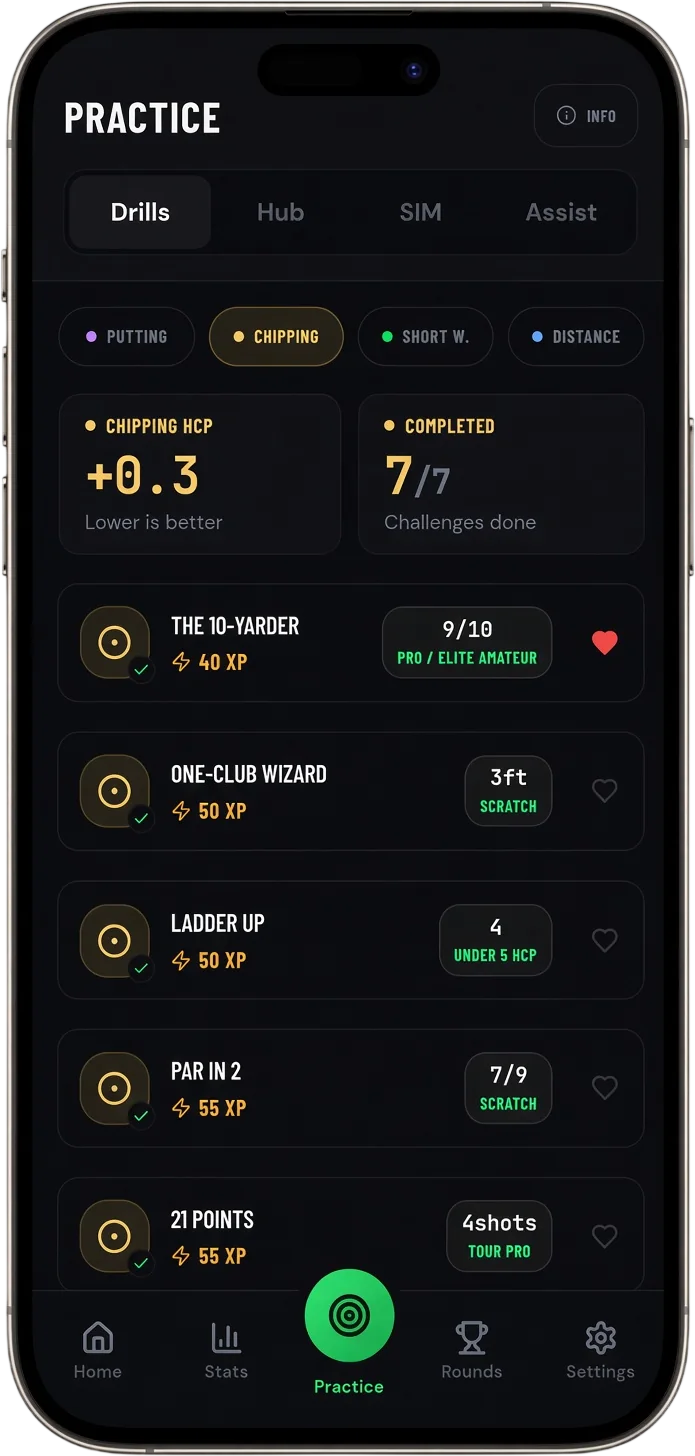
Run these putting challenges with automatic scoring and track your progress over time.
See Putting Drills →You don’t need to practise every day. You need to practise with intent three times a week for 20–30 minutes. That’s enough to see measurable improvement within a few weeks. Here’s a simple framework:
Session 1 — Putting focus. Block practice on 4-foot putts (gate drill, 10 minutes). Variable practice mixing 3, 6, 10, and 20-foot putts (5 minutes). Finish with the Clock Drill or 3-6-9 Ladder as a scored test (5 minutes).
Session 2 — Chipping focus. Block practice from one lie and one distance (10 minutes). Variable practice with different lies and targets (5 minutes). Finish with a scored up-and-down challenge from 5 different spots around the green (5 minutes).
Session 3 — Mixed session. Alternate between putting and chipping drills. Finish with a full scored test that combines both — 5 up-and-down attempts followed by a putting challenge. This mirrors what you face on the course: chip it close, then make the putt.
Consistency beats volume. Three focused sessions a week will get you to the 80s faster than one marathon range session on a Saturday.
Track your round stats to see where your strokes are going — and whether your practice is working.
Round Stats →It depends on your starting point and how often you practise, but most golfers shooting around 100 can break 90 within 2–3 months of consistent, structured short game practice. The key is practising with a plan — block practice to build skills, variable practice to make them transfer, and scored tests to prove it under pressure.
Too many wasted strokes inside 100 yards. A golfer shooting 100 takes roughly 60 of those shots around and on the green — chips, pitches, and putts. Missed short putts and poor chipping are the biggest contributors. Fixing the short game is the fastest path to lower scores.
Critical. A golfer shooting around 100 often misses 6–10 putts from inside 6 feet per round. Each one is a full stroke lost. Improving your make rate inside 6 feet by even 20–30% can save 3–5 strokes per round — often enough on its own to get you under 90.
Structured short game practice with scored challenges. Focus on putts inside 6 feet, chipping from varied lies, and up-and-down situations. Track your scores in each drill so you can see improvement over time. Golfers who measure their practice improve faster than those who just hit balls and hope for the best.
Struggling to break 100 or 90? See how Scoring Zone helps high handicappers improve.
Scoring Zone for High Handicappers →Read the complete guide to improving your short game.
The Complete Short Game Guide →7 days free
Then from $4.99/month · Cancel anytime
Start your 7-day free trial
35+ drills & tests · Short Game Handicap · Performance tracking