Practice & Improvement

Golf Practice Tips for Beginners
How to Build a Routine That Works
April 4, 2026 · 9 min read · Stephen Pickering
How to Build a Routine That Works
April 4, 2026 · 9 min read · Stephen Pickering
Key takeaway: The difference between beginners who improve quickly and those who stay stuck isn’t talent — it’s how they practise. Spend at least half your time on short game, give every session a structure with targets and scoring, and track your stats from day one.
You’ve played a few rounds. You love the game. But every practice session feels like guesswork — hit some balls on the range, roll a few putts, leave without knowing if any of it made a difference. That’s normal. Every golfer starts there.
The difference between beginners who improve quickly and those who stay stuck for years isn’t talent or how many rounds they play. It’s how they practise. Golf practice tips for beginners come down to three things: work on the right skills, give your sessions structure, and track your progress so you know what’s actually working.
Here’s how to do all three.
Over 60% of your shots in a round happen within 100 yards of the hole. Putting, chipping, pitching. These are the shots that determine your score — not your driver, not your 7-iron. Yet most beginners spend almost all of their practice time on the range hitting full shots.
Flip the ratio. Spend at least half of every practice session on short game. You’ll see results on the scorecard within weeks — not months.
Putting is the most forgiving skill to learn as a beginner. You don’t need speed, flexibility, or perfect mechanics. You need two things: the ability to control distance and a repeatable stroke from 3–6 feet.
Start every practice session with putting. Roll 10 putts from 3 feet. Then 10 from 6 feet. Then 10 lag putts from 20–30 feet where the goal is finishing within a 3-foot circle — not making the putt. That’s 30 putts, roughly 10 minutes, and it covers the two skills that eliminate most wasted strokes on the green.
Beginners get overwhelmed by club selection around the green. Don’t. Pick one club — a pitching wedge or a 9-iron — and learn one basic chip shot. Ball back in your stance, weight slightly forward, hands ahead of the ball, and a simple pendulum stroke.
Practise hitting 10 chips to a target 15 yards away. Count how many finish within 6 feet. When you can consistently land 7 out of 10 inside that zone, you have a chipping technique you can trust on the course. Then — and only then — start experimenting with other clubs.
You don’t need two hours. Thirty minutes with structure beats ninety minutes of aimless hitting. Here’s a simple session plan that works:
Minutes 1–10: Putting. Five putts from 3 feet, five from 6 feet, five lag putts from 25+ feet. Score yourself: how many short putts did you make? How many lag putts finished within 3 feet?
Minutes 11–20: Chipping. Ten chips from just off the green to a target 15 yards away. Count how many finish inside 6 feet. Then 10 chips from a different angle or distance.
Minutes 21–30: Full swing. Pick one club — a 7-iron is ideal. Hit 15–20 balls with a specific target. Focus on making contact with the centre of the face, not on distance or shape.
That’s it. Three skills, clear targets, built-in scoring. Every session has a purpose.
Hitting 100 balls on the range without a target teaches your body nothing useful. Your brain needs a goal to organise around. Pick a flag, a distance marker, or a spot on the green — and aim every shot at it.
The same applies to short game. Don’t just chip “towards the hole.” Chip to a specific spot with a specific result in mind. The difference between mindless repetition and deliberate practice is a target and a way to keep score.
Drills can feel like homework. Games feel like competition — even when you’re competing against yourself. The most effective way to practise as a beginner is to turn every drill into a challenge with a scoring system.
Instead of “hit 20 chips,” make it “chip 10 balls and score 1 point for each one inside 6 feet — beat your last score.” Instead of “putt for 10 minutes,” try “make 5 in a row from 4 feet — miss and restart.” The pressure of a streak or a target score mimics the feeling of playing on the course, which means your practice transfers better.
Gamified practice gives you three things that raw repetition doesn’t:
A score to beat. You finished with 7 out of 10 last time. Now you want 8. That creates focus.
A streak to protect. You’ve made 4 in a row from 5 feet. The 5th putt suddenly matters more. That’s pressure practice without needing a playing partner.
A sense of progression. When you can see that your scores are improving session to session, motivation takes care of itself. Progress is the best motivator there is.
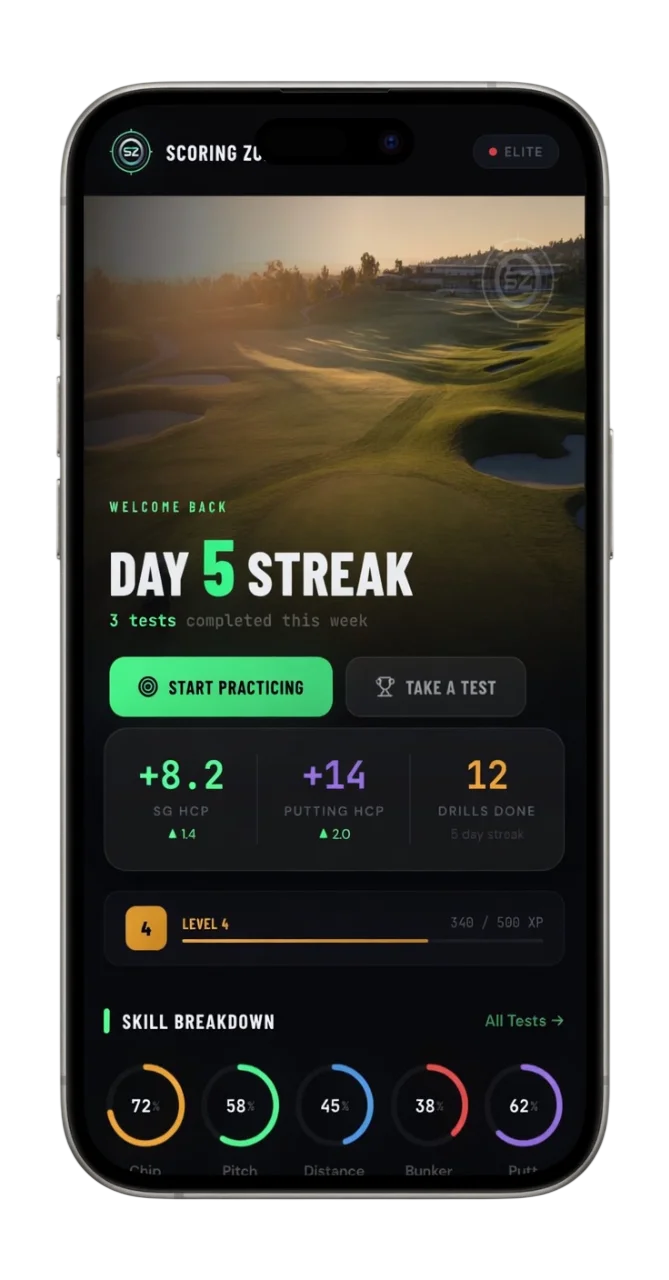
Scoring Zone is built around this idea. Every drill is a scored challenge with points, XP, streaks, and benchmarks. You start at Level 1 with foundational drills and unlock harder challenges as your skills progress. It turns practice into a game you want to come back to — which is how real improvement happens.
See how gamified practice works with scored challenges and XP progression.
Putting Drills →Most beginners practise by feel. “That session felt good.” “I think my putting is getting better.” But feelings lie. Data doesn’t.
Start tracking two numbers from your very first session: putts per round and up-and-down percentage. These are the two stats that move the needle fastest for beginners. After five rounds, you’ll have a clear picture of where you’re losing strokes — and that picture tells you exactly what to practise next.
A common mistake: beginners think stat tracking is for low handicappers. It’s the opposite. Tracking is most valuable when you’re starting out, because you have the most to gain and the biggest blind spots.
You might think your driving costs you the most strokes. The data might show it’s actually three putts. You might feel like your chipping is fine. The numbers might reveal you’re only converting 10% of up-and-downs. Without data, you practise what you enjoy. With data, you practise what you need.
Scoring Zone tracks your practice and your rounds automatically. After two rounds, it generates strokes gained data against your handicap benchmark — showing you exactly which part of your game is costing you the most. That’s the shortcut to knowing what to work on next.
Track every round with strokes gained analysis from your first scorecard.
Round Stats →The driving range is seductive. Big swings, long shots, satisfying contact. But range sessions don’t lower scores. Short game sessions do. Commit to the 50/50 split: half your time on full swing, half on short game. Your scores will thank you.
“I’ll just hit some balls” is not a plan. Every session needs a structure: what skills, how long on each, what targets, and how you’re keeping score. It doesn’t need to be complicated — the 30-minute session template above is enough. But it needs to exist before you pick up a club.
Work on one thing per session. If it’s putting distance control, don’t also try to fix your grip and your chipping technique in the same half hour. Your brain can only process one change at a time. Pick a focus, drill it, score it, and move on next session.
Build structured practice sessions that target your weaknesses automatically.
Practice Assistant →Thirty to forty-five minutes is the sweet spot. Longer sessions lead to fatigue and sloppy repetitions that reinforce bad habits. Three focused 30-minute sessions per week will improve your game faster than one marathon weekend session. Quality matters far more than volume.
Start with putting and chipping. These shots make up over 60% of your total strokes in a round, they’re the easiest to learn, and they have the biggest impact on your score. Once you can reliably two-putt from 30 feet and chip onto the green from 20 yards, add full-swing work to your sessions.
Absolutely. A putting mat and a few balls are enough to build real putting skill at home. Focus on stroke consistency from 3–6 feet and distance control to different targets on the mat. Chipping into a net or garden target works too. Home practice is especially useful for beginners building a repeatable stroke without the distractions of the course.
Turn drills into challenges with targets and scoring systems. Instead of hitting 50 putts aimlessly, try to make 10 in a row from 4 feet — miss one and restart. Gamified practice with points, streaks, and progression gives you something to beat each session and keeps practice engaging instead of repetitive.
Stephen Pickering
3-handicap golfer with 25 years on the course. Built Scoring Zone to bring structure and pressure to short game practice. Writes about what actually works from the practice green, not the press box.
Join golfers already levelling up with scored challenges, XP progression, and automatic performance tracking. It takes one session to feel the difference.
Download Scoring Zone Free →Full access to all drills, stats, and features. No credit card required — then from $4.99/month.
Get Scoring Zone Free →