Putting

Golf Green Readers: What Works, and What’s Legal
Slope Devices, Reading Apps and Level Markers — and the Rule Almost Every Review Misses
September 5, 2026 · 8 min read · Stephen Pickering
Slope Devices, Reading Apps and Level Markers — and the Rule Almost Every Review Misses
September 5, 2026 · 8 min read · Stephen Pickering
Key takeaway: Rule 4.3a(1) allows distance and direction information but prohibits measuring elevation changes — so slope devices, levelling ball markers and break-reading apps are all a two-shot penalty during a round, and a second breach of any kind is disqualification. They are practice-green calibration tools. And a slope number only answers half the question: break depends on speed as much as gradient.
Search for a golf green reader and you get a wall of gadgets — apps that read slope, handheld levels, ball markers with a bubble in them. What you almost never get is the sentence that matters most: using any of them to measure slope during a round is a two-shot penalty.
That is not a technicality buried in an appendix. It is Rule 4.3a(1), it applies to every competition you play, and a second breach disqualifies you. So this is a guide in two halves — what each type of green reader actually does, and where you are allowed to do it. Get the second half right and the first half becomes genuinely useful.
The Rules of Golf draw a clean line. You are allowed to get information on distance or direction — a rangefinder, a compass, a GPS yardage. That is it.
You are not allowed to do any of the following during a round:
A digital level held against the green measures elevation change. A ball marker with a bubble and directional arrows measures elevation change. An app that returns “two cups right” is interpreting information to recommend a line of play. All three are breaches.
The penalty for a first breach of Rule 4.3 is the general penalty — two strokes in stroke play, loss of hole in match play. If the breach happens between two holes, it applies to the next hole.
The penalty for a second breach is disqualification, and this is the part that surprises people: it applies even if the second breach is a completely different kind of breach to the first. Use a slope device on the fourth and an alignment aid on the eleventh and you have not collected four shots, you have gone home.
Printed green books are handled differently. Rule 4.3 caps the size and scale of detailed green-reading materials, and since January 2022 committees have been able to adopt Model Local Rule G-11, which restricts players to a single committee-approved yardage book: no bigger than 7 inches by 4.25 inches, with green diagrams at a scale no finer than 3/8 inch per 5 yards, showing significant slopes and tiers only.
That local rule is aimed squarely at the top of the professional game — it needs a committee willing to approve books — so it will not touch your Saturday medal. The general size and scale limits in Rule 4.3 do apply to you.
The technique the rules can never take off you:
How to Read Greens in Golf →The best known is BreakMaster, which comes as both a handheld unit and a phone app. The device sits on the green and reads slope in one or two directions, in degrees; the app version does the same job through your phone and needs calibrating on a flat surface first. Tour caddies use them to build green maps in practice rounds.
They are accurate and they are genuinely educational, because slope is much harder to see than people think. Stand on a green you have played for twenty years, guess the fall, then measure it — the number is frequently not what you called. That gap is worth knowing about.
Practice-green tool. Not a round tool.
Tour Read and similar subscription apps go further than measuring: they return the actual break and the pace for a given putt. That is the most useful thing on this page and also the most clearly illegal in competition, because handing you a line of play is exactly what Rule 4.3a(1) prohibits.
Where they earn their money is calibration. Read the putt yourself, commit to a call, then check it. Do that thirty times on a practice green and you are training your eye against ground truth rather than against a hunch.
The cheap end of the category — a ball marker with a small bubble level and directional arrows, sometimes on a hat clip. They are everywhere on Amazon and they are extremely tempting because they look like an ordinary marker.
Be careful here. A marker that reads slope is a device that measures elevation change, and the fact that it is sitting innocently on the green next to your ball does not change what it is doing. If you carry one, keep it for practice.
Systems like WhyGolf’s Green Reading System take the opposite approach: rather than measuring the slope for you, they train your feet to feel it at home. There is no rules question at all with something you use before you tee off, and the skill it builds is the one you are allowed to take onto the course.
Where the strokes actually go on the greens:
How to Stop Three Putting →Here is what none of these devices can give you. Break is not a property of the green. It is a property of the green and your speed.
The same eight-footer takes twice the break at dying pace that it takes struck firmly at the back of the hole. So a device that tells you the slope is 2.4 degrees has answered the easy half of the question and left the hard half — how hard are you going to hit it, and therefore how much of that slope will actually act on the ball — entirely to you.
That is why so many amateurs who read greens perfectly still miss low. The line was right for a putt they did not hit. Their problem was never slope; it was pace, and no gadget on this page measures pace.
If you want to make more putts, the order is: speed first, then start line, then read. Speed is what turns a good read into a holed putt and it is the only one of the three that also decides how far away your misses finish — which is what three-putts are made of.
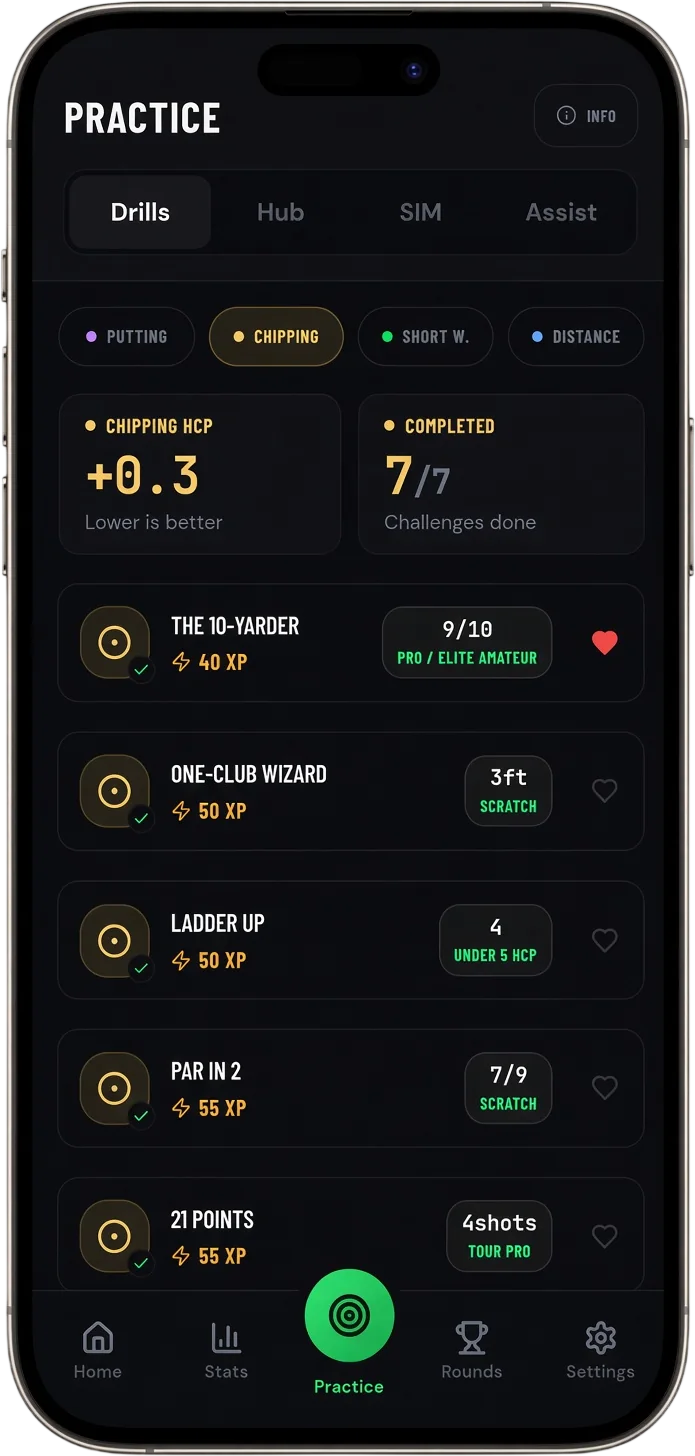
Scoring Zone is built around that order. Lag King asks for ten putts from over 40 feet and counts how many finish inside three feet; Speedmaster scores five putts from 30 feet on where exactly they come to rest, with points for finishing past the hole and nothing at all for leaving it short. Both put a number on pace, which is the thing a slope reading assumes you already have.
The drill work behind the number:
How to Improve Putting Distance Control →Buy one if you want to, and use it like this.
On the practice green, before the round. Read the putt by eye, call the break out loud, then measure. You are scoring your own eye, and the score improves.
Never in a competition. Not the app, not the device, not the clever ball marker. The two shots are bad; the second-breach disqualification is worse.
Check your club’s policy for casual rounds. Plenty of societies and social games do not care. Ask rather than assume, because “I did not know” has never yet been a defence in the Rules of Golf.
Score the session it sits in. A reading is a fact, not a result. Log the drill you did around it — Scoring Zone’s Putting Handicap is calculated from scored tests rather than from how the session felt — and you will find out within a month whether the device changed anything.
Do that and the device stops being a crutch you cannot use when it counts, and becomes what it should have been all along — a way of finding out that the putt you have been reading straight for two decades falls half a cup left.
Not during a round. Rule 4.3a(1) allows distance and direction information but prohibits measuring elevation changes and interpreting information to get a recommended line of play. A slope device, a levelling ball marker and a break-reading app all fall the wrong side of that line. The penalty is two strokes in stroke play or loss of hole in match play, and a second breach — of any kind — is disqualification. On a practice green, outside a round, they are fine.
No. An app that returns the break or the line does precisely what Rule 4.3a(1) forbids. Printed green books are governed separately: Rule 4.3 limits their size and scale, and Model Local Rule G-11 lets a committee restrict players to one approved yardage book of no more than 7 inches by 4.25 inches, with green detail no finer than 3/8 inch per 5 yards.
They make you read slope better, which is only part of the job. Break depends on speed as much as gradient — the same putt takes twice the break dying at the hole as it does struck firm. A number in degrees still has to be converted into a stroke, and that conversion is the skill. As a practice-green calibration tool, checking your eye against the truth, they are genuinely useful.
Fix your speed first, then worry about the read. Most amateur misses finish low because the putt was struck too softly, not because the line was wrong — so the read gets blamed for a pace problem. Track where your misses actually finish over a few sessions with a scored lag drill, and the pattern will tell you which of the two you are really fighting.
7 days free
Then from $4.99/month · Cancel anytime
Start your 7-day free trial
35+ drills & tests · Short Game Handicap · Performance tracking