Practice & Improvement

Pressure Putting Drills
6 Drills That Train Your Nerves, Not Just Your Stroke
April 2, 2026 · 10 min read · Stephen Pickering
6 Drills That Train Your Nerves, Not Just Your Stroke
April 2, 2026 · 10 min read · Stephen Pickering
You make everything on the practice green. Then you stand over a four-footer to save par and your arms turn to concrete. Sound familiar?
The problem isn’t your stroke. It’s that your practice never taught you to handle the moment. Pressure putting drills fix this by adding real consequences — scoring, restart penalties, and streak requirements — to every session. They close the gap between the practice green and the first tee. Here are six that work, ordered from foundational to advanced, so you can build the skill most golfers never train.
Research in sport psychology calls it “choking under pressure” — a measurable decline in fine motor performance when the stakes rise. Your heart rate increases. Your grip tightens by a few grams. Your backswing shortens. None of these changes are dramatic on their own, but together they turn a confident stroke into a tentative jab.
The average amateur three-putts 3–5 times per round. That’s 6–10 wasted strokes — and the majority come from short putts missed under pressure, not long putts left in the wrong postcode. The five-footer to save bogey after a bad chip. The three-footer to close out the front nine. These are the putts that cost you, and they’re the exact putts that standard practice ignores.
You don’t fix pressure putting by hitting more putts. You fix it by hitting putts that matter. Sport psychologists call this “stress inoculation” — exposing yourself to controlled doses of pressure so your nervous system adapts. Pressure putting drills create that exposure. Every drill below has a scoring system or a consequence for missing, which forces your body to rehearse performing under load rather than in comfort.
Setup: Place two tees just wider than your putter head — about one ball-width of clearance on each side — roughly 18 inches in front of your ball. Set up at 6 feet from the hole on a straight putt. The ball must pass cleanly through the gate.
What it trains: Putter face control at impact. Most missed putts under pressure aren’t misread — they’re mis-started. When your hands tighten, the face twists a degree or two at impact. The gate makes that visible immediately. This is the foundational drill because start line is the first thing pressure destroys.
Target: 8 out of 10 through the gate and holed. Move to 8 feet when consistent.Setup: Place balls at 3 feet, 6 feet, and 9 feet from the hole in a straight line. Start at 3 feet. Make it, move to 6. Make it, move to 9. Miss at any distance and drop back one rung. Your goal is to climb all three without falling back to the start.
What it trains: Building confidence through a sequence. The 3-footer is easy — but standing over the 9-footer knowing a miss sends you back to 6 feet changes the way you breathe. This mirrors the on-course experience of building momentum through a round and then needing to hold it together for one more putt.
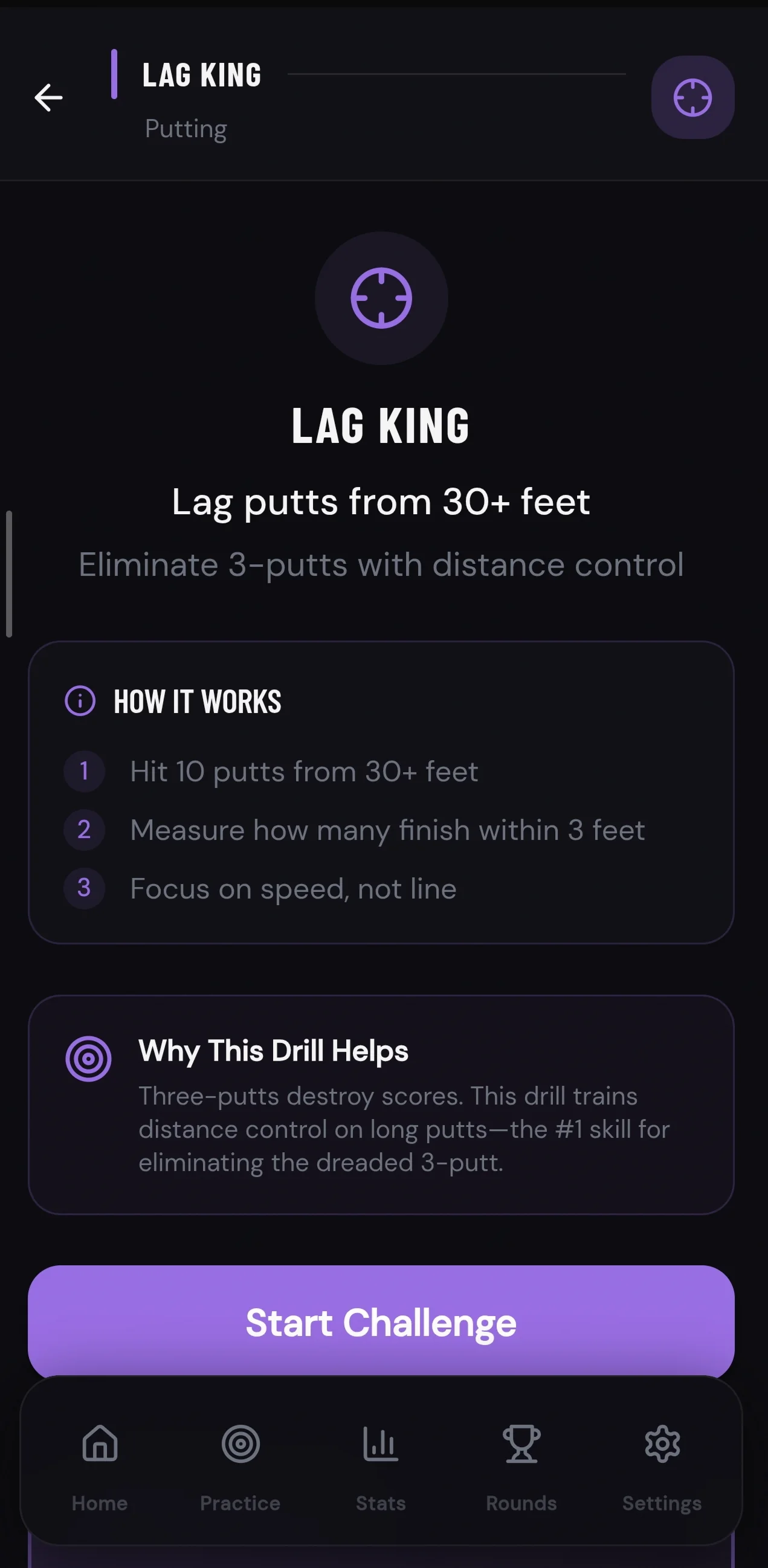
Target: Complete the full ladder in under 6 total attempts. Elite: 3 straight makes.Setup: Place a ball at 30 feet from the hole. Putt. Your ball must finish within a 3-foot radius of the hole (use a club length as your guide). Hit 10 putts. Score 1 point for each putt inside the zone, 0 for anything outside.
What it trains: Speed control under scoring pressure. Three-putts almost always start with a poor lag putt. If your first putt finishes within 3 feet, you three-putt less than 2% of the time. This drill makes that 3-foot zone the only acceptable outcome — and scoring each putt adds just enough pressure to sharpen your focus.
Target: 7 out of 10 inside the zone. Then add a 40-foot station.Want scored versions of these drills with automatic tracking and performance benchmarks?
See Putting Drills →Setup: Pick one hole. Set up at 4 feet. Make consecutive putts. Your score is your longest streak. Miss once and your streak resets to zero. Record your best streak each session.
What it trains: Composure escalation. The first five putts feel routine. By putt seven, you’re aware of the streak. By putt nine, your palms are sweating over a four-footer — which is exactly what happens when you need to close out a good round. This drill teaches you to stay in your process when internal pressure is climbing.
Target: Streak of 10 from 4 feet. Move to 5 feet when you can consistently hit 10.Setup: Choose 9 holes on the practice green at varying distances and breaks. From each hole, you get two putts. Par is 2 for each hole, so par for the round is 18. Three-putt any hole and you’re “eliminated” — session over, record your score at that point.
What it trains: Course simulation and consequence management. The elimination rule creates genuine anxiety on every first putt — especially when you’ve left yourself outside 5 feet. It trains you to lag well (to avoid the three-putt) and to hole out confidently (to save par). This is the closest you can get to on-course pressure without actually playing.
Target: Complete all 9 holes without elimination. Elite: shoot 15 or under.Setup: Set up four putts: a 3-footer, a 5-footer, a breaking 7-footer, and a 12-footer. You must make all four in a row. Miss any putt and restart from the 3-footer. These represent the last four holes of a round where you’re trying to post a number.
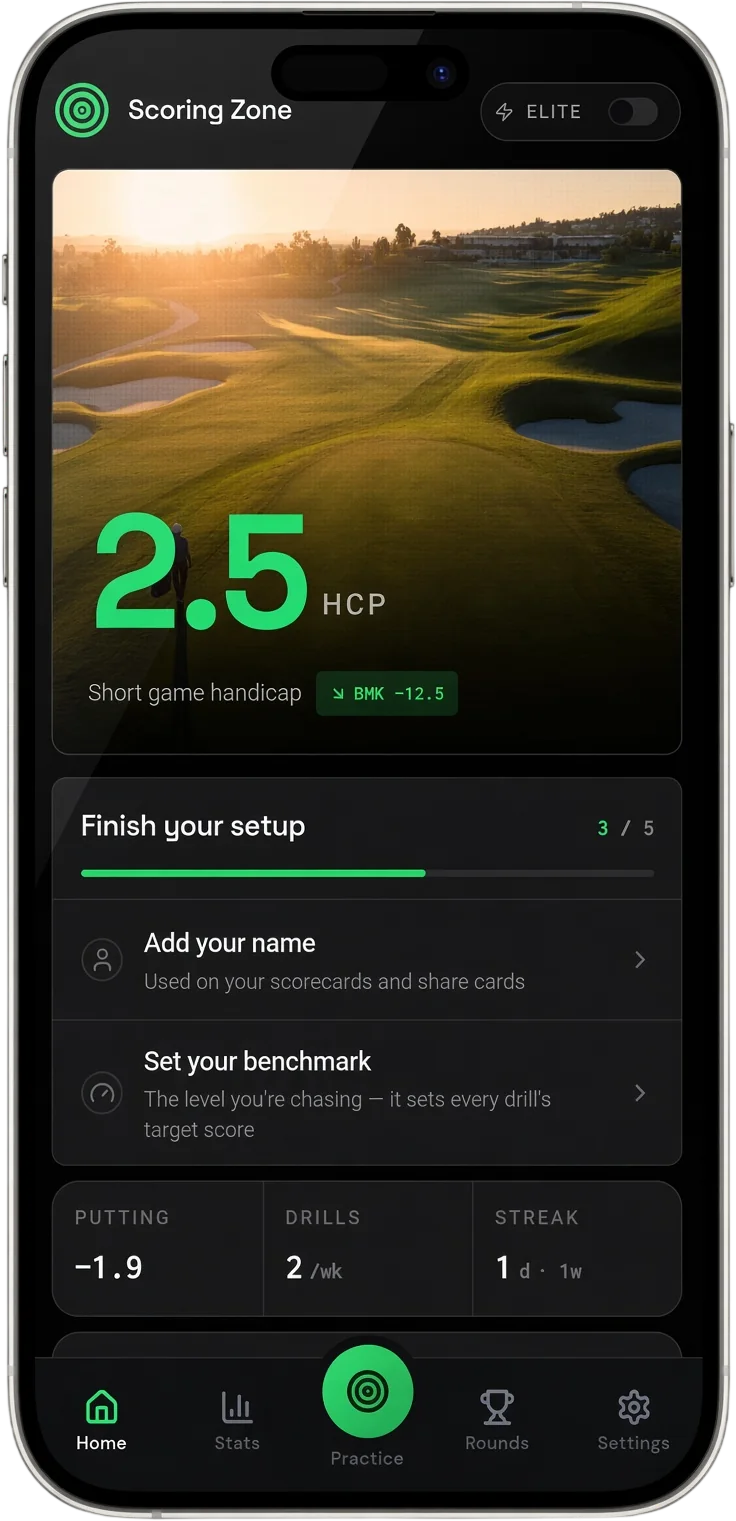
What it trains: The closing mentality. Every golfer knows the feeling of playing well through 14 holes and then losing it coming in. This drill compresses that experience into four putts. The 3-footer feels easy — until you’ve already failed the 7-footer twice and you’re back at the start. Scoring Zone’s Elite Mode uses this same progressive-consequence structure to build closing ability.
Target: Complete all four in a row. Track how many total attempts it takes per session.Don’t run all six drills in one session. Pick two or three and rotate weekly. A strong 20-minute pressure putting session follows this structure:
Foundation (5 min): Gate Drill — 10 putts from 6 feet. Gets your start line dialled and your eyes calibrated before the pressure ramps up.
Pressure block (10 min): Consecutive Makes or the Elimination Round — one full attempt with restart rules. This is where the real adaptation happens. Don’t rush it.
Finish (5 min): Lag Zone Test from 30 and 40 feet. Builds speed control and ends the session with a feel for pace rather than anxiety over short putts.
The critical piece most golfers skip: score every session. Write the numbers down. If you ran Consecutive Makes, record your best streak. If you ran the Elimination Round, record where you finished. Without data, you’re guessing whether you’re improving — and guessing is what got you here.
One more thing: pressure drills are mentally taxing by design. Twenty minutes is enough. Going longer leads to fatigue-driven misses that teach bad habits rather than resilience. Treat these sessions like interval training — short, intense, and consistent.
Track your three-putts per round alongside your drill scores. When the Lag Zone Test climbs from 5/10 to 8/10, you’ll see the on-course number drop. Scoring Zone’s Pressure Mode tracks this connection automatically — but even a notebook works. The point is measurement.
See how your putting stats trend over time — round by round, drill by drill.
Round Stats →Add consequences to every putt. Use drills with streak requirements, restart penalties, and scoring thresholds. The key is removing the safety net of casual practice — when a miss costs you something (restarting, losing points, ending the session), your body learns to handle pressure the same way it does on the course.
The Consecutive Make drill. Set up at 4 feet and try to make 10 in a row. Miss and restart from zero. It exposes the mental side of short putts — the first five are easy, but putts seven through ten feel completely different. That escalating pressure is exactly what you face over a four-footer to save par.
Fifteen to twenty minutes, two or three times per week. Pressure drills are mentally taxing by design. Going longer than 20 minutes leads to fatigue-driven misses that teach bad habits rather than building resilience. Short, intense, scored sessions outperform long, unfocused ones every time.
Yes — directly. Three-putts come from two places: poor lag putting (first putt finishes too far away) and missed short putts (failing to clean up from inside 5 feet). Pressure drills attack both. Lag drills with a 3-foot target zone train distance control. Consecutive make drills train the composure to hole the second putt. Track three-putts per round and you’ll see the number drop within 2–3 weeks.
Playing competitively? See how Scoring Zone is built for tournament-level preparation.
Scoring Zone for Competitive Golfers →Read the complete guide to improving your putting.
The Complete Putting Guide →7 days free
Then from $4.99/month · Cancel anytime
Start your 7-day free trial
35+ drills & tests · Short Game Handicap · Performance tracking