Golf Basics
Golf Clubs Types and Names: The Complete Guide
Every Wood, Iron, Wedge, Hybrid and Putter — Explained Plainly
April 24, 2026 · 11 min read · Stephen Pickering
Every Wood, Iron, Wedge, Hybrid and Putter — Explained Plainly
April 24, 2026 · 11 min read · Stephen Pickering
Key takeaway: A full golf bag holds up to 14 clubs across 5 types: woods, hybrids, irons, wedges, and putters. Beginners don’t need all 14 — an 8 to 10 club starter set covers every distance. The wedges matter most for scoring because 60% of golf shots happen inside 100 yards.
There are 5 types of golf clubs: woods (driver + fairway woods, for distance off the tee and from the fairway), hybrids (replace long irons, easier to hit), irons (numbered 3–9, for approach shots), wedges (pitching, gap, sand, lob — for short game and bunkers), and putters (on the green). You’re allowed a maximum of 14 clubs in a bag.
This guide covers every type of golf club and every name you’ll hear on the course — what each club does, the typical yardage, when to use it, and how to build a 14-club bag that actually suits the way you play.
Every golf club falls into one of five categories. Each is built for a specific part of the game:
- Woods — the longest-hitting clubs, used mostly off the tee or from the fairway on long par 5s - Hybrids — a cross between woods and irons; easier to hit than long irons - Irons — numbered clubs for a wide range of distances, from long approach shots to short iron play - Wedges — the highest-lofted clubs, for shots inside 100 yards, greenside chips, and bunkers - Putters — used on and around the green to roll the ball into the hole
The rules of golf allow up to 14 clubs in your bag. Your job is to pick a combination that covers every distance you’ll face without overlap.
The driver is the longest club in your bag and the one with the lowest loft — usually between 9° and 12°. It’s used almost exclusively off the tee on par 4s and par 5s, where you want maximum distance. A typical amateur hits a driver 200–250 yards; a tour pro averages around 300 yards.
Modern drivers have large, hollow titanium heads (around 460cc — the legal maximum) designed to be forgiving on mis-hits. If you’re struggling off the tee, the issue is usually setup and tempo, not the club.
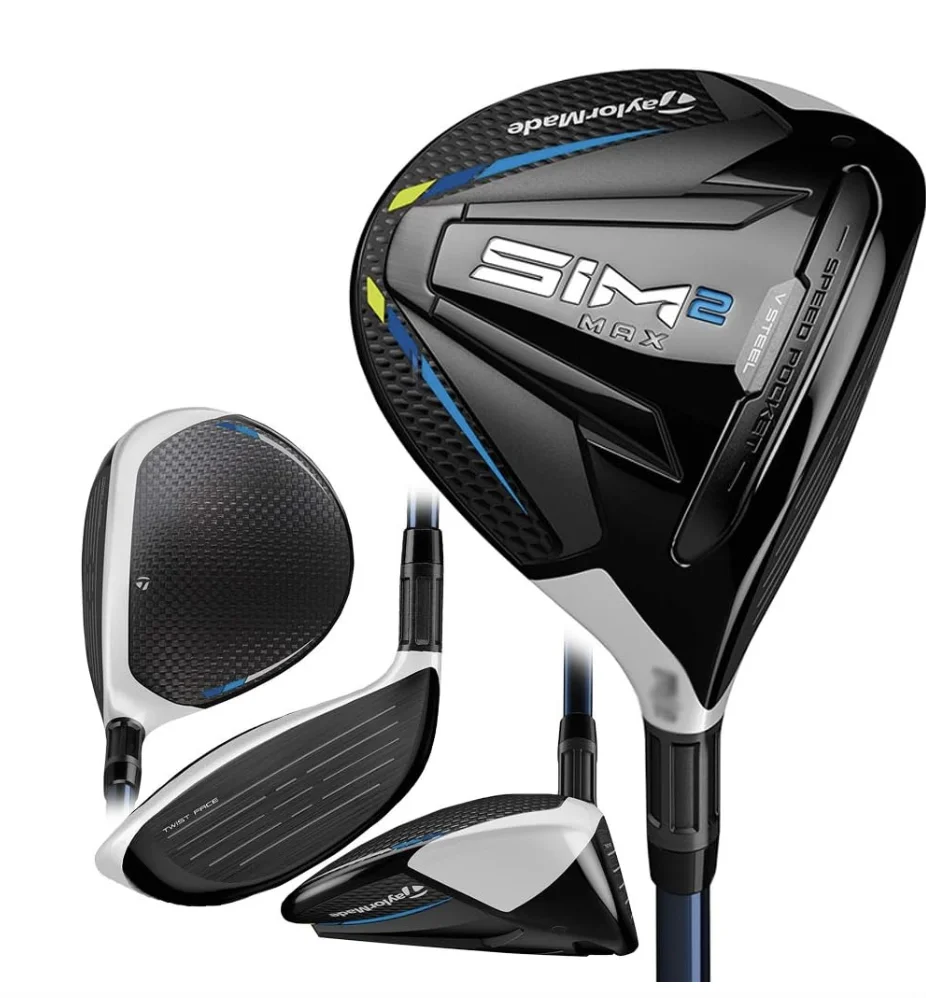
Fairway woods are shorter than a driver with higher loft. The most common are the 3-wood (15°) and 5-wood (18°). Some players also carry a 7-wood or 9-wood for even more forgiveness on long approach shots.
Use them: - Off the tee when you need accuracy over distance - From the fairway on long par 5s when you’re trying to reach in two - From good lies in the light rough
Fairway woods are harder to hit off the deck than drivers off a tee — they’re an intermediate club that rewards clean contact.
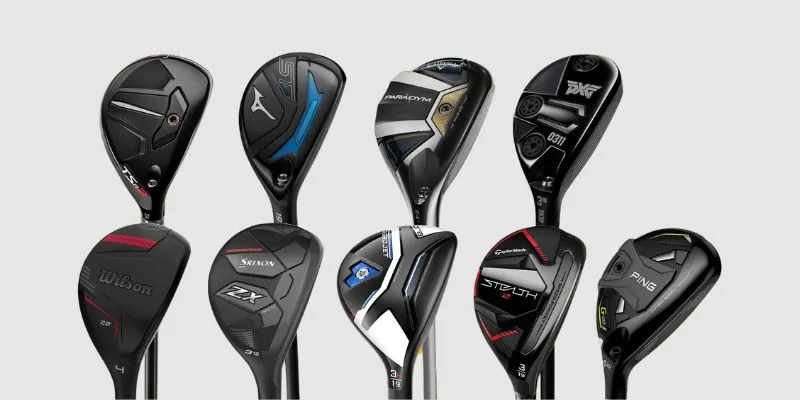
A hybrid is a cross between a fairway wood and an iron. The head shape is smaller and more compact than a wood but larger and more forgiving than an iron. They’re designed to replace the long irons (2-iron, 3-iron, 4-iron) that most amateurs find extremely hard to hit.
Hybrids are named by number and often shown with an H — so you’ll see 3H, 4H, 5H on the bottom of the club. Each number corresponds roughly to the iron it replaces: a 4H replaces a 4-iron.
Most amateurs benefit from carrying one or two hybrids. If you’re a high-handicapper, swap your long irons (4-iron and below) for hybrids and your consistency will improve overnight.
Long irons are where most amateurs lose shots. Here’s how to sharpen the ones you keep.
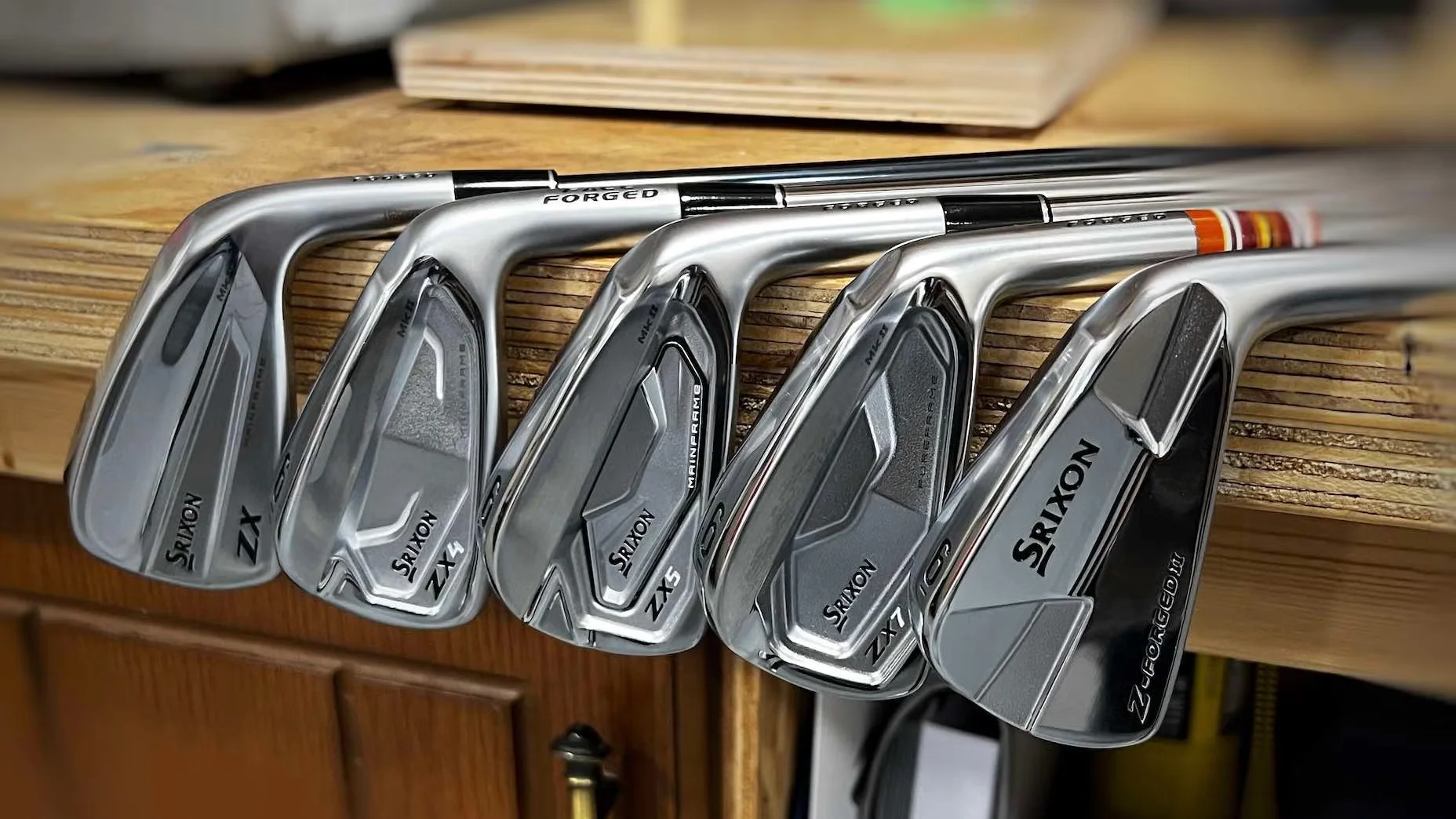
See Golf Practice Tips for Beginners →Irons are numbered from longest-hitting (lowest number, lowest loft) to shortest-hitting (highest number, highest loft). A typical amateur bag contains irons numbered 4 through 9, though some golfers carry lower numbers (3-iron, 2-iron) and most replace those with hybrids.
Here’s how the numbering works and typical amateur carry distances:
| Iron | Loft | Typical Distance (Amateur) |
|---|---|---|
| 4-iron | 24° | 170–180 yds |
| 5-iron | 27° | 160–170 yds |
| 6-iron | 30° | 150–160 yds |
| 7-iron | 34° | 140–150 yds |
| 8-iron | 38° | 130–140 yds |
| 9-iron | 42° | 120–130 yds |
The 7-iron is often considered the “reference club” — the one most golfers know best. Use it to benchmark your own distances and calibrate the rest of your bag.
Irons are further split into three groups based on difficulty:
- Long irons (2, 3, 4) — hardest to hit. Low loft, long shaft, small sweet spot. Most amateurs replace these with hybrids. - Mid irons (5, 6, 7) — the workhorses. Versatile enough for most approach shots. - Short irons (8, 9) — the easiest to hit pure. High loft, short shaft, stop on the green.
Iron sets come in different design categories:
- Game-improvement irons — cavity back, wide sole, perimeter weighting. Very forgiving. Best for beginners and mid-handicappers. - Players irons (blades or muscle-backs) — thinner top line, smaller head, less forgiveness but more workability. Best for low-handicappers and pros. - Combo sets — mix both. Long irons are game-improvement; short irons are blade-style. Good compromise for 5–15 handicaps.
If you’re unsure which you need, go game-improvement. Modern forgiving irons are so good that even single-figure golfers use them now.
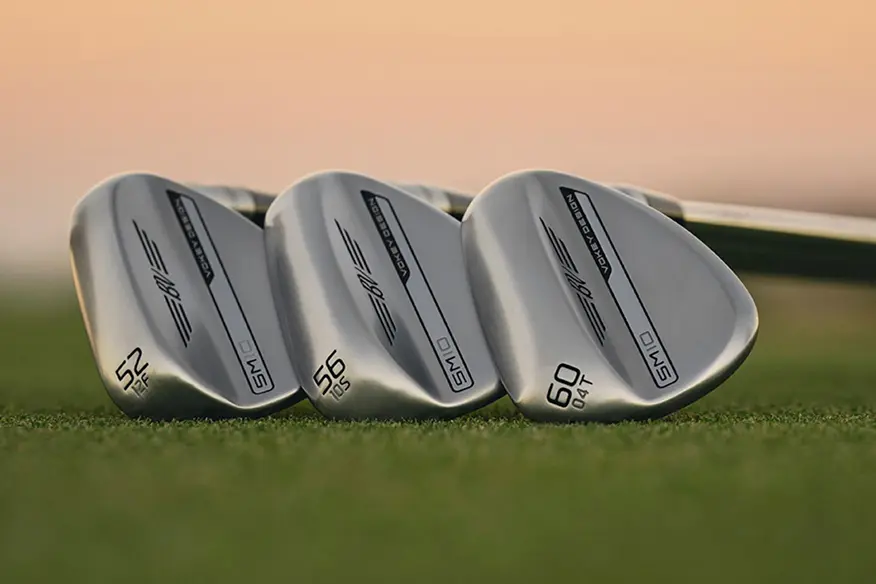
Wedges are the most specialised clubs in the bag and the most important ones for scoring. Each has a specific loft and purpose:
| Wedge | Abbreviation | Loft | Typical Use |
|---|---|---|---|
| Pitching Wedge | PW | 46–48° | Full swings 100–120 yards, long chips |
| Gap Wedge | GW / AW | 50–52° | The “gap” between PW and SW, 80–100 yds |
| Sand Wedge | SW | 54–56° | Bunker shots, 70–90 yard full swings |
| Lob Wedge | LW | 58–62° | High-flying soft-landing shots, flop shots |
Most golfers carry all four. The pitching wedge traditionally comes matched with your iron set. The other three are usually bought separately to get the specific lofts and bounce angles you need.
Around 60% of all golf shots happen inside 100 yards. Your wedges are what you use for the vast majority of those shots. Dialling in your wedge distances and contact — more than any other part of the bag — is what separates bogey golfers from single-figure golfers.
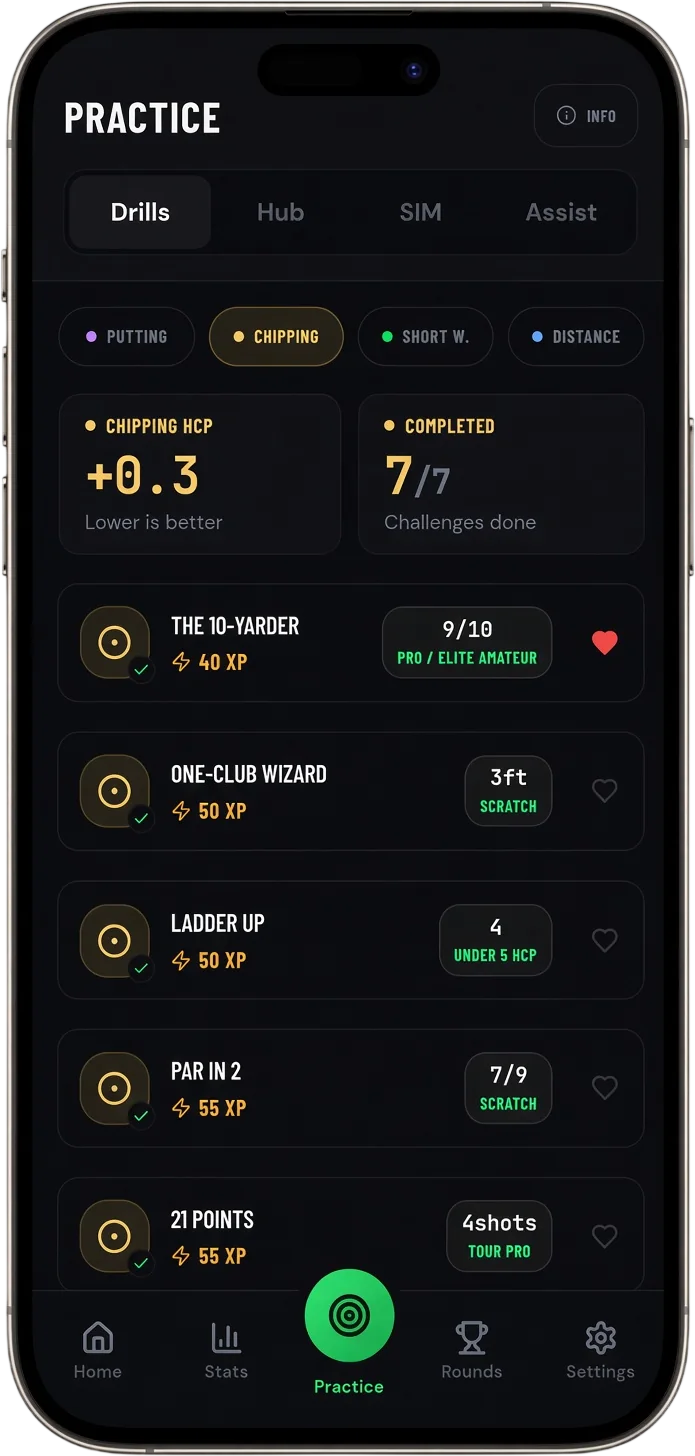
Scoring Zone is built around exactly this principle. The app’s drill library covers wedge distance control, chipping proximity, and pressure-based scoring challenges from every distance your wedges cover. If you want lower scores, the wedges in your bag and your skill with them matter more than any other club.
Dial in exact yardages for every wedge and swing length.
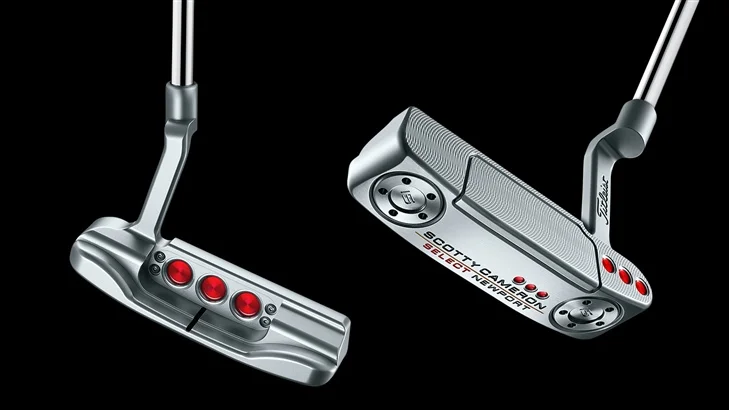
Golf Wedge Distances Chart →Putters come in two main head shapes, each with different stroke characteristics:
- Blade putters — traditional, compact, less forgiving. Best for golfers with an arcing stroke (the putter head opens on the backswing and closes through impact). Classic example: Scotty Cameron Newport. - Mallet putters — larger, more forgiving, often with alignment lines and higher MOI (moment of inertia). Best for golfers with a straight-back-straight-through stroke. Common example: Odyssey 2-Ball.
Neither is “better” — pick the one that matches your natural stroke.
Putters also come in three main grip styles:
- Conventional — standard grip with both hands matching - Claw — trail hand grips the putter with fingers in a pinching motion (Justin Rose, Phil Mickelson, Sergio García) - Pencil / saw — trail hand holds the putter like a writing pencil (Tommy Fleetwood)
The claw and pencil grips are commonly used by golfers with the yips or with inconsistent short putting — they remove the dominant hand’s ability to over-control the stroke.
If your putting feels twitchy or inconsistent under pressure, grip changes and scored drills are the proven fix.
Golf Yips: The Real Cure →Beginners don’t need 14 clubs. A minimal starter bag covers every realistic distance:
- Driver (1) - 5-wood or 7-wood (1) - 5-hybrid or 4-hybrid (1) - Irons 6, 7, 8, 9 (4) - Pitching wedge (1, usually comes with iron set) - Sand wedge (1) - Putter (1)
That’s 10 clubs. Enough to play any course. Add more as your game develops.
A typical 12–18 handicap bag:
- Driver - 3-wood, 5-wood - 4-hybrid - Irons 5, 6, 7, 8, 9 - Pitching wedge, gap wedge, sand wedge, lob wedge - Putter
Total: 14 clubs. Most comprehensive setup for the broadest range of shots.
Better golfers often carry more irons and fewer hybrids:
- Driver - 3-wood - Irons 3, 4, 5, 6, 7, 8, 9 - Pitching wedge, gap wedge, sand wedge, lob wedge - Putter
Total: 14 clubs. No hybrids — the 3-iron and 4-iron are skill-dependent and the player trusts them. Tour pros sometimes sub in a 2-iron or driving iron for specific courses.
Standard clubs are built to a fixed length, lie angle, and shaft flex. Those specs work for an “average” golfer — but you probably aren’t average. Your height, wrist-to-floor measurement, swing speed, and swing path all affect which specs fit your body and motion.
A fitting (usually free at major golf retailers when you buy clubs) tests:
- Shaft length and flex (stiff, regular, senior, ladies) - Lie angle (flat, standard, upright) - Grip size (thin, standard, midsize, jumbo) - Loft adjustments
Fitted clubs consistently add 5–15 yards of accuracy per iron and reduce injury risk. Don’t buy a full set blind.
Iron technology has plateaued. A modern iron is not dramatically better than one from 5 years ago — used clubs from reputable sellers (2nd Swing, PGA Tour Superstore used section, Golf WRX classifieds) can save 40–60% of new prices with negligible performance loss. Drivers and putters, on the other hand, see more technology progression — buy those newer if budget allows.
Five main types: woods (driver, fairway woods), hybrids, irons, wedges, and putters. The rules of golf allow up to 14 clubs in your bag, and most golfers carry a mix of all five types based on the courses they play and their skill level.
A typical bag contains a driver (1-wood), fairway woods (3-wood, 5-wood), hybrids (often 3H, 4H, 5H), irons (numbered from long to short, usually 4-iron through 9-iron), wedges (pitching wedge, gap wedge, sand wedge, lob wedge), and a putter.
Beginners don’t need all 14 clubs. A starter set typically includes a driver, a 5- or 7-wood, a 5-hybrid, irons from 6 through 9, a pitching wedge, sand wedge, and a putter — around 8 to 10 clubs. Focus on forgiving game-improvement models and hybrids instead of long irons.
A full mid-handicapper bag: 1 driver, 2 fairway woods (3W, 5W), 1–2 hybrids, 6 irons (4 or 5-iron through 9-iron), 3–4 wedges (PW, GW, SW, LW), and 1 putter. The exact composition varies — better golfers carry more irons, beginners carry more hybrids.
7 days free
Then from $4.99/month · Cancel anytime
Start your 7-day free trial
35+ drills & tests · Short Game Handicap · Performance tracking