Short Game

Golf Yips: The Real Cure for Putting and Chipping Yips
Why the Yips Aren’t Just Mental — and the Grip Changes + Drills That Actually Fix Them
April 23, 2026 · 8 min read · Stephen Pickering
Why the Yips Aren’t Just Mental — and the Grip Changes + Drills That Actually Fix Them
April 23, 2026 · 8 min read · Stephen Pickering
Key takeaway: The golf yips are a technical problem first, mental problem second. The #1 cure for putting yips is a grip change to the claw grip (Justin Rose) or pencil grip (Tommy Fleetwood) — both remove the dominant hand’s over-control. For chipping yips, fix technique first (consider a lesson), then rebuild confidence with performance-based scored drills.
The golf yips are one of the cruellest things in the game. A golfer who’s been putting well for years suddenly can’t hole a four-footer. A chipper who’s been getting up and down for decades starts bladding shots across the green. The scorecard collapses. Confidence evaporates. And every piece of mainstream advice — “it’s all mental”, “just breathe”, “trust your stroke” — somehow makes it worse.
Here’s the honest truth most coaching content misses: the golf yips are a technical problem first and a mental problem second. The mental component is real, but it’s caused by the technical breakdown, not the other way around. Fix the technique and the mental side almost always follows. This guide covers the real causes of putting yips and chipping yips, plus the specific cures — grip changes, lessons, and scored drills — that work.
The golf yips show up in two distinct places:
- Putting yips — a sudden jerk, twitch, or flinch at impact on a putt. Usually on short putts (3–6 feet) where the pressure is highest. The ball gets yanked left, pushed right, or decelerated into a dead pull. - Chipping yips — involuntary flinches that produce fat chips (hitting the ground first), thin chips (blading across the green), or a sudden scooping motion that sends the ball nowhere useful.
Both versions share the same anatomy: an involuntary muscle response at the critical moment of impact, amplified by the golfer’s attempt to consciously prevent it.
Here’s the loop that almost every yipper describes:
1. A technique flaw produces a bad outcome (missed putt, fat chip) 2. The brain flags the shot type as dangerous 3. Next time, the golfer consciously tries to prevent the bad outcome — gripping tighter, slowing down, hesitating at impact 4. That conscious correction introduces tension and disrupts the automatic motor pattern 5. The result is worse, not better 6. Confidence erodes. The flinch becomes chronic.
Notice what’s not in this loop: a primary mental illness or a spontaneous psychological event. The mental element is real, but it’s downstream of the technical breakdown. Treat the root cause — the technique — and the feedback loop unwinds.
The single most effective fix for putting yips is a grip change. This isn’t a cosmetic tweak — it physically removes the dominant hand’s over-control, which is where the twitch originates for most golfers.
Two grip changes have the strongest track record:
The claw grip (Justin Rose)
Justin Rose switched to the claw grip mid-career and has credited it with saving his putting. In the claw grip, the trail hand (right hand for a right-handed golfer) grips the putter with the thumb running down the front of the grip and the fingers pinching from the side — as if holding a pencil in your fist. The palm doesn’t face the target. The grip is passive.
The reason it works: the trail hand is almost always the source of the twitch. By gripping the putter in a way that physically prevents the trail hand from firing independently, you remove the mechanism of the yip. Phil Mickelson, Sergio Garcia, Tommy Fleetwood, Webb Simpson, and many other tour players have used versions of the claw grip for the same reason.
The pencil grip (Tommy Fleetwood)
Tommy Fleetwood uses a pencil grip — closely related to the claw but with the trail hand holding the putter like a writing pencil, with the thumb and index finger forming a clean pinch. Many golfers find this even more effective than the claw because it removes almost all active role from the trail hand.
The switch to either grip feels alien for the first 100–200 putts. Stick with it. The whole point is that the familiar motion pattern — the one where the yip lives — is no longer available to execute. That discomfort is the cure working.
The grip change alone isn’t enough. You need to pair it with scored drills that progressively reintroduce pressure in a controlled environment. Two drills in particular work for yipping putters:
Gate drill (confidence builder) — Place two tees just wider than the putter head, about 3 feet in front of you, forming a gate. Putt 10 balls through the gate to a ball marker 6 feet beyond. You’re not trying to make the putt — you’re training a neutral, tension-free stroke that starts the ball on line. No yip-trigger, no pressure. Build 50–100 reps before moving on.
Five-Foot Circle (pressure reintroduction) — Place a ball 5 feet from the hole. Make 10 in a row. Miss any, the streak resets to zero. 15-minute timer. This drill forces the new grip to hold up under consecutive-make pressure — exactly the scenario where the old yip used to fire.
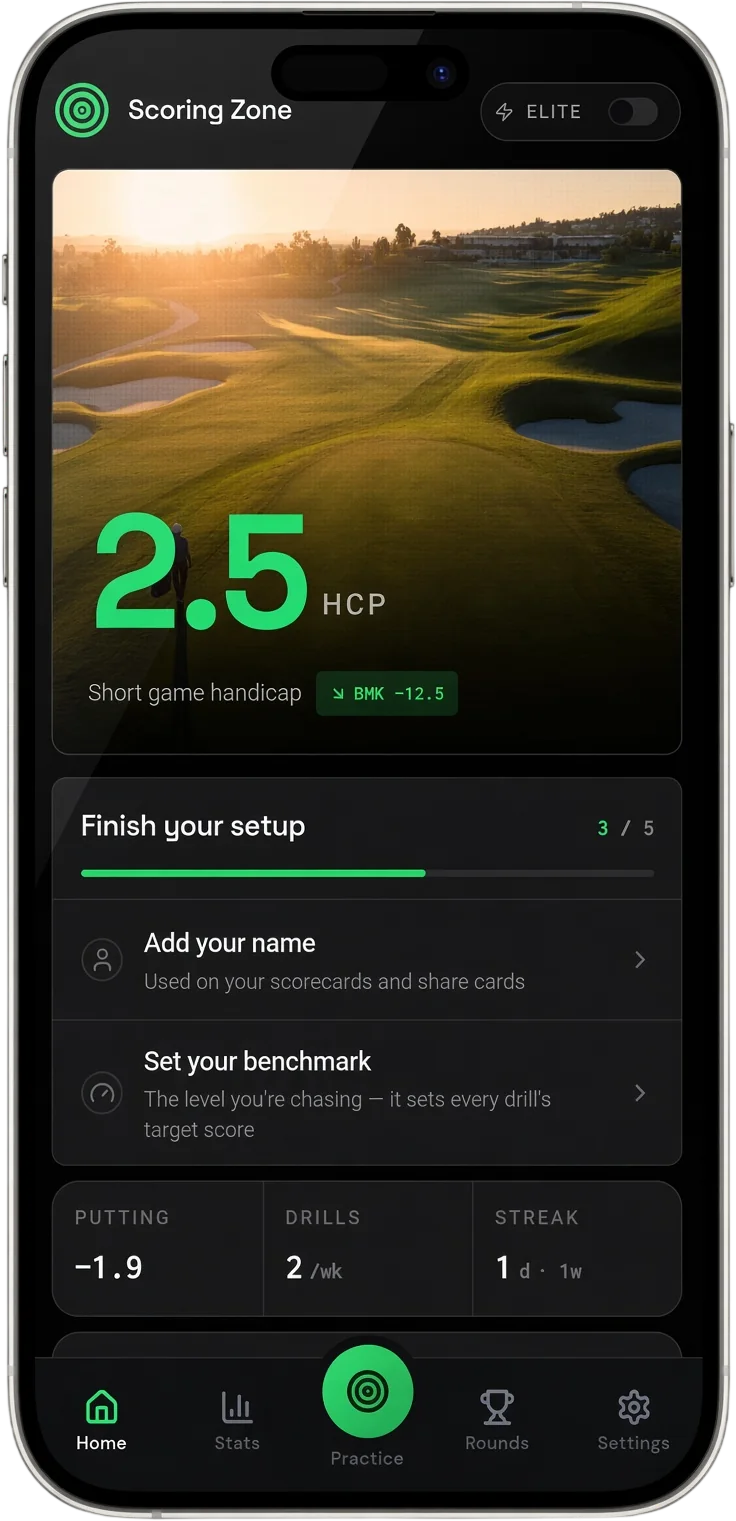
Scoring Zone’s Putting Drills module includes both of these drills with automatic scoring and session-to-session tracking. Watching your make streak climb week over week is how confidence rebuilds — not through affirmations, but through proof.
See the full library of scored putting drills that rebuild confidence under pressure.
See Putting Drills →Chipping yips are different to putting yips because they’re almost always caused by a genuine setup flaw. Weight on the back foot. Ball too far forward. Hands behind the clubhead. These flaws produce fat or thin contact — and once your brain has flagged chip shots as unreliable, the yip takes hold.
The honest advice: get a lesson. A qualified PGA coach will spot the setup fault in five minutes. What you’re paying for isn’t the diagnosis — it’s the correct feel for a weight-forward, shaft-leaning, ball-first contact position. You can read about it all day and still not feel it until someone physically puts you in the right position.
Once technique is clean, the rest is practice volume and pressure management.
Once the setup is corrected, you need to rebuild the neural pattern of clean contact — and you need to do it with scored accountability, not mindless repetition. This is where performance-based practice separates improvement from going through the motions.
Two drills to prioritise:
The chalk-line drill — Draw a chalk line on the grass (or use a line on a mat). Place a ball just in front of the line. Your goal: contact the ball first and have your club strike the ground on or past the line. Hit 10 shots and count how many result in clean, line-after-ball contact. 8 out of 10 is your benchmark. This gives direct visual feedback on whether your setup is producing correct low-point.
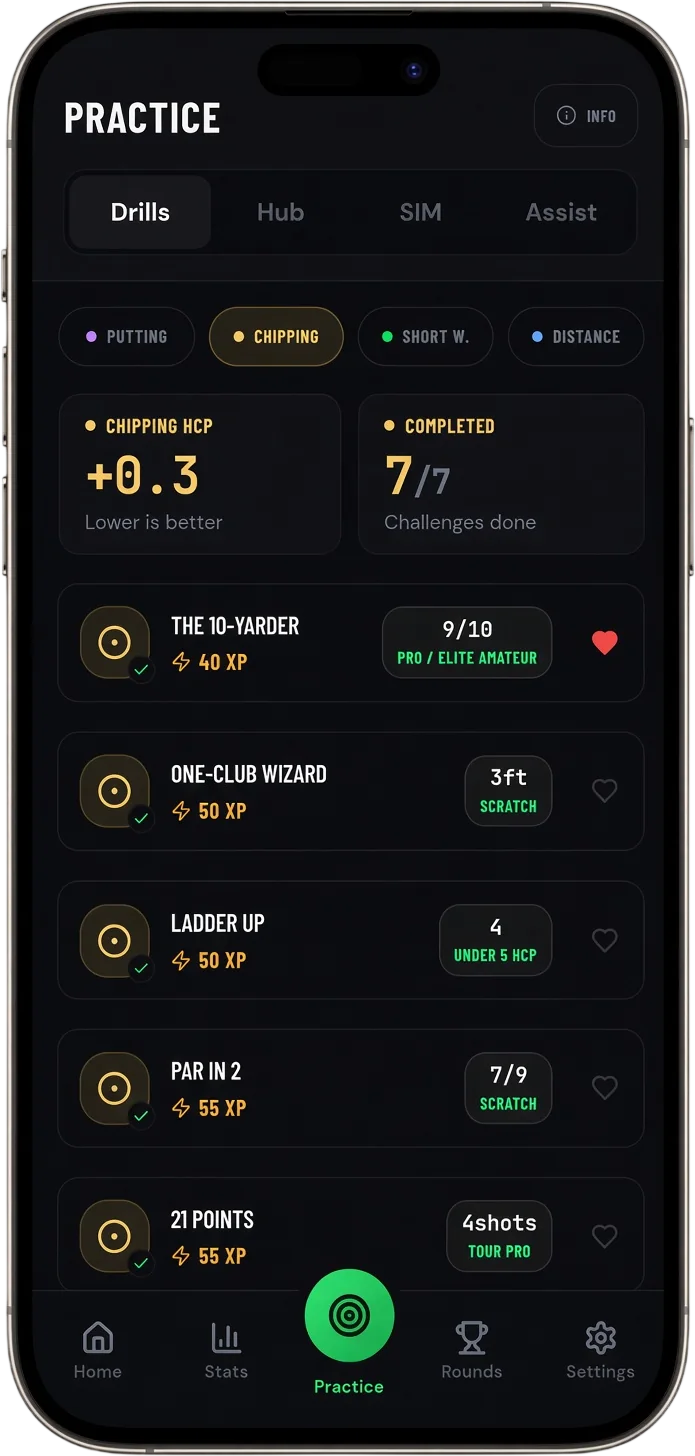
The Ten Yarder — Chip 10 balls from just off the green to a hole 10 yards away. Count how many finish within 3 feet. Scoring Zone has this drill built in with handicap benchmarks so you know whether you’re tracking at, above, or below your bracket. Watching the score climb session over session is what rebuilds the “this shot is safe” mental model your brain needs.
Pressure-based drills come last. Add a consecutive-success requirement (5 in a row inside 3 feet, reset on failure) once the chalk-line drill is producing consistent clean contact. The yip dissolves when the brain stops flagging the shot as dangerous — and that only happens with concrete evidence of success, which is exactly what scored drills provide.
Structured chipping drills with scoring, benchmarks, and handicap-level targets.
See Chipping Drills →The standard advice for yips — breathe, visualise, trust your stroke, stay in the present — isn’t wrong. It’s incomplete. It treats the symptom (anxiety at impact) rather than the cause (a technique that your brain has correctly identified as unreliable).
Trust is the *output* of proof, not the input. You can’t will yourself to trust a putting stroke that keeps missing. You can build a new stroke with a new grip and then let the evidence of successful repetition build trust over time. That’s how confidence actually works — bottom-up, from data, not top-down from affirmations.
Once the technical base is solid, the psychological layer is worth working on. Sports psychology for golf — breathing routines, pre-shot process focus, post-shot reset rituals — is genuinely useful as a finisher, not a starter. The sequence matters: fix the technique first, then layer the mental work on top of a reliable motion. In the other order, you’re asking the brain to override evidence, which rarely works for long.
A golfer who commits to a grip change and scored drills typically sees:
- Week 1–2: The new grip feels alien. Scores get worse before they get better. Don’t bail out here — this is the yip-producing motion pattern being replaced. - Week 3–4: Clean reps start compounding. Practice scores climb. The old flinch is suppressed by the mechanical fact that the new grip can’t execute it. - Week 5–8: Confidence returns on the practice green. The real test — pressure — is still ahead. - Month 3+: The new motion becomes automatic. You’ll still have pressure moments, but the flinch is no longer a reliable feature of your stroke.
The same timeline applies to chipping yips: lesson in week 1, chalk-line drill and Ten Yarder for weeks 2–6, pressure drills from week 6 onwards. The golfers who rebuild fastest are the ones who commit fully to the new pattern and don’t test the old one.
The golf yips are involuntary muscle spasms or jerks that disrupt a golfer’s stroke — most commonly on short putts and chip shots. They appear as a sudden flinch or loss of control at impact, usually under pressure. The root cause is typically a technique breakdown that becomes amplified by conscious correction and tension, not a purely psychological condition.
The most effective cure is a grip change paired with scored drills. The claw grip (used by Justin Rose) and the pencil grip (used by Tommy Fleetwood) both remove the dominant hand’s over-control — the source of the twitch for most golfers. Pair the new grip with the Gate drill and Five-Foot Circle to rebuild confidence through consecutive-make reps.
Chipping yips are fixed by rebuilding technique first — often with a lesson from a qualified PGA coach — then transitioning to performance-based practice. Weight forward, ball back of centre, hands slightly ahead. Once the setup is clean, use the chalk-line drill and the Ten Yarder (10 chips, count how many finish inside 3 feet) to restore confidence under scored accountability.
Primarily technical, secondarily psychological. A flaw in setup, grip, or mechanics produces bad outcomes. The golfer tries to consciously correct them, which adds tension and over-control — producing worse outcomes. Treat the technique first and the mental component usually resolves. Starting with mental work rarely succeeds because the brain can’t trust a stroke that keeps missing.
7 days free
Then from $4.99/month · Cancel anytime
Start your 7-day free trial
35+ drills & tests · Short Game Handicap · Performance tracking