Practice & Improvement
Golf Wedge Distances Chart: Dial In Your Yardages
PW, GW, SW, LW Distances by Swing Length — and How to Measure Your Own
April 19, 2026 · 7 min read · Stephen Pickering
PW, GW, SW, LW Distances by Swing Length — and How to Measure Your Own
April 19, 2026 · 7 min read · Stephen Pickering
Key takeaway: Typical amateur wedge distances: PW 100–115, GW 85–100, SW 70–85, LW 50–70 yards at full swing. But averages don’t matter — your own numbers do. Use the clock system (7, 9, 10 o’clock) to build a personal gap chart with 9 precise yardages across your wedge set.
Most amateur golfers know roughly how far they hit a 7-iron. Ask them their sand wedge carry distance at a three-quarter swing and you’ll get a guess. That guess is what’s costing you 3–5 shots per round. Wedge distances aren’t about power — they’re about knowing exactly how far each club goes at different swing lengths, on command. This golf wedge distances chart gives you the typical yardages by club and swing length, plus a practical method to measure your own.
These are average carry distances for a mid-handicap amateur. Your own numbers will vary based on swing speed, strike quality, and equipment — but this gives you a baseline to measure against.
| Wedge | Loft | Full Swing | 3/4 Swing | 1/2 Swing |
|---|---|---|---|---|
| Pitching Wedge (PW) | 46° | 100–115 yds | 85–95 yds | 65–75 yds |
| Gap Wedge (GW) | 50–52° | 85–100 yds | 70–85 yds | 55–65 yds |
| Sand Wedge (SW) | 54–56° | 70–85 yds | 55–70 yds | 40–50 yds |
| Lob Wedge (LW) | 58–60° | 50–70 yds | 40–55 yds | 30–40 yds |
For reference, here’s what a PGA Tour player hits the same clubs. The gap is less about full-swing distance and more about consistency — tour pros hit each yardage within a 3–5 yard dispersion, amateurs hit the same shot within a 15–20 yard range.
| Wedge | Loft | Full Swing |
|---|---|---|
| Pitching Wedge (PW) | 46° | 125–140 yds |
| Gap Wedge (GW) | 50° | 110–125 yds |
| Sand Wedge (SW) | 56° | 95–110 yds |
| Lob Wedge (LW) | 60° | 75–90 yds |
The usable lesson: your goal isn’t more distance. It’s tighter dispersion.
Every professional tour player uses some version of this method. Hit each wedge at three different swing lengths, measured by where your lead arm stops on the backswing.
- 7 o’clock — half swing, lead arm parallel to the ground or just below - 9 o’clock — three-quarter swing, lead arm pointing straight up - 10 o’clock — near-full, lead arm pointing slightly past vertical
Hit 10 shots at each position with each wedge, record the carry distance, and take the average. That gives you 9 personal yardages across your short game — enough to know exactly which club-and-swing combination to use from almost any distance inside 100 yards.
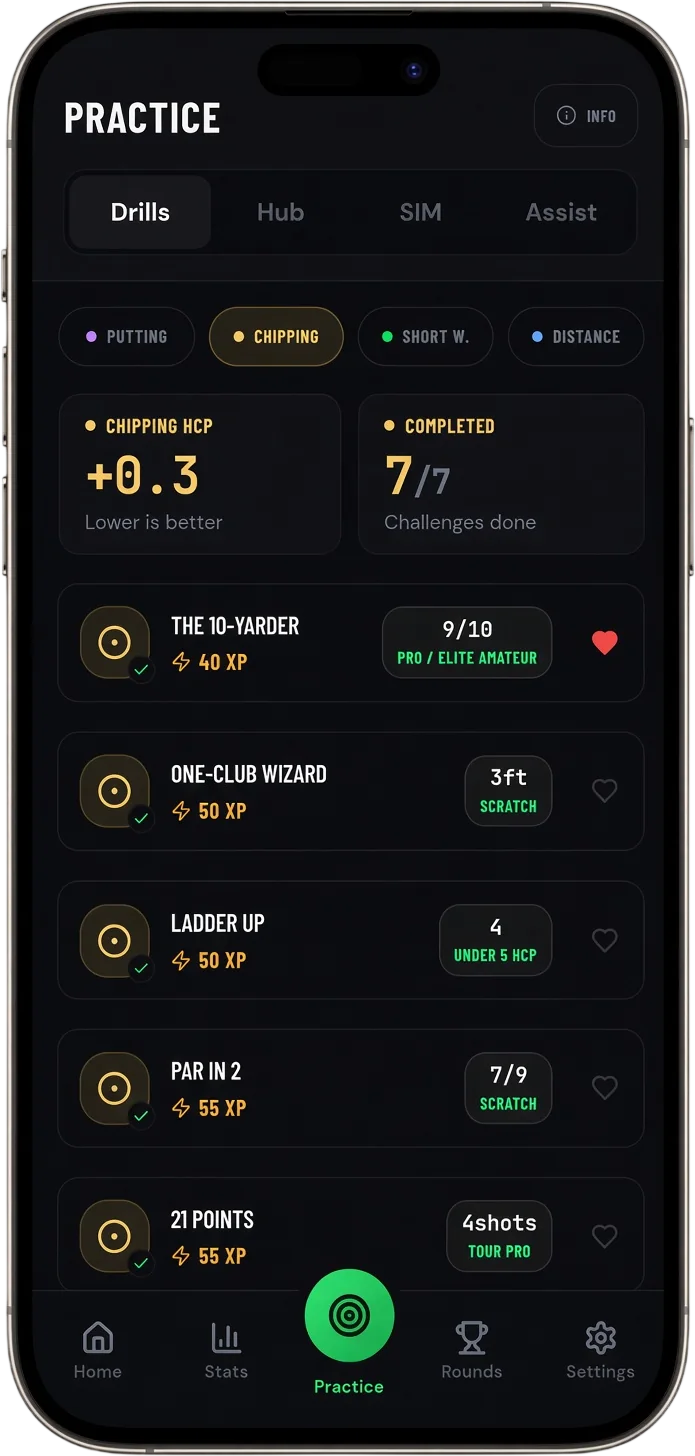
Scoring Zone’s Practice Assistant includes a built-in clock system for all three wedges. You record each yardage once, and the app stores your personal gap chart for reference during future practice sessions.
Build your personal wedge distance chart using the clock system.
See Practice Assistant →If you have access to a launch monitor (personal unit or a sim bay), use it. Even budget launch monitors give you carry distance within a few yards of accuracy — which is all you need for wedge yardages.
If you don’t, the alternative is a range with clearly marked flags or a pitching net with measured distances. Hit ten shots, estimate the carry for each, and take the average. Less precise, but usable.
What doesn’t work: eyeballing a single shot on a Saturday and calling that your yardage. One shot tells you nothing about dispersion — and dispersion is the entire point.
When you’re faced with a wedge shot, start by identifying your target yardage. If your personal chart shows a gap wedge at full swing = 92 yards and a sand wedge at full swing = 78 yards, you have a 14-yard gap between those two clubs.
A 90-yard shot falls between them. That’s where three-quarter or half swings come in. Use your chart to pick a club-and-swing combination that matches the shot, not the other way around.
The worst wedge decision is being stuck between full-swing distances and trying to swing harder or softer with your “normal” swing to compensate. That’s where you lose shots to fat and thin contact.
Your chart is a baseline, not a rule. Adjust for:
- Wind — 1–2 clubs up into a breeze, 1 club down downwind - Uphill/downhill — add yardage for uphill, subtract for downhill - Firm vs soft greens — carry-only shots for firm greens; flight-plus-rollout works on soft - Lie — rough takes 10–20% off carry distance; bare lies run out more
Once you know your personal chart, these adjustments become precise instead of guesswork.
A simple launch-monitor or sim-bay drill: pick a target yardage (say 75 yards). Hit 20 shots. Count how many land within a 5-yard zone of the target. Your goal is 16 out of 20, or 80%. Anything below 60% means your distance control needs more reps before course management changes anything.
Scoring Zone’s SIM Lab includes a version of this drill with automatic tracking — hit your shots on a launch monitor and the app records proximity to the target for every shot, building a session-by-session trend.
Test your wedge distance control with automated proximity tracking.
See SIM Lab →Block practice (all shots from 80 yards, then all from 90) builds mechanics. Random practice (alternating between yardages on every shot) builds course-ready skill. Once you have a clock-system chart, practise random yardages — call out a number, hit the corresponding shot, then move to a new number.
This is how wedge distances become automatic instead of mechanical.
A typical amateur hits pitching wedge 100–115 yards, gap wedge 85–100, sand wedge 70–85, and lob wedge 50–70. But averages don’t matter — your own distances are what count. Measure your full swing, three-quarter, and half swing with each wedge on a launch monitor or in a tracked practice session.
The most reliable method is the clock system: hit ten shots each at 7 o’clock (half), 9 o’clock (three-quarter), and 10 o’clock (near-full) swing lengths with each wedge. Record the carry distance for each and take the average. That gives you a personalised gap chart reflecting how you actually swing.
Most amateurs benefit from three or four wedges with no more than 4–6 degrees of loft gap between them: typically PW (46°), GW (50° or 52°), SW (56°), and LW (58° or 60°). Larger gaps leave yardage blind spots where you’re never quite sure which club to pick.
Around 60% of all golf shots happen inside 100 yards. A 20-yard misjudgement often means a chip from off the green instead of a birdie putt. Tour pros leave themselves an average of 20 feet from 125 yards — amateurs at 30–40 feet is usually a distance control issue, not a technique one.
7 days free
Then from $4.99/month · Cancel anytime
Start your 7-day free trial
35+ drills & tests · Short Game Handicap · Performance tracking