Golf Basics

What Percentage of Golfers Break 90? Score-by-Score Data
The Real Numbers for Breaking 100, 95, 90, 85, 80, 75 and Par
April 28, 2026 · 9 min read · Stephen Pickering
The Real Numbers for Breaking 100, 95, 90, 85, 80, 75 and Par
April 28, 2026 · 9 min read · Stephen Pickering
Key takeaway: About 26% of handicapped golfers regularly break 90 and roughly 55% have done it once. Break 100 sits at ~55%, break 80 at ~10%, and shooting par at ~2%. Published figures vary wildly because studies conflate “once” with “regularly” and sample only the ~10–12% of golfers who keep a handicap. Moving up a bracket is a short game job — 60% of shots happen inside 100 yards.
About 26% of golfers regularly break 90 on a regulation par-72 course from the standard tees. Roughly 55% have done it at least once. Three out of four golfers never get there as a matter of routine, despite years of green fees and new drivers.
That’s the headline number, but it’s rarely the number people actually want. Golfers search this looking for their own target — 100, 95, 85, 80, 75, par — and every article answers for 90 and stops. So this one covers the full range, with both figures that matter: how many break each score *regularly*, and how many have broken it *at least once*.
There’s also a proper answer to why published percentages swing from 20% to 49% depending on where you read them. That inconsistency isn’t sloppiness; it’s three specific measurement problems, and once you see them the whole picture makes sense.
These figures are for golfers who maintain an official handicap, playing a regulation par-72 course from standard tees, holing out every putt. The caveats section below explains why that qualifier matters enormously.
| Target score | Regularly break it | Broken it at least once |
|---|---|---|
| Break 110 | ~78% | ~94% |
| Break 100 | ~55% | ~86% |
| Break 95 | ~40% | ~72% |
| Break 90 | ~26% | ~55% |
| Break 85 | ~16% | ~38% |
| Break 80 | ~10% | ~26% |
| Break 75 | ~4% | ~12% |
| Shoot par (72) | ~2% | ~8% |
| Break 70 | ~1.5% | ~6% |
| Break 60 | <0.01% | <0.01% |
Two things jump out of that table.
The first is how brutal the drop-off is between 90 and 80. Going from breaking 90 to breaking 80 isn’t a step — it eliminates roughly 60% of the golfers who made it to the first milestone. There are more golfers who have never broken 100 than there are golfers who regularly break 85.
The second is the gap between the two columns. Roughly twice as many golfers have broken a given score once as break it regularly. That gap is the entire story of amateur golf: almost everyone has one round in them that’s five shots better than they are. Consistency is the hard part, and consistency is a short game property.
Around 55% of handicapped golfers regularly break 100, and roughly 86% have broken 100 at least once — a figure drawn from analysis of some 15,000 USGA-handicapped players.
Across all golfers, including the large majority who never keep a card, the regular figure drops to somewhere near 40%.
Breaking 100 means averaging just under bogey-and-a-half golf. What stops most golfers isn’t the standard of their good holes — it’s the frequency of their disasters. A golfer capable of breaking 100 typically makes six or seven pars and bogeys a round and then hands it all back with two triples and a snowman.
The route out is unglamorous: stop compounding mistakes. Take the punch-out. Play to the fat side of the green. Never take on a carry you convert less than half the time.
About 40% of handicapped golfers regularly break 95, and about 26% regularly break 90.
Sit with that for a second: the gap between breaking 95 and breaking 90 is five shots, and it costs you 14 percentage points of the golfing population. It’s the tightest, most competitive five strokes in the game, and it’s where golfers spend years.
The 90–99 bracket is the single largest group in golf. If you shoot in the 90s, you are statistically the most common golfer in the world.
A handicap of around 17 or below breaks 90 most of the time.
If you’re a 20 handicap chasing your first sub-90, the maths is friendlier than it feels. You’re allowed 20 shots over par, so a net 92 is your average round. You need three strokes. Three strokes is exactly what disappears when a golfer stops three-putting twice a round.
For the full roadmap from 95 down to 89, with the specific shots that cost most golfers the round:
How to Break 90 in Golf: A Short Game Plan That Works →Roughly 16% of handicapped golfers regularly break 85, and about 10% regularly break 80. Around a quarter have broken 80 once.
Breaking 80 needs a handicap around 7 or better. What actually separates the golfers who get there is not ball-striking, which is the assumption most people make. It’s conversion.
A scratch golfer gets up and down roughly 50% of the time. A 10-handicap manages about 32%. A 20-handicap manages about 10%. On a round where you miss eight greens — which is a good round for a single-figure player — that difference is three to four strokes, and it’s the whole gap between 82 and 78.
The same pattern shows in putting. Tour pros average around 29 putts and three-putt about once every two rounds. A 15-plus handicapper averages 36 to 40 putts and three-putts three times a round. From 11 to 30 feet, an amateur is around seven times more likely to three-putt than a tour player.
Breaking 80 is a short game achievement wearing a ball-striking costume.
This is the thin end.
Break 75: roughly 4% of handicapped golfers regularly, about 12% at least once. You’re looking at a handicap of about 3 or better.
Shoot par (72 or better): roughly 2% regularly, around 8% at least once. Shooting par as a matter of routine means playing off scratch, and fewer than 2% of registered golfers hold a scratch or better index. Across the whole golfing population it’s well under 1%.
Break 70: roughly 1.5% regularly. At this level you’re a plus-handicap amateur, a college player or a professional. Note that a lot of “I broke 70” rounds happen on short par-70 or par-71 courses — breaking 70 on a genuine par-72 championship layout is a different achievement.
Effectively none. Well under 0.01%, and that’s being generous.
Breaking 60 means shooting 59 or lower. It has happened a small number of times in the entire recorded history of professional golf — a handful of 59s and two 58s across every PGA Tour event ever played. Al Geiberger was the first in 1977; Jim Furyk’s 58 in 2016 is the record.
If you’re searching this because someone in your fourball claims they’ve done it, the odds are considerably better that they were playing a par-3 course.
Search this topic and you’ll find “break 90” quoted anywhere from 20% to 49%. Both numbers can be defended. Three things explain the spread.
The single biggest source of confusion. “Breaking 90” can mean shooting 89 one glorious Tuesday in 2019, or shooting under 90 more often than not. The two figures differ by roughly a factor of two, and studies frequently don’t specify which they measured.
Both columns are in the table above for exactly this reason.
Only about 10 to 12% of golfers maintain an official handicap. Every study built on a handicap database, a shot-tracking app, or a survey of golf club members is sampling the most committed decile of the sport.
Those golfers play more, practise more and score better than the population as a whole. Any figure drawn from that pool overstates the picture across all golfers, typically by 10 to 15 percentage points at the break-100 level.
Tee choice, course rating and slope, whether gimmes were conceded, whether the round was in competition, whether every putt was holed out. None of it is standardised across studies.
A golfer who shoots 88 off the forward tees on a 6,000-yard course with two conceded four-footers has not made the same score as a golfer who shoots 88 off the back tees at a 73.5-rated course holing everything out. Both go in the dataset as “broke 90”.
Whichever row of that table you’re currently on, the mechanism for moving up one is the same, and it doesn’t involve your swing.
Around 60% of all shots happen inside 100 yards. For a golfer shooting 95, that’s roughly 57 short game shots against 38 full swings. Walk into any driving range and the ratio of practice is almost exactly inverted — most of the bays are hitting drivers and most of the practice green is empty.
That mismatch is the whole reason the table above has the shape it does.
Three things move golfers between brackets:
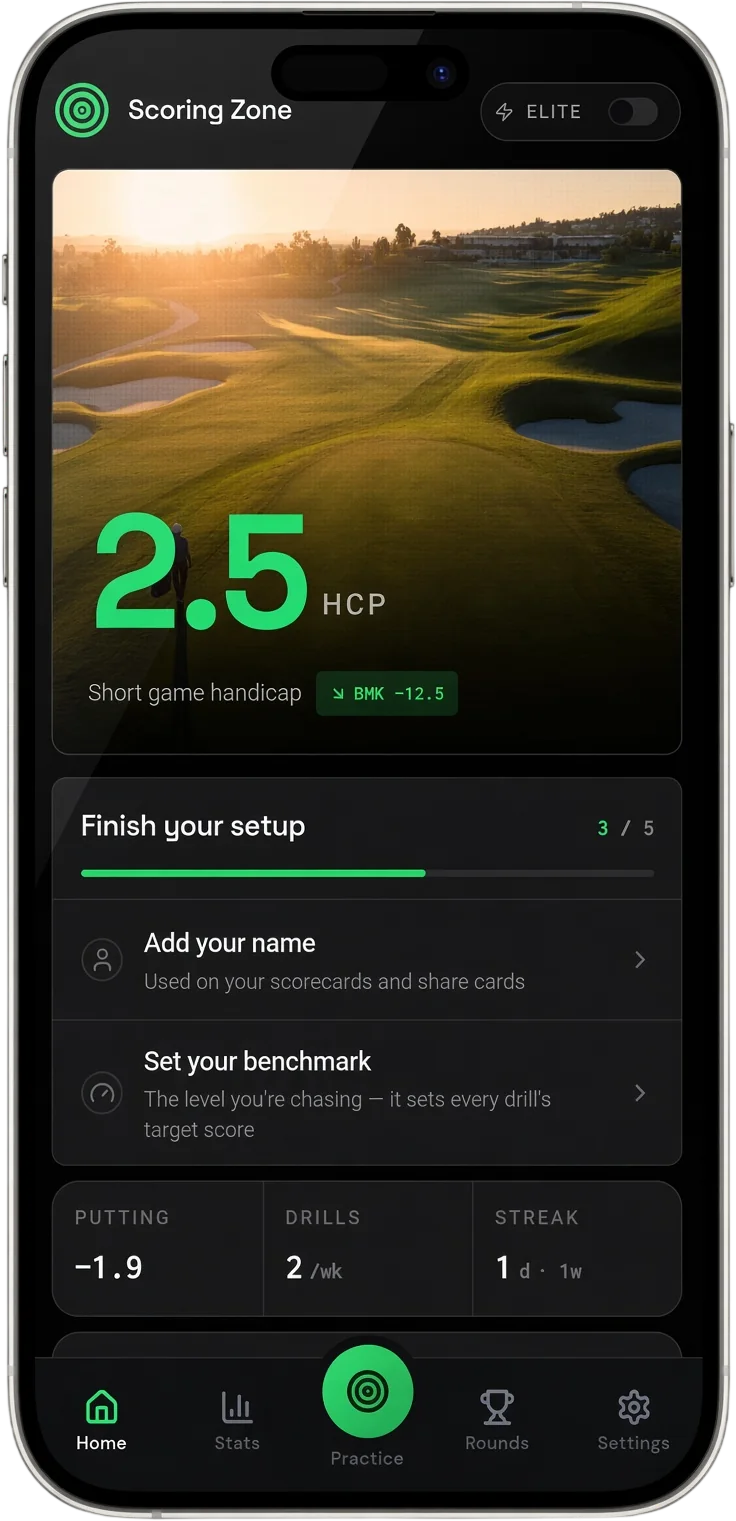
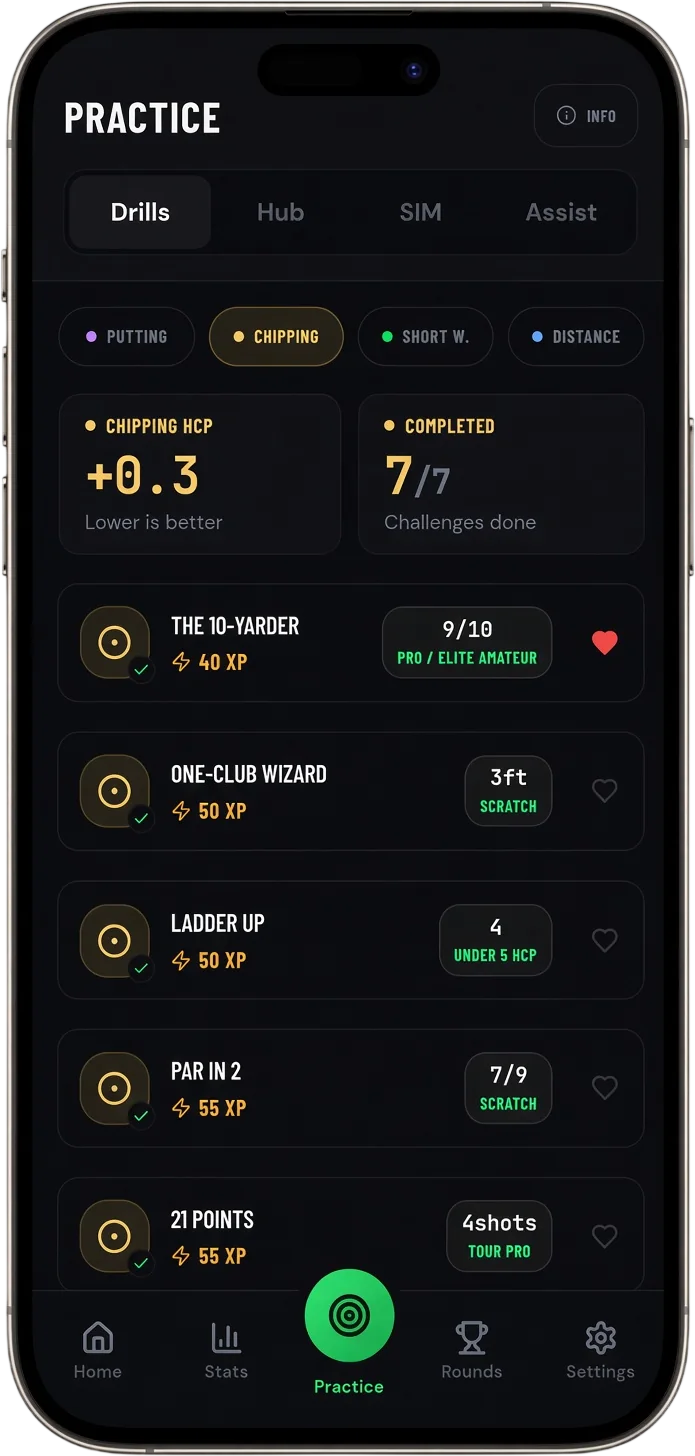
This is the framework Scoring Zone is built on — scored short game drills with benchmarks by skill level, so you can see whether you’re genuinely improving or just clocking practice time. The Performance Hub assessment runs 60 shots and returns a Short Game Handicap and a Putting Handicap, which is the most useful single number a golfer stuck in the 90s can have.
For the short game drills that cut strokes fastest for amateurs, with scoring targets for each:
How to Improve Your Golf Short Game →Hit ten putts from 40 feet or more. Count how many finish inside three feet. Speed only, forget the line.
A golfer shooting in the 90s typically lands two or three inside three feet. Get to five or six and your three-putt count roughly halves. That alone is worth 1.5 to 2 strokes a round.
Set up nine different shots around the green, varying the lie and distance. From each, try to get up and down in two — one chip, one putt or better. No gimmies; every second shot must be at least a putter length.
Count your pars out of nine. A 90s golfer usually scores two or three. A scratch player scores five or six. Halving that gap is worth three to four strokes a round, which is the exact size of the jump from one bracket to the next.
Write the number down every time you run it. Scoring Zone scores this one automatically and benchmarks it against your handicap bracket, but a notebook does the same job as long as you’re honest about the gimmes.
Putts from three to six feet under a timer with a running streak counter that resets on a miss.
Most three-putt damage isn’t the 40-footer. It’s the four-footer coming back, and it’s missed because there’s a consequence attached to it. The practice green has no consequence. The timer and the reset give it one.
Roughly 26% of golfers who maintain a handicap regularly break 90 on a regulation par-72 course from the standard tees, and around 55% have broken 90 at least once. Across all golfers, including the majority who never keep an official handicap, the regular figure is lower — closer to 20%. Breaking 90 is a top-quartile achievement, not a beginner one.
About 55% of golfers with an official handicap regularly break 100, and roughly 86% have broken 100 at least once. Among all golfers, including casual players who do not keep a handicap, the figure who regularly break 100 is closer to 40%. Breaking 100 is the single biggest scoring milestone in amateur golf because it is where the largest group of players sits.
Around 10% of handicapped golfers regularly break 80, and roughly a quarter have done it at least once. Breaking 80 requires a handicap of about 7 or better and, more than anything else, a short game that converts up-and-downs at close to 50%. It is the point where scoring stops being about avoiding disasters and starts being about making birdies.
Roughly 2% of handicapped golfers regularly shoot par or better on a regulation course, and around 8% have shot par at least once in their lives. Shooting par consistently means playing off scratch, which fewer than 2% of registered golfers achieve. Across the entire golfing population the figure is well under 1%.
Three reasons. First, definitions: breaking 90 once is not the same as breaking 90 regularly, and studies rarely say which they mean. Second, population: only about 10 to 12 percent of golfers maintain an official handicap, and studies based on handicap databases or shot-tracking apps sample the most committed players, which inflates every figure. Third, conditions: tee choice, course rating and whether putts are holed out all move the numbers by several percent.
7 days free
Then from $4.99/month · Cancel anytime
Start your 7-day free trial
35+ drills & tests · Short Game Handicap · Performance tracking