Practice & Improvement
How to Practice Golf Effectively: An Evidence-Based Framework
Block vs Random, Deliberate Practice, and the Time Allocation That Actually Works
April 25, 2026 · 9 min read · Stephen Pickering
Block vs Random, Deliberate Practice, and the Time Allocation That Actually Works
April 25, 2026 · 9 min read · Stephen Pickering
Key takeaway: Effective golf practice has 3 ingredients: a specific skill goal, scored repetitions with feedback, and a mix of block and random practice. Allocate 50% of your time to short game (60% of your strokes happen there), use 45-minute sessions over 3-hour marathons, and track 3 numbers — practice scores, round stats, and handicap — to confirm you’re actually improving.
Most golfers practise wrong. They go to the range, hit a bucket of balls, mostly with the driver, mostly to nowhere in particular, and call it practice. Then they wonder why their handicap hasn’t moved in three years.
Effective golf practice is a skill of its own. It’s not the amount of time you put in — plenty of golfers practise five times a week and stay 18-handicaps forever. It’s how you structure those sessions. This guide lays out a coach-led framework for practising effectively: block vs random practice, deliberate practice principles, the right time allocation by skill, and how to track whether your practice is actually working.
Mindless repetition feels like practice. It isn’t. It’s exercise. Research from sports science is clear: skill acquisition happens through structured, targeted, feedback-rich repetition — not volume.
The problem with the standard range session:
- No skill goal. Most amateurs don’t know what they’re working on. They hit a 7-iron, then a 5-iron, then the driver, drift back to the wedge. There’s no specific skill being trained. - No feedback. Without a target, a launch monitor, or a scored drill, you don’t know if you’re improving from one shot to the next. - No transfer. Hitting 50 balls from a flat lie at the same yardage doesn’t translate to a real round, where every shot is different. - Wrong allocation. Most practice time goes to the driver. Most strokes happen with a wedge or a putter.
You’re not practising. You’re rehearsing the same flawed move under conditions that don’t match the course.
Every session should target one (maybe two) skills. Not “the swing.” Not “putting.” A skill is narrow enough to measure: lag putting from 30 feet, chipping with a sand wedge from light rough, pitching from 50 yards, downhill 6-footers.
If you can’t write down what you worked on after the session in 10 words or fewer, the session was too vague.
Every drill needs a scoring system — even a crude one.
- Ten chips. How many finished within 3 feet? - Ten 30-foot putts. How many finished within 3 feet? - Twenty pitches. Average proximity to the target?
Without a number, you can’t tell if you’re improving. With a number — even a rough one — you have feedback. Feedback is what turns hitting balls into actual practice.
Block practice = same shot, repeated. Hit 20 chips with the same club from the same lie to the same flag.
Random practice = different shots, mixed up. Chip from rough, then from a tight lie, then from short grass, alternating clubs.
Most golfers do only block. Tour pros do both — block to *build* the move, random to *transfer* it to the course. Random feels harder because it is. That’s the point. The course is random. Your practice should be too, at least half the time.
For a beginner-friendly starter routine that uses these principles, see this guide.
Golf Practice Tips for Beginners →“Deliberate practice” is a term from sports science, and it has four properties:
1. Specific goal — narrow enough to measure 2. Edge of ability — hard enough to fail at, not so hard you fail every time 3. Immediate feedback — you know in seconds whether each rep was a hit or miss 4. Repetition with refinement — each rep is an attempt to fix what was wrong with the last one
For golf, that translates to drills with a scoring target you fail at sometimes, played at intensity, with attention paid to what went wrong on each rep.
A golfer who does 30 minutes of deliberate practice will improve faster than a golfer who does 3 hours of unstructured range work. There’s no contest. Every study on skill acquisition since Anders Ericsson’s original work backs this up.
Average distribution of strokes for an amateur on a par-72 course:
- Off the tee (driver, fairway wood, long iron): about 14 shots - Approach (mid/short irons from 100+ yards): about 18 shots - Inside 100 yards (wedges, chipping, pitching): about 22 shots - Putting: about 32 shots
So roughly 60% of shots happen inside 100 yards. Yet most amateurs spend roughly 80% of practice time on full swing. The mismatch is enormous.
Recommended allocation:
- 50% short game (chipping, pitching, putting) - 30% irons (mid and short — the clubs that actually hit greens) - 20% driver and woods
Flip your range card. If you’re spending three hours on the driver and 15 minutes on the chipping green, you’re practising the wrong sport.
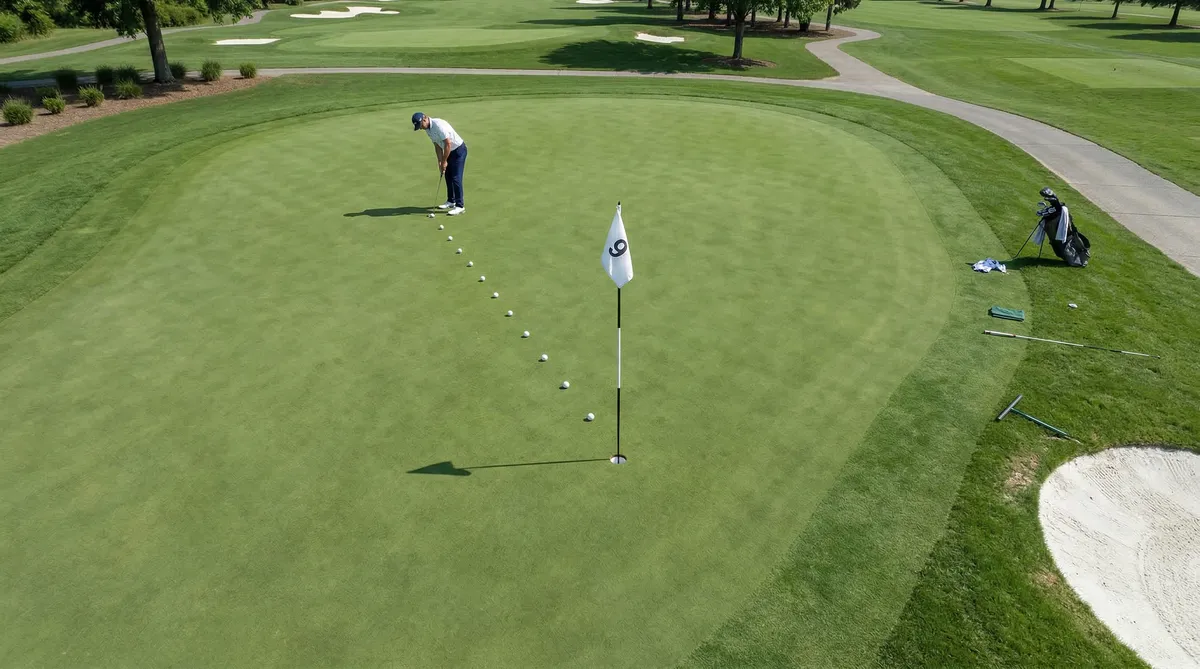
Start on the green. Three drills, three minutes each.
- 5 putts from 3 feet — make all 5, restart on a miss - 10 putts from 10 feet — count makes - 10 lag putts from 30 feet — count how many finish within 3 feet of the hole
This warms up your stroke, gets your eye in, and gives you three numbers you can compare across sessions.
Pick one skill — chipping today, pitching next session. Use a scored drill.
A simple one for chipping: ten chips from 10 yards to a flag. Count how many finish within 3 feet. Aim for at least 5 of 10. If you’re consistently doing 7+, increase the distance to 15 yards.
A simple one for pitching: 10 pitches from 50 yards. Count how many finish within 5 yards of the flag. Aim for 7 of 10.
Five minutes of block: 10 7-irons to a target, all the same shot, focusing on contact.
Ten minutes of random: alternating clubs (8-iron, 6-iron, 4-iron, hybrid) and targets, with a 30-second pause between shots. This simulates round conditions far better than 30 straight 7-irons.
Finish with a pressure drill. Ten 4-foot putts. Make them all consecutively. If you miss, restart. Walk off the green when you’ve made 10 in a row.
This trains the kind of putt you face on the 17th green when there’s something on the line. It also gives you a clear “session passed/failed” gate that builds focus over time.
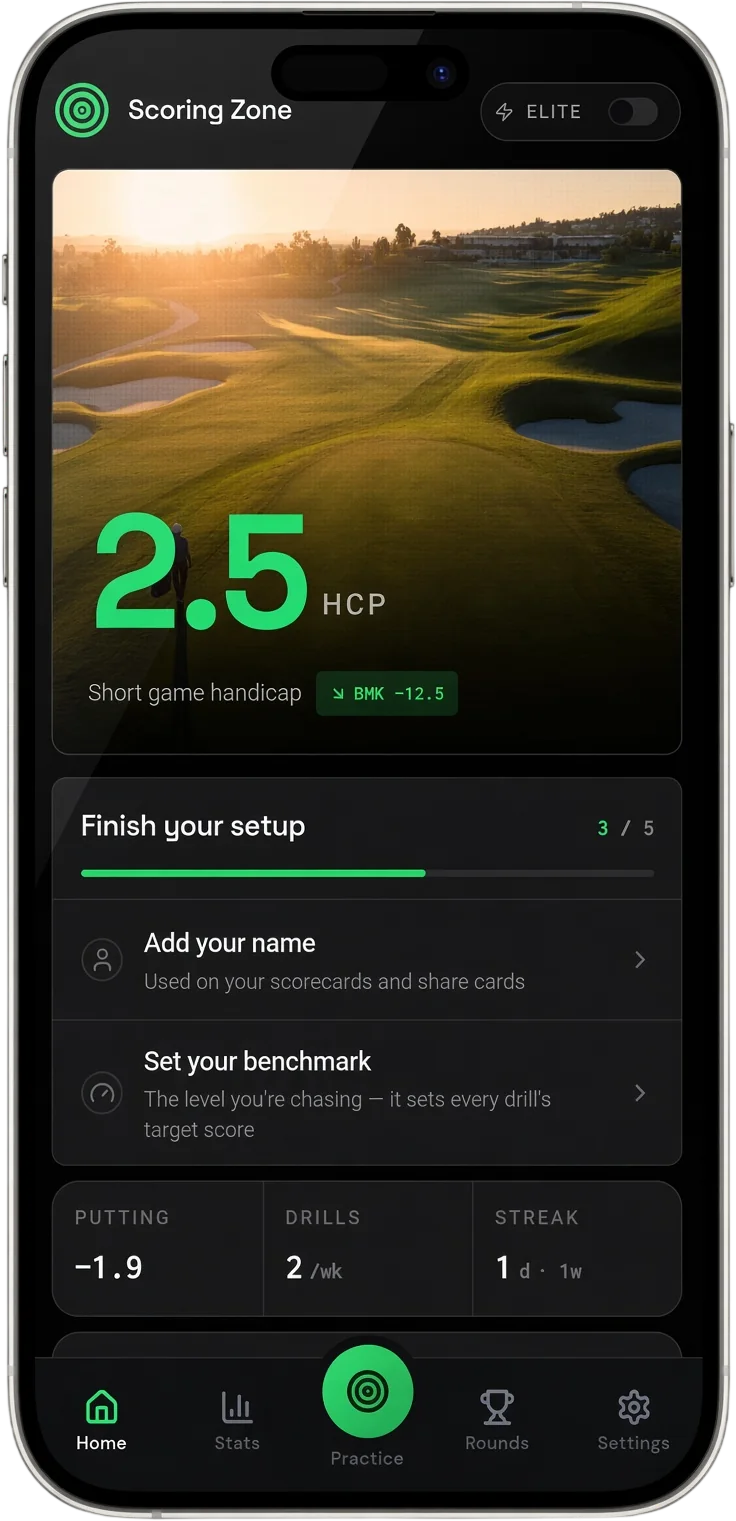
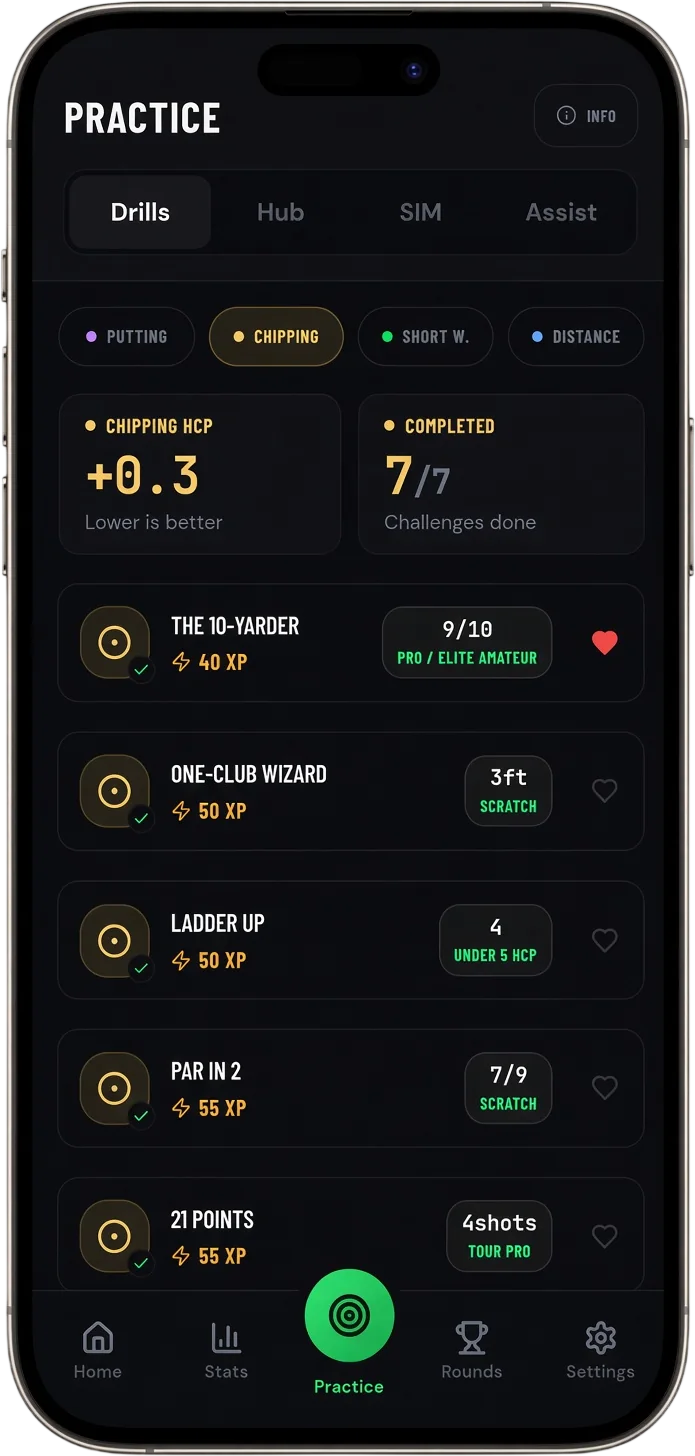
Scoring Zone is built around scored, pressure-based drills like these — every session is logged, every drill has a benchmark for your handicap level, and you can see whether your numbers are actually moving from one week to the next.
For a deeper short-game-specific routine, see this guide.
How to Practice Short Game →Three numbers tell you everything:
1. Practice scores trending up. If your “10 chips inside 3 feet” number is going from 4 → 5 → 6 → 7 across sessions, you’re improving. If it’s flat, the drill isn’t doing anything. 2. Round stats trending the right way. Up-and-down percentage, putts per round, three-putt frequency, scrambling percentage. Track over 10–15 rounds. The stat furthest from average for your handicap is your bottleneck. 3. Handicap dropping over time. This is the lagging indicator. If your practice scores are improving and your round stats are improving but your handicap isn’t moving, something on the course (course management, mental game) is leaking strokes.
If none of these three numbers is moving, your practice isn’t working. Change something — the drill, the focus, the time allocation — and look again in three weeks.
Effective golf practice has three ingredients: a specific skill goal, scored repetitions with feedback, and a mix of block and random practice. Block practice (same shot, repeated) builds the move. Random practice (different clubs and targets) transfers it to the course. Allocate at least 50% of your time to short game — that’s where 60% of your strokes happen.
Deliberate practice is structured, focused practice on a specific skill at the edge of your current ability, with immediate feedback. In golf that means: pick one thing (say, lag putting from 30 feet), set a measurable target (8 of 10 within 3 feet), and track every session. Mindless ball-beating on the range is the opposite of deliberate practice.
Quality beats quantity. 45–60 minutes of focused, scored practice will outperform 3 hours of unstructured range time. Tour pros structure their sessions in 20-minute blocks with rotating skill focus. For amateurs, 3–4 sessions per week of 45 minutes each — with at least 2 of them being short game — moves the needle faster than weekend marathons.
Short game. About 60% of shots in an average round happen inside 100 yards, but most amateurs spend 80%+ of their practice time on full swing. Flip the ratio: spend at least half your practice time on chipping, pitching, and putting. The improvement curve from short game practice is steeper than from range work for everyone except true beginners.
7 days free
Then from $4.99/month · Cancel anytime
Start your 7-day free trial
35+ drills & tests · Short Game Handicap · Performance tracking