Practice & Improvement

How to Practice Short Game
The Complete Guide to Practising Smarter Inside 100 Yards
April 2, 2026 · 14 min read · Stephen Pickering
The Complete Guide to Practising Smarter Inside 100 Yards
April 2, 2026 · 14 min read · Stephen Pickering
You spend an hour at the range pounding drivers. Then you walk to the putting green, roll a few balls at the nearest hole, and call it a day. Sound familiar? You just spent 80 percent of your practice time on the part of the game that accounts for 40 percent of your shots — and almost nothing on the part that accounts for the rest.
Knowing how to practice short game is the single biggest lever most golfers never pull. 60 percent of golf shots happen inside 100 yards. Yet most golfers spend 80 percent of practice time on full swing. The maths does not work, and neither will your scores until you fix it. This guide gives you the framework, the time splits, and two complete practice plans you can use this week.
There is a reason the driving range is packed and the chipping green is empty. Hitting drivers feels productive. The ball goes far, the sound is satisfying, and you can see instant feedback. Short game practice offers none of that dopamine. A good chip looks boring. A solid lag putt is invisible to anyone watching. So golfers gravitate toward what feels good instead of what works.
The result is predictable. You can stripe a 7-iron 170 yards but you chunk a chip from 30 yards out. You hit 11 greens instead of your usual 7 — but your score barely changes because you are still three-putting and failing to get up and down. The full swing was never the bottleneck. The short game was.
Even golfers who do practice short game usually practice it wrong. They dump a bucket of balls next to the green and hit the same chip over and over from a flat lie. No target, no scoring, no plan. This is the equivalent of going to the gym and doing random exercises for 45 minutes — you might break a sweat, but you will not get stronger in any measurable way.
Effective short game practice has three things that aimless practice does not: a plan for what to work on, a scoring system that creates accountability, and a way to track whether you are improving. Without all three, you are just going through the motions.
Short game is not one skill. It is at least four: putting, chipping, pitching, and bunker play. Each has different mechanics, different distance ranges, and different practice needs. Most golfers, when they do practise short game, focus on one — usually putting — and ignore the rest. A complete short game practice plan touches all four areas in every session, even if you only spend five minutes on some of them.
Every short game session should include time on four areas. The proportions shift based on how much time you have, but none should be skipped entirely:
Putting (40–50% of time): Putting accounts for the most strokes in every round. It deserves the biggest share. Focus on three sub-skills: short putts inside 6 feet (these are the ones you must make), lag putts from 20+ feet (these prevent three-putts), and mid-range putts from 8–15 feet (these are where you steal strokes).
Chipping (20–25% of time): Chips are the shots from just off the green where the ball spends most of its journey on the ground. Practice from different lies — tight, fluffy, uphill, downhill. Vary your landing spots. The goal is to get the ball rolling like a putt as quickly as possible.
Pitching (15–20% of time): Pitches are the 20–50 yard shots that carry most of the way and stop quickly. These require distance control that only comes from deliberate practice with specific targets. Hit to a 30-yard target, then 40, then 50. Score yourself on proximity.
Bunker play (10–15% of time): Even 5 minutes in the bunker each session adds up. Focus on getting out every time first, then work on distance control. Most amateurs leave bunker shots in the sand — simply making consistent contact is a massive win.
Do not spend 30 straight minutes on one area. Rotate between skills every 8–12 minutes. This mirrors what happens on the course, where you shift between putting, chipping, and pitching throughout a round. Your brain needs to switch gears, and practicing the switch itself is valuable.
There is also a focus benefit. After 12 minutes on one skill, attention starts to drift. Switching resets your concentration. You come back to each area fresher, which means higher-quality reps.
The single most important change you can make to your short game practice is to keep score. Every drill, every session. It does not need to be complicated — a target number to beat, a streak to extend, a par to break. What matters is that there is a consequence to each shot.
Scored practice does two things unscored practice cannot. First, it creates the mild pressure that simulates course conditions. Second, it gives you data. You cannot improve what you do not measure. When you know your average up-and-down rate from practice sessions, you can see whether this week is better than last week. That feedback loop is how real improvement happens.
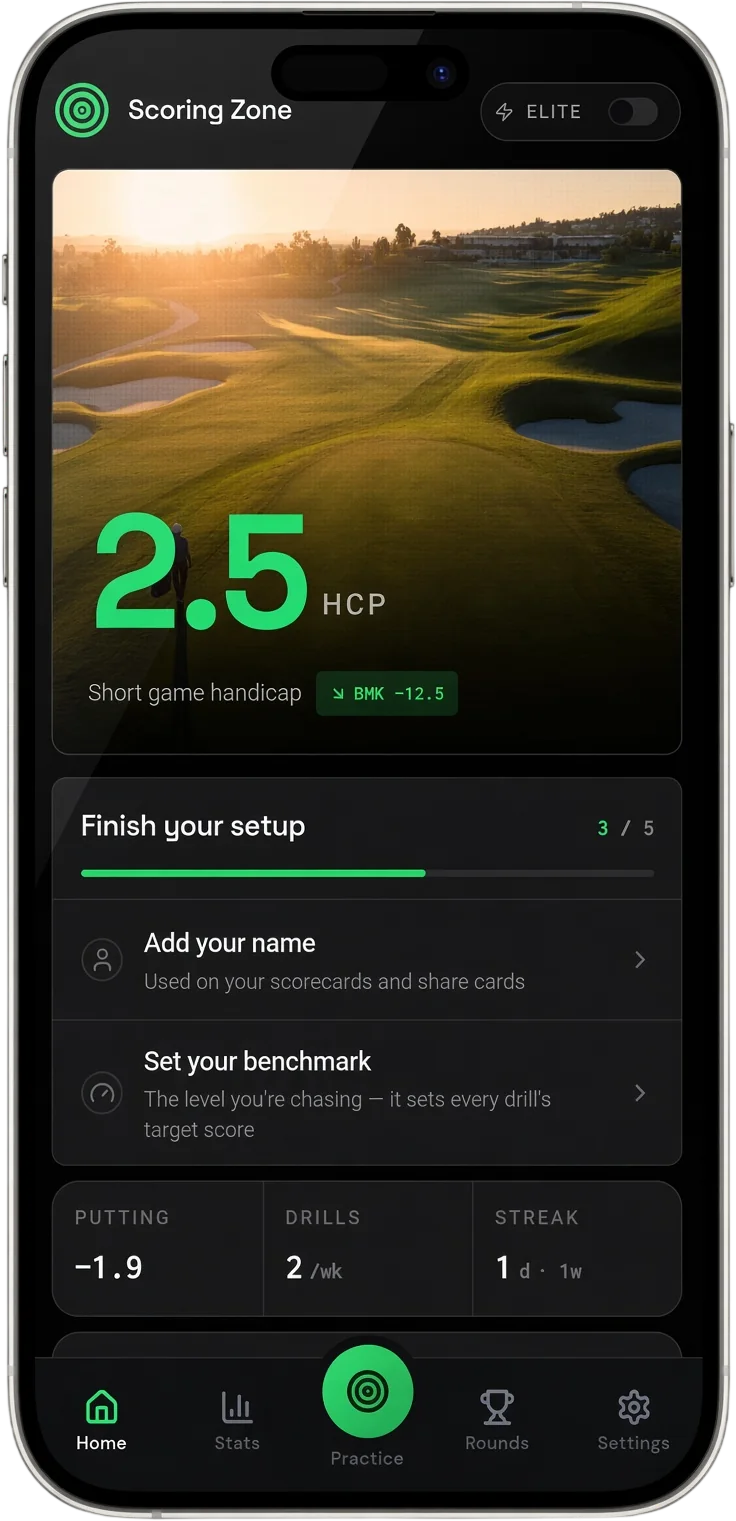
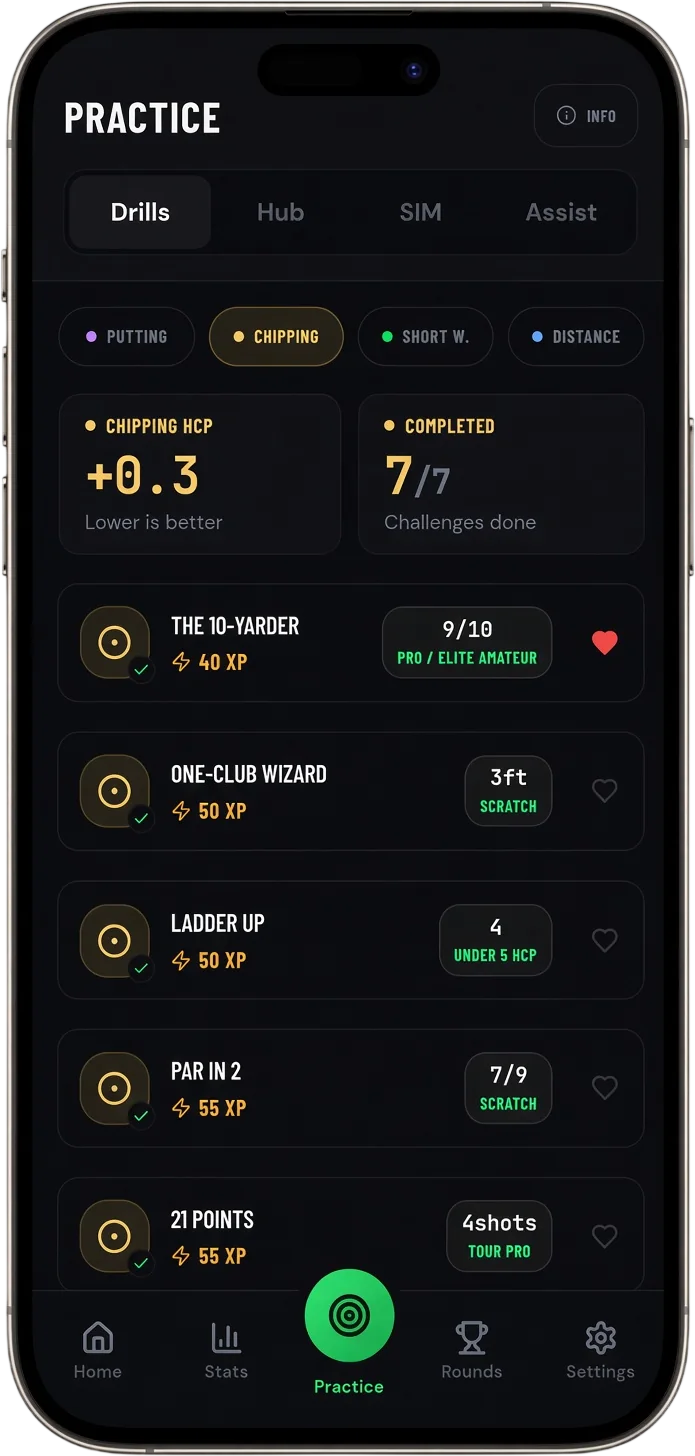
Need scored chipping drills with automatic tracking and skill-level benchmarks?
See Chipping Drills →This is for golfers who arrive 30 minutes before a round or squeeze in a quick session after work. It is tight, structured, and covers all four areas. No wasted time.
Putting — Short makes (8 min): Place 4 balls at 3 feet, 4 feet, 5 feet, and 6 feet. Work through all four distances. Your target: make 12 out of 16. If you hit the target, move each ball back one foot and repeat. Track your score.
Chipping — Up and down game (7 min): Drop 10 balls around the green in different positions — some tight lies, some rough, some uphill. Chip each ball and putt out. Par for each ball is 2. Your target: 22 or under for 10 balls. This is the most game-like short game drill you can do because it mirrors exactly what happens on the course.
Pitching — Distance ladder (7 min): Pick three targets at 20, 30, and 40 yards. Hit 3 balls to each target. Score 2 points if the ball finishes within 10 feet, 1 point if within 20 feet, 0 if outside. Your target: 12 out of 18 possible points.
Putting — Lag putts (5 min): Find the longest putt on the green. Hit 10 balls. Score 1 point for every ball that stops within 3 feet. Your target: 7 out of 10. This is your three-putt prevention drill.
Bunker — Escape drill (3 min): Hit 5 bunker shots. The only goal is to get every ball out of the sand and onto the green. Track your percentage. Once you can go 5 for 5 consistently, start aiming for a specific quadrant of the green.
That is 30 minutes. Every minute is accounted for. Every area is touched. Every drill has a score. Bring a notepad or use your phone — write down the numbers before you leave.
This is the deep practice session. Use it once or twice a week when you have time to work on your game with real intention. The extra 30 minutes let you add variety, increase reps, and build more pressure into each drill.
Putting — Gate drill warm-up (5 min): Set two tees just wider than a ball, 3 feet from the hole. Putt through the gate. This calibrates your stroke and gets your putter face square. Make 10 through the gate before moving on.
Putting — Clock drill (10 min): Place 8 balls in a circle around the hole at 4 feet. Make all 8 in a row. Miss one and start over. This is pure pressure putting. Once you complete the circle, move to 5 feet and try again. Track how many restarts you need.
Chipping — Three clubs, one target (10 min): Pick a hole 15 feet onto the green. Chip to it with your sand wedge, pitching wedge, and 8-iron — 5 balls with each club. Score how many finish inside 6 feet. This teaches you to see multiple shot options around the green, which is exactly what good chippers do on the course.
Pitching — Scoring zone ladder (10 min): Set targets at 20, 30, 40, and 50 yards. Hit 5 balls to each target. Score 2 points for inside 10 feet, 1 for inside 20 feet. Your target: 20 out of 40 points. Rest a minute between distances to reset your feel — this prevents your brain from going on autopilot.
Bunker — Distance control (8 min): Place a towel on the green at 15 feet from the bunker, then another at 30 feet. Hit 5 balls to each towel. Score 1 point for each ball that finishes within a club-length of the towel. Your target: 5 out of 10.
Chipping — Worst-lie challenge (7 min): Find the worst lies around the green — bare patches, deep rough, downhill to a tight pin. Hit 8 balls from these spots and putt out. Par is 2 for each. This builds confidence for the shots that make you nervous on the course. Golfers who only practise from perfect lies panic when they get a bad one.
Putting — Pressure finish (10 min): Play Par 18. Pick 9 spots around the green at varying distances. From each spot, putt to the hole — two putts is par. Par for the round is 18. This is your session-ending competition. Track the score every time you do this plan and watch the number drop over weeks.
The 60-minute plan hits every area twice and builds in genuine pressure through scored drills with restart penalties. It is the kind of practice routine that tour players use — adapted for amateurs who do not have all day.
You do not need a spreadsheet with 40 columns. Track three numbers and you will have a clear picture of whether your short game practice is translating to lower scores:
Up-and-down percentage: After every round, count how many times you missed the green and how many of those you got up and down in two shots. This is the single best measure of overall short game performance. Tour average is around 60 percent. Most amateurs are below 30 percent. Getting from 25 to 40 percent can save you 3–5 shots per round.
Three-putts per round: Count them. The average mid-handicapper three-putts 3–5 times per round. That is 6–10 wasted strokes. If this number drops by even two per round, you are looking at a real handicap reduction.
Practice drill scores: This is why scoring every drill matters. When your Clock Drill completion rate goes from needing 5 restarts to 1, or your up-and-down game goes from 26 to 20, you have proof that the practice is working — even before it shows up on the course. Practice scores lead course scores by about 2–3 weeks.
Do not check after every session. That is noise. Check weekly. Compare this week’s practice scores to last week’s. Compare this month’s round stats to last month’s. Improvement in short game is gradual — but it is the most consistent kind of improvement in golf because it relies on touch and repetition, not swing changes that take months to groove.
If you practise short game three times per week with scored drills and track the numbers for six weeks, you will see measurable improvement. That is not a promise based on hope — it is what happens when you apply structure to the part of the game with the highest return on practice time.
After three weeks, look at your numbers. If your putting scores are improving but your up-and-down percentage is flat, you need more chipping and pitching time. If your lag putting is solid but you are missing short putts on the course, shift more time to the 3–6 foot range. The practice plan is a starting point. Your data tells you where to go next.
This is where most golfers give up — not because the plan does not work, but because they never measured anything, so they have no evidence that it is working. Score your drills. Track your rounds. Let the numbers tell you what to do.
See your short game stats trend over time — up-and-down rate, three-putts, proximity to hole, round by round.
Round Stats →30 to 60 minutes is the sweet spot. Anything under 20 minutes is too short to cover putting, chipping, and pitching with enough reps. Anything over 90 minutes and fatigue sets in, which makes practice sloppy. Two to three focused sessions per week beats one long, unfocused one.
At least 50 percent. Since 60 percent of golf shots happen inside 100 yards, giving half your practice time to short game is the minimum. Most tour players spend 60 to 70 percent of practice on short game and putting. If you currently spend 80 percent on full swing, start by flipping the ratio.
You can practice putting on a home mat with scored drills like the clock drill or streak builder. For chipping, use foam balls or almost golf balls in your garden or living room. Focus on contact quality and clubface control. You will not get distance calibration indoors, but you will build the mechanics that matter most.
Putting. It accounts for roughly 40 percent of all strokes in a round. If you only have 30 minutes, spend 15 on putting and split the remaining 15 between chipping and pitching. If you have 60 minutes, give putting 20 to 25 minutes and divide the rest across chipping, pitching, and bunker play.
Read the complete guide to improving your short game.
The Complete Short Game Guide →7 days free
Then from $4.99/month · Cancel anytime
Start your 7-day free trial
35+ drills & tests · Short Game Handicap · Performance tracking