Golf Basics

How to Play Golf: A Beginner’s Guide to the Basics
Equipment, Rules, Scoring, Etiquette — and Where to Actually Start
April 25, 2026 · 11 min read · Stephen Pickering
Equipment, Rules, Scoring, Etiquette — and Where to Actually Start
April 25, 2026 · 11 min read · Stephen Pickering
Key takeaway: You only need 5 clubs, 5 basic rules, and a 9-hole twilight tee time to play your first round. The fastest improvement comes from short game practice (60% of shots happen inside 100 yards), one early lesson with a pro to set grip and posture, and tracking three numbers from day one: fairways hit, greens in regulation, and putts per round.
Most beginner golf guides drown you in jargon before you’ve held a club. This one doesn’t. If you’ve never played a round, never picked up a 7-iron, and aren’t sure what a bogey is — start here.
This guide walks you through how to play golf from the very first decision (which clubs do I actually need?) to the moment you finish your first 9-hole round. The basic rules, the scoring system, the etiquette that stops other golfers glaring at you, and the practice priorities that will get you off the bottom rung fastest. No fluff. Just the things a coach would tell you in your first lesson.
Golf is a target sport. You hit a small ball from a designated starting area (the tee box) into a hole in the ground (the cup) on a manicured patch of grass (the green). The fewer strokes it takes you, the better.
A standard golf course has 18 holes. Each hole has a “par” — the number of strokes a competent golfer is expected to take. Par 3s are short, par 4s are medium, par 5s are long. Add up all the pars and you get the total course par, usually 70–72.
That’s the entire game in three sentences. Everything else — the clubs, the rules, the etiquette — is built around getting the ball into 18 holes in as few strokes as possible.
Walk into a golf shop and you’ll be sold a 14-club bag for £600. Don’t do it. A beginner needs exactly five clubs:
- Driver — for tee shots on long holes - 7-iron — your all-purpose mid-range club from the fairway - Pitching wedge — for shots from 80–110 yards and chips around the green - Sand wedge — for bunker shots and short, high pitches - Putter — for everything on the green
You can buy a beginner half-set for £100–£200 or pick up a used set on Facebook Marketplace for less. Skip the premium balls (you’ll lose them anyway), wear comfortable trainers if you don’t have spikes, and use any glove you can find. The kit barely matters in your first year.
Buy 12 cheap golf balls (any brand under £15 a dozen). You will lose at least three of them in your first round. Buy a packet of 50 wooden tees — you only use a tee on the par 3 and par 4 tee boxes, not on every shot.
That’s it. No rangefinder, no GPS watch, no glove conditioner, no swing trainers. The cheapest path into golf is genuinely cheap.
Golf has hundreds of rules. You need to know five of them to play your first round without breaking anything important.
1. Play it as it lies. Wherever your ball stops, that’s where you hit your next shot from. Don’t move it, don’t kick it, don’t improve the lie. 2. Count every stroke. Every swing where you intend to hit the ball counts as a stroke, even if you miss it completely. 3. Lost ball or out-of-bounds: one-shot penalty. Drop a new ball near where you lost it and add a penalty stroke to your score for that hole. 4. Hazards (bunkers and water): don’t ground your club. When you address a ball in a bunker or water hazard, your club shouldn’t touch the sand or water before you swing. One-shot penalty if it does. 5. Keep up with the group ahead. If you’ve taken 8–10 shots on a hole and the group behind is waiting, pick up the ball and move on. This isn’t a rule, it’s etiquette — but it’s the most important “rule” for a beginner.
Two coloured stakes and lines mark special areas:
- White stakes: out of bounds. One-shot penalty, replay the shot. - Yellow or red lines/stakes: penalty area (water hazards). One-shot penalty, drop a ball in a permitted location and play on.
That’s enough rules-knowledge to play 18 holes without embarrassing yourself.
On every hole, you compare your score to the hole’s par.
- Eagle: 2 under par on the hole (rare for a beginner — and often the round of your life) - Birdie: 1 under par on the hole (also rare for a beginner) - Par: equal to par (a great score on any hole when you’re starting out) - Bogey: 1 over par (a very respectable beginner score) - Double bogey: 2 over par - Triple bogey: 3 over par
A new golfer playing a par-72 course will typically shoot 100–115. That means somewhere between 28 and 43 shots over par. You’re looking for bogeys and double bogeys, with the occasional par mixed in. Don’t measure yourself against a tour pro shooting 70 — measure yourself against the version of you who teed off three months ago.
Most beginners play stroke play (count every stroke, lowest total wins). But you’ll hear about Stableford — a points-based system where double bogey or worse gets zero points, bogey gets 1 point, par 2 points, birdie 3 points. It’s friendlier for beginners because a disaster hole doesn’t ruin your entire scorecard. If your local club runs Stableford competitions, that’s a great place to start playing in a group.
For a complete glossary of every term you’ll hear at the course, see this beginner guide.
Golf Scoring Terms Explained →Golf etiquette is what separates a beginner the regulars are happy to play with from one they aren’t. Most of it is common sense:
- Don’t talk while someone is swinging. Wait until the ball is in flight before speaking, walking, or rummaging in your bag. - Repair the course as you go. Replace divots in the fairway. Rake bunkers after you’ve played from them. Fix any pitch mark your ball makes on the green. - Don’t walk in someone’s putting line. When you’re on the green, watch where you step — the line between another golfer’s ball and the hole is sacred. - Keep pace. Be ready to play when it’s your turn. If your group is consistently a hole behind the group ahead, let the group behind play through. - No phone calls on the course. Texting and silent use is fine. Loud calls aren’t.
You’ll get one or two things wrong in your first round. Every regular golfer did. Just pay attention, watch the better players in your group, and pick it up as you go.
A typical practice facility has three zones:
- Driving range: a big field with tees and target greens. You hit balls with full swings using your driver, irons, and wedges. Useful for learning ball-striking — but limited, because every shot is from the same flat lie with no consequences. - Short game area: a chipping green with bunkers. You hit chips, pitches, and bunker shots to a target green. This is where most amateurs underspend their practice time. - Putting green: for putting practice. Critical, but boring without structure.
The mistake almost every beginner makes is spending 80% of their range time on the driver. Don’t. The driver is one shot per hole maximum. You’ll hit twenty putts and ten chips on most rounds. Spend at least half your practice time inside 50 yards.
Allocate your practice time roughly like this:
- 50% short game (chipping, pitching, putting) - 30% irons (mid and short irons — the clubs that actually hit greens) - 20% driver and woods
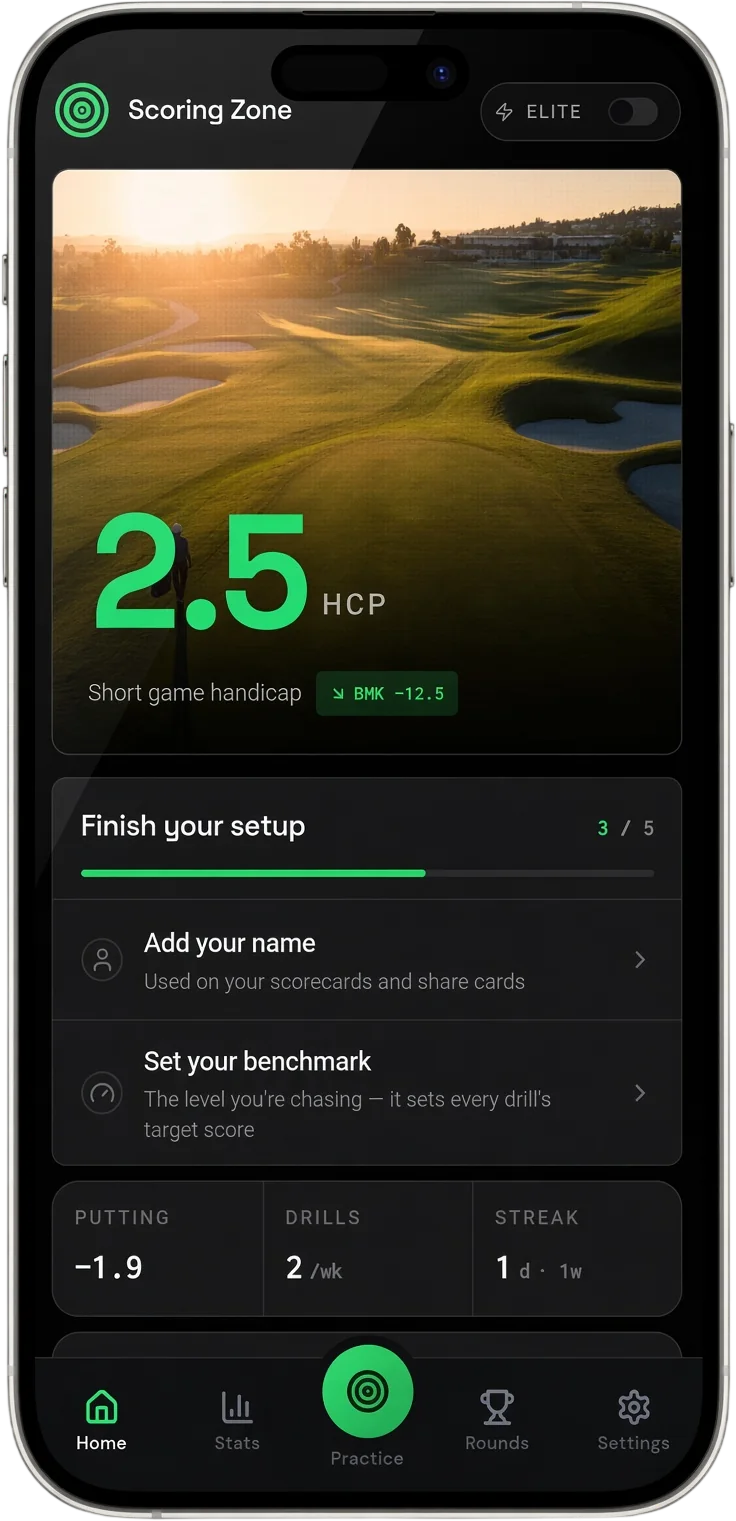
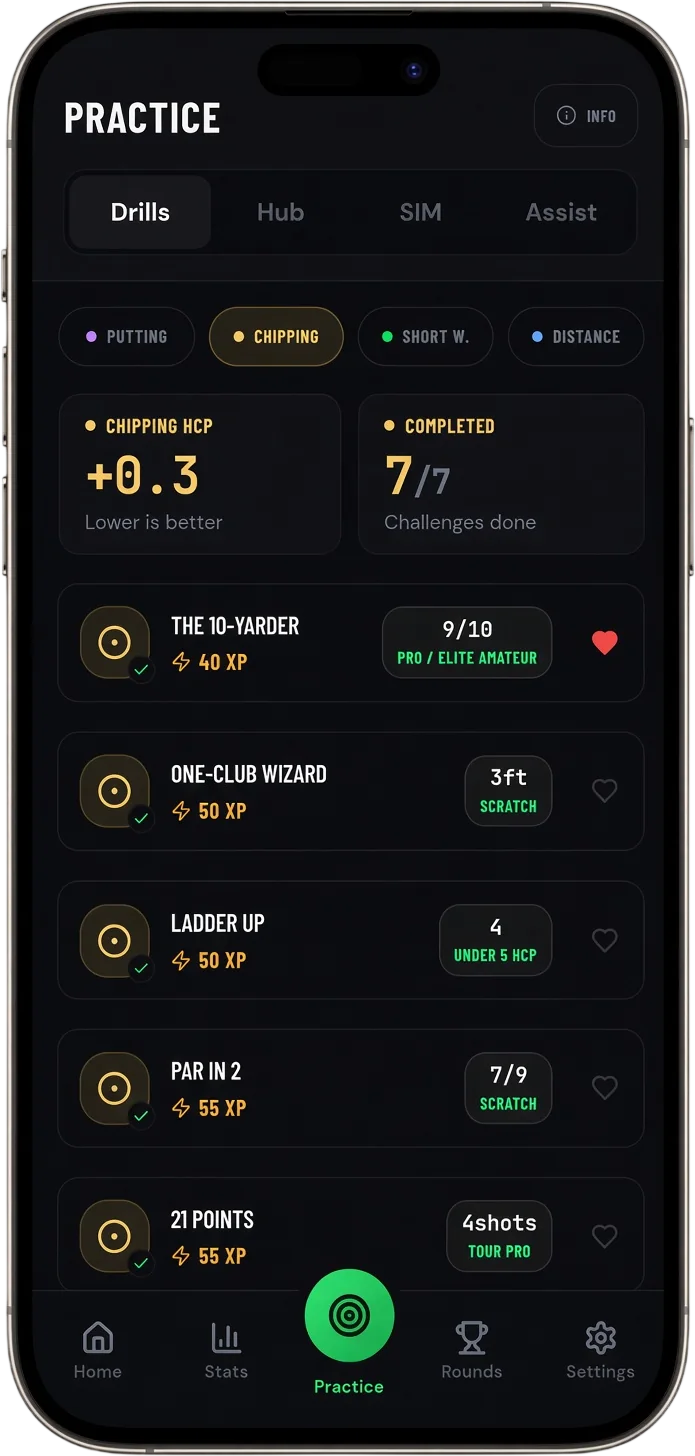
This ratio reflects how shots are distributed in an actual round. Around 60–65% of all shots in golf happen inside 100 yards. Practising in proportion to that fact is the fastest way to drop scores. Scoring Zone is built specifically for this side of the game — every drill is scored, and your progress against benchmarks for your skill level is tracked round by round.
For a structured starter routine, here’s a beginner-friendly practice plan.
Golf Practice Tips for Beginners →Don’t book 18 holes for your first time. Book 9 holes at twilight (mid-week, late afternoon) when the course is quiet. Play with one friend or solo. You’ll be slower than experienced golfers, you’ll lose balls, you’ll hit shots into other fairways. All of that is fine if no one is breathing down your neck.
Tell the pro shop you’re a beginner. They’ll often pair you with patient golfers, give you a quieter tee time, and let you skip holes that are getting away from you.
Don’t aim for a score on your first round. Aim for these instead:
- Make solid contact with the ball at least once on every hole. - Finish each hole in 8 strokes or fewer (pick up if you go past). - Don’t lose more than three balls. - Don’t slow down the group behind you.
If you walk off the 9th green having achieved those four things, you’ve had a great first round. The score will come later.
The single best thing a beginner can do is take one lesson with a PGA professional in their first month. Not ten lessons. One. The lesson should cover grip, posture, alignment, and ball position. Get those four fundamentals right and you’ll save yourself two years of bad-habit golf.
After that lesson, practise what they showed you for at least six weeks before booking another. Most golfers take a lesson, change four things at once, get worse, and quit. One change at a time, six weeks of practice each — that’s how you actually improve.
The scorecard hides everything. You can shoot 95 with three triple bogeys and twelve pars, or shoot 95 with eighteen identical bogeys. Same score. Completely different rounds. Completely different practice priorities.
Track three numbers from day one: how many fairways you hit off the tee, how many greens you hit in regulation, and how many putts you take per round. Those three stats tell you exactly where the strokes are leaking. Scoring Zone’s round stats and short game assessments do this automatically — and after a couple of rounds, you get strokes gained data that benchmarks you against your own handicap.
Start with a half-set of clubs (driver, 7-iron, pitching wedge, sand wedge, putter), book a lesson to learn the basic grip and posture, then play a 9-hole twilight round at a quiet local course. Don’t buy a full bag, expensive shoes, or premium balls until you’ve played 10 rounds.
Play the ball as it lies, count every stroke, take a one-shot penalty for lost balls or out-of-bounds, and don’t ground your club in a hazard. Pick up after 8–10 shots on a hole if you’re holding up the group behind. Most other rules can be learned over your first season.
You can play your first 9-hole round within a month of starting, even if you shoot 70 over par. Reaching a 100-shooter level takes 6–12 months of regular play. Breaking 90 typically takes 2–3 years for most amateurs. The fastest improvement comes from short game practice — 60% of shots happen inside 100 yards.
A beginner only needs five clubs: a driver, a 7-iron, a pitching wedge, a sand wedge, and a putter. This covers tee shots, approach shots, chips around the green, bunker play, and putting. A full 14-club set isn’t needed until you’ve played for at least a season and know what gaps you actually need to fill.
7 days free
Then from $4.99/month · Cancel anytime
Start your 7-day free trial
35+ drills & tests · Short Game Handicap · Performance tracking