Mental Game

How to Handle Pressure in Golf: 7 Practical Tactics
Routines, breathing, and scored practice that transfer to the course
May 8, 2026 · 9 min read · Stephen Pickering
Routines, breathing, and scored practice that transfer to the course
May 8, 2026 · 9 min read · Stephen Pickering
Key takeaway: Pressure isn’t a personality trait — it’s a predictable nervous-system response you can train. Build a repeatable pre-shot routine, breathe long on the exhale, focus on process over outcome, and practise scored drills with consequence so the body learns the response before the next club championship.
You’ve stood over a 4-foot putt to win the match. Hands tight, breathing shallow, mind racing. The same putt you’d tap in without thinking on a Tuesday now feels like the most important stroke of your life — and you push it three feet past.
Pressure in golf isn’t bad luck. It isn’t a personality flaw. It’s a predictable physiological response that costs amateurs 3–5 strokes per round in club competitions, money matches, and the closing holes of any round that matters. The good news: every part of how to handle pressure in golf is trainable. The pre-shot routine, the breathing, the process focus, the scored practice — none of it is mystical. Here’s the system tour pros use, broken down for the rest of us.
Pressure triggers the sympathetic nervous system. Cortisol and adrenaline spike. Heart rate jumps 20–30 beats per minute. Breathing shortens to the upper chest. Fine motor control — the exact thing you need for a putting stroke or a delicate chip — degrades measurably.
Studies on golfers under tournament pressure show swing tempo speeds up by 10–15%. Grip pressure climbs by up to 50%. Your eyes narrow their focus to the ball at the cost of the target. None of this is in your head — it’s in your nervous system, and trying to “just relax” doesn’t work because the body has already decided this matters.
Most golfers respond to pressure by gripping tighter, swinging harder, and thinking more about the result. Every one of those instincts is wrong. Tighter grip kills feel. Harder swings break tempo. Outcome focus pulls your attention away from the shot itself.
Tour pros aren’t free of pressure — they feel it on every shot that matters. They’ve trained themselves to do specific, repeatable things when it shows up. That’s the difference. Pressure is a skill, and like any other golf skill, it improves with structured practice.
A pre-shot routine is the single most powerful pressure tool in golf. It gives your conscious mind something specific to do, which crowds out the noise about consequences. Pick 4–5 steps you do identically on every shot:
1. Stand behind the ball, pick your target 2. Two practice swings with intent 3. Step in, set the club face 4. One look at the target 5. Trigger — go
Time it. A solid routine takes 10–15 seconds from selection to swing. The same length, every time. Under pressure, the routine carries you. Without one, your mind has nothing to anchor to and the nerves take over.
The fastest way to dial down a sympathetic stress response is to extend your exhale. Inhale for a count of 4, exhale for a count of 8. Two cycles is enough — you’ll feel your shoulders drop, your jaw unclench, and your hands soften on the grip.
Do it during the routine, not over the ball. Once you start your final waggle, the breathing work is done — focus shifts to the shot.
Under pressure, vague targets become impossible. “Hit the green” gives the brain too much room to wander. “Hit the right edge of the front bunker” gives it a single point.
The smaller the target, the less mental space remains for outcome anxiety. Pros pick targets the size of a dustbin lid. Most amateurs aim at the entire green and wonder why they push it long-right.
Process language: “smooth tempo,” “balanced finish,” “clean strike,” “head still.”
Outcome language: “don’t go in the water,” “don’t 3-putt this,” “don’t be the guy who blew it.”
Your brain doesn’t process negatives well — “don’t go in the water” is heard as “water.” Replace every outcome thought with one process cue. Stick to that cue from the moment you pick the club to the moment the ball leaves the club face.
Build a repeatable routine you can lean on under pressure.
Pre-Shot Routine Guide →When you’re nervous, you walk faster. When you walk faster, you arrive at the ball still in fight-or-flight, and the routine starts on the back foot. Deliberately slow your walking pace by 20% on the back nine of any round that matters. It looks like nothing. It does everything.
Tour pros are walking metronomes. Watch any closing nine of a major and count their steps. They’ve trained their physical pace because mental pace follows it.
You will hit a bad shot under pressure. The question is what happens next — one bad shot or three.
Pick a physical reset: tug your glove, exhale hard, mutter a single word (“next”). Use the same one every time. The reset breaks the spiral and tells your brain that shot is filed away.
Tiger does the club twirl. Rory exhales sharply and walks. Pick yours and use it without exception, especially after the bad shots.
Pressure compounds when you start projecting forward — “if I make this I’m 1-up with two to play.” That kind of arithmetic is poison.
Narrow your focus to the next shot, period. The closing three holes of a tight round are 9–12 individual problems, not one big one. Solve them one at a time and the score takes care of itself.
Hitting balls on a quiet range tells you nothing about how you’ll perform when the match is on the line. Real pressure practice has three ingredients: a specific target, a scoring system, and a consequence for failure.
If your drill has no fail condition — no streak that resets, no benchmark you have to hit — your nervous system stays calm, and you’re not training the thing you actually need on the course.
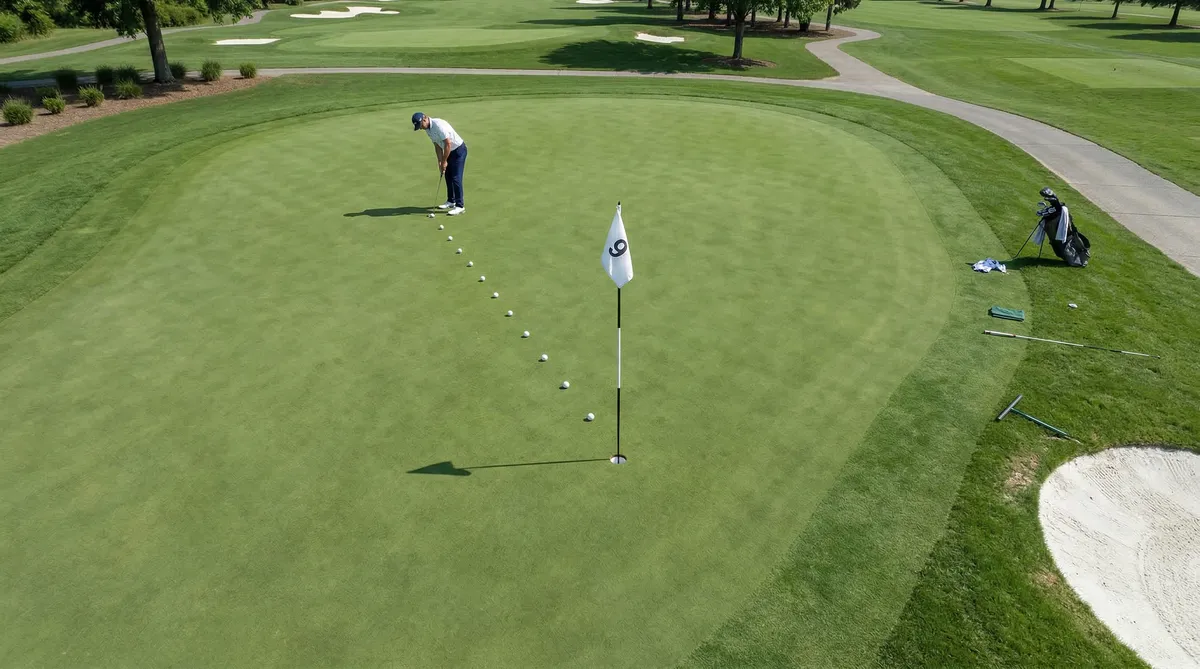
Place a ball five feet from the hole. Make 10 in a row. Miss any putt and your streak resets to zero. A 15-minute timer runs in the background — if it expires, you fail.
This is one of the closest analogues to club championship pressure you can replicate solo. By the time you’re at 7 in a row, your hands tighten and your tempo speeds up — exactly what happens on the course. Train the response now and it stops being a stranger when it shows up Sunday.
Set up nine chip shots around the green. For each one, try to hole out in two shots or fewer — chip and one putt. Even if your chip finishes close, you must putt from at least a putter length away. No gimmies.
Now add the pressure: keep a running tally and aim for a personal best. Nothing creates real practice pressure like a number on the line. A score of 5 out of 9 is solid for a mid-handicapper.
Putts from 3, 4, 5, and 6 feet — 10 putts at each distance. Score yourself out of 40. The scoring is the pressure. The first 20 are easy; the last 10 are not. You’ll feel the squeeze on putt 35 and you’ll learn what that feels like in your hands and tempo before it ever costs you a match.
Scoring Zone’s Performance Hub includes the Clutch Putt Challenge alongside other scored, time-pressured tests that simulate on-course nerves. Each one has a benchmark, a streak that resets when you miss, and a clear score so you can see whether your pressure performance is genuinely improving from session to session.
Take the full short game pressure test and get your Short Game Handicap.
Performance Hub →“I felt nervous on the back nine” is not data. “I missed 3 of 4 putts inside 6 feet on the back nine” is. Without a number, you can’t tell whether your pressure work is paying off — and you’ll convince yourself it is when it isn’t.
Track two stats over 10 rounds: putts made inside 6 feet, and shots gained or lost on the closing 3 holes vs the opening 3. If both numbers improve, your pressure game is genuinely better. If they don’t, the practice isn’t transferring and you need to add more consequence to your drills.
Pressure is the one part of golf you can’t measure on the course because every situation is different. Scored drills give you a controlled environment with the same setup, the same scoring, and the same fail conditions every time. Your number on the Clutch Putt Challenge over 30 sessions is one of the cleanest signals available for whether your pressure performance is moving in the right direction.
Round-by-round stats showing how your closing-hole performance trends over time.
Round Stats →Pressure shifts your attention from the shot to the outcome. Heart rate climbs, breathing shortens, and tempo speeds up by 10–15%. The body reacts before the mind catches up. The fix isn’t to try harder — it’s to train under pressure in practice so your nervous system stops treating it as a threat.
Shift focus from outcome to process. Pick a single task — a target, a swing thought, a breathing cue — and commit to that one thing only. A repeatable pre-shot routine grips your attention, slows your tempo down, and stops the spiral that turns nerves into a death-grip on the club.
Yes — by adding consequence to your practice. Set a target, a scoring system, and a fail condition. A drill where missing means starting over creates real stakes. Your hands tighten, your tempo speeds up, and you learn to manage it before the next club championship rather than during it.
Build a pre-shot routine you can execute identically on any shot — and expose yourself to scored, pressure-based practice 2–3 times per week. Track your performance: scored drills with benchmarks turn pressure from a vague feeling into a measurable skill that improves with reps.
Stephen Pickering
3-handicap golfer with 25 years on the course. Built Scoring Zone to bring structure and pressure to short game practice. Writes about what actually works from the practice green, not the press box.
Join golfers using scored, time-pressured drills and the Clutch Putt Challenge to turn nerves into a measurable skill. One session is enough to feel the difference.
Download Scoring Zone Free →Full access to all drills, stats, and features. No payment required.
Get Scoring Zone Free →