Short Game

How to Stop Chunking Chip Shots: Setup Fixes + 2 Drills
The Real Cause of Fat Chips — and How to Fix Them Without Changing Your Swing
April 22, 2026 · 7 min read · Stephen Pickering
The Real Cause of Fat Chips — and How to Fix Them Without Changing Your Swing
April 22, 2026 · 7 min read · Stephen Pickering
Key takeaway: 80% of chunked chips come from setup, not swing. Weight on back foot moves the low point of your swing behind the ball, so the club hits ground first. The fix: weight 60–70% on lead foot, ball slightly back, hands ahead. Three setup changes, zero swing change — and the fat chip is gone.
A chunked chip is the most frustrating shot in golf. You’re 10 yards off the green, playing for up-and-down, and the club hits the ground two inches behind the ball. Ball goes nowhere. Bogey or worse. Here’s the honest truth about how to stop chunking chip shots: it’s almost never a swing problem. It’s a setup problem. Fix three things about how you stand to the ball and the fat chip disappears — without changing your swing at all.
The low point of your swing arc is directly below your sternum. If your weight stays on your back foot through impact, your sternum is behind the ball — which means the low point of your swing is behind the ball, and the club hits the ground first.
Over 80% of chunked chips come from this one issue. You don’t have a swing fault. You have a setup fault that forces the swing to bottom out in the wrong place.
If weight is back and the ball is forward (middle or front of stance), you’re giving the club even more distance to travel before reaching the ball. Every inch of forward ball position is an inch more of ground the club has to survive before contact.
The fix is weight forward, ball slightly back, hands ahead. Three simple adjustments that change the geometry of the swing without changing the swing itself.
The psychological cause of chunking is usually fear of the opposite shot — a thin chip that races across the green. To avoid thinning it, golfers instinctively try to “scoop” the ball by dropping their hands or flipping their wrists. That scoop is exactly what causes the chunk.
The counterintuitive truth: the setup that prevents chunking also prevents thinning. Ball-first contact is ball-first contact. You’re not risking a thin shot by committing to the weight-forward position — you’re actually protecting against it.
At address, lean your sternum slightly toward the target so 60–70% of your weight is on your lead foot. Keep it there through the swing — don’t shift back on the takeaway. Chipping isn’t a full swing. It’s closer to a putting stroke with a little bit of hit.
If you can’t feel the weight shift, exaggerate it. Stand with all your weight on your lead foot. Hit 10 shots like that. You’ll feel how the low point of the swing moves in front of the ball — which is exactly where you want it.
For most standard chip shots, play the ball just back of centre (slightly toward your trail foot). This moves the ball behind the low point of your swing, which guarantees the club descends into the ball rather than picking it up or scooping.
Back ball position isn’t optional for chip shots. It’s what makes the setup work.
Your hands should be ahead of the clubhead at address and at impact. A slight forward lean of the shaft (10–15 degrees) delofts the club slightly and ensures ball-first contact.
If you can look down at address and see the ball is behind your hands, you’re set up correctly. If the ball is ahead of your hands, you’ve got a chunked shot waiting to happen.
Full guide to beginner-friendly chipping technique with setup walkthroughs.
Golf Chipping Technique for Beginners →Find a grass range or a mat with a clear visible line (chalk works best). Place a ball 1 inch in front of the line.
Set up with the ball just in front of the line. Your goal: strike the ball and have the club contact the ground at or after the line, not before it. If your divot or contact mark is behind the line, you chunked the shot.
Hit 10 balls. Count how many times the club contacts the ground on or past the line. Target: 8 out of 10. This drill gives you direct visual feedback on whether your low point is where it should be.
Move to a practice green or chipping area with a pin 10 yards away. Chip 10 balls toward the hole with a single club (wedge of your choice). Count how many finish inside 3 feet of the hole.
This drill measures the practical outcome of your setup. Ball-first contact with correct setup produces consistent distance and direction. Chunked or thinned contact produces scatter. If you’re hitting 3 out of 10 inside 3 feet, you’ve still got setup issues. 6+ out of 10 means the fix is sticking.
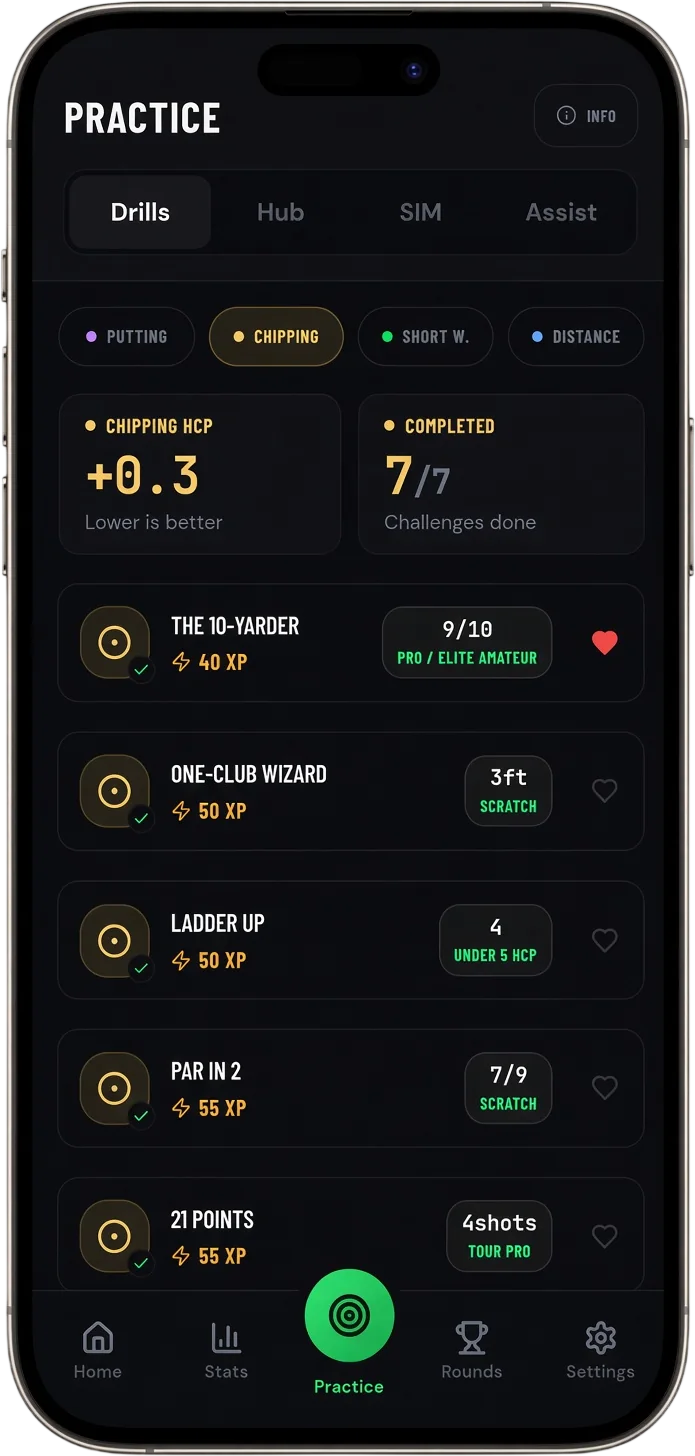
Scoring Zone’s Ten Yarder drill is built around exactly this scoring system — chip 10 balls, count how many finish inside 3 feet, benchmark against your handicap level. Every session is scored and tracked so you can see whether your setup fix is producing real improvement.
Practise with scored chipping drills that benchmark against your handicap.
See Chipping Drills →Most golfers who chunk chips don’t need a new swing. They need a setup they can repeat under pressure. The way to get that: 20 minutes of deliberate setup reps before every practice session, plus one pre-shot routine cue that checks weight, ball position, and hands.
Pick one cue. “Lean forward.” “Ball back.” “Hands ahead.” One phrase you repeat to yourself every time you stand to a chip. The brain latches onto single cues much better than checklists.
Setup fixes that work on the practice green often collapse on the course because the stakes change. Build pressure into your chipping practice with consecutive-success requirements — chip 10 balls, and if any go thin or fat, restart the count from zero.
This is how the setup becomes automatic instead of conscious. You’re training the habit against resistance, which is the only way the habit survives on the course.
The most common cause is weight distribution. If your weight stays on your back foot through impact, the low point of your swing moves behind the ball — which means the club hits the ground before the ball. Over 80% of chunked chips come from setup issues, not swing mechanics.
For standard chip shots, set up with 60–70% of your weight on your lead foot. Keep that weight forward throughout the swing — don’t shift back on the takeaway. Chipping is a short, weight-forward motion more like a putt than a full swing.
Three adjustments: weight forward (60–70% on lead foot), ball slightly back of centre, hands ahead of the clubhead. These three setup changes eliminate most chunked chips. Practise until they’re automatic — the setup fix only works if you can repeat it under pressure.
The chalk line drill: place a ball an inch in front of a visible line, set up with weight forward, and focus on striking the line on or after contact — not before it. Ten shots, count how many hit or cross the line. This trains ball-first contact through direct visual feedback.
7 days free
Then from $4.99/month · Cancel anytime
Start your 7-day free trial
35+ drills & tests · Short Game Handicap · Performance tracking