Putting
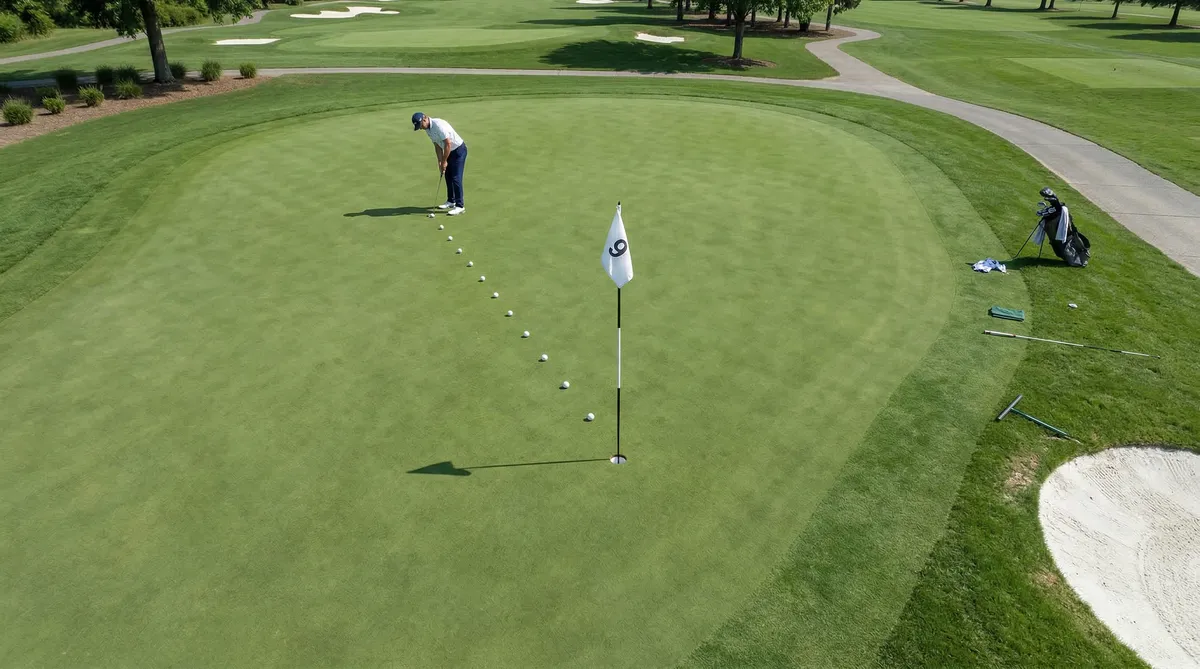
How to Putt Straight: Fix Your Start Line for Good
Control the Putter Face, Fix Your Start Line, and Hole More Putts
July 14, 2026 · 7 min read · Stephen Pickering
Control the Putter Face, Fix Your Start Line, and Hole More Putts
July 14, 2026 · 7 min read · Stephen Pickering
Key takeaway: The putter face controls roughly 80% of where a putt starts — so if your putts drift off line, look at the face before the stroke path. A square face comes from aiming the face first (then your body), setting your eyes over the ball, and letting the shoulders run the stroke while the hands stay quiet. Groove it with the gate drill, the coin toss, and the five-foot circle, then track your putts per round to prove it’s working.
If you want to know how to putt straight, forget about your stroke path for a minute. The ball doesn’t care where your putter travels nearly as much as it cares where the face is pointing at impact. Face angle controls roughly 80% of where a putt starts — so if your putts keep drifting off line, the face is the first place to look, not the arc of your swing.
The good news is that a square face is far easier to build than a perfect stroke. It comes down to how you aim, how you set up, and a couple of drills that give you instant feedback. Fix those and the ball starts where you’re looking — which is the whole point.
Research on putting is clear: the direction the face points at impact accounts for around 80% of a putt’s start line, and the path the putter travels accounts for the rest. That means you can have a slightly wandering stroke and still start putts on line — as long as the face is square when it meets the ball. Chasing a picture-perfect straight stroke while ignoring the face is fixing the wrong thing.
An open or closed face at impact almost always comes from the hands and wrists taking over — a little flick, a little steer, a squeeze of grip pressure at the last second. The putter face reacts instantly to any of it. Quiet the hands and the face stays square. That’s why the fixes below start with your setup and grip, not your stroke.
Set the putter face behind the ball and aim it at your target first — most golfers aim their feet and shoulders and let the face fall wherever. Use the line on your ball or a line on the putter to point the face exactly down your intended start line. Then build your stance around it. Face first, body second, every time.
Set up so your eyes sit directly over the ball, or just inside it. When your eyes are inside or outside that line, your view of the target distorts and you’ll aim the face without realising it. A simple check: set up, drop a ball from the bridge of your nose, and see where it lands. It should drop on or just inside your ball.
Grip lightly and even, then rock the stroke with your shoulders while your hands stay passive. The putter should feel like it’s swinging under a steady triangle formed by your arms and shoulders. Keep the length of the backswing and through-swing roughly equal so you’re accelerating smoothly through the ball, not decelerating and steering it.
Once your start line is solid, distance control is the next thing to master.
How to Improve Putting Distance Control →Push two tees into the green just wider than your putter head, a foot in front of the ball, and roll putts through the gate without clipping either tee. If the face is open or closed at impact, the ball catches a tee and you know immediately. It’s the most direct feedback you can get on your start line, and you can set it up on any carpet at home.
Place a coin about six feet away on a flat part of the green and try to roll your ball over it. A coin is far smaller than the hole, so it sharpens your focus on starting the ball on a precise line. Hit ten and count how many roll over the coin. It trains aim and face control at the same time.
Place a ball five feet from the hole on a straight putt and try to make ten in a row. Miss, and your streak resets to zero. Five feet is the distance where a square face and a confident start line matter most — miss from here and it’s a wasted shot. This one adds pressure, because the further into your streak you get, the more each putt is worth. Scoring Zone builds this exact challenge into its putting drills so you can track your streak and benchmark it against your handicap.
Get scored putting drills that track your start line and streaks automatically.
See Putting Drills →You can groove a square face all week, but the only proof that matters is on the course. Putts per round and three-putt count tell you whether your straighter start line is actually saving shots. If those numbers are falling, the work is paying off. If they’re flat, you know to keep after it rather than assume you’ve fixed it. Guessing is how most golfers convince themselves they putt better than they do — the data keeps you honest. That’s exactly why Scoring Zone scores your drills and tracks your putting stats round by round: so you’re measuring progress, not imagining it.
See your putts per round and three-putts trend over time.
Round Stats →Almost always because the putter face is slightly open or closed at impact. Face angle controls roughly 80% of where a putt starts, so even a tiny amount of face rotation sends the ball off line. It usually isn’t your stroke path — it’s the face pointing somewhere other than your target at the moment of contact.
Start with a light, even grip pressure and let the putter swing from your shoulders, not your hands. Flicking or steering with the wrists is what opens and closes the face. A gate drill — two tees just wider than your putter head — gives you instant feedback when the face is off.
On short putts, keeping the stroke short and straight works well. On longer putts the putter naturally arcs slightly inside as it lengthens — that’s normal and you shouldn’t fight it. What matters most on every putt is that the face is square to your start line at impact.
Set two tees or coins just wider than your putter head as a gate about a foot in front of the ball, and roll putts through without touching either side. You can do it on any carpet. It trains a square face and an on-line start with instant feedback, no hole required.
Stephen Pickering
3-handicap golfer with 25 years on the course. Built Scoring Zone to bring structure and pressure to short game practice. Writes about what actually works from the practice green, not the press box.
Join golfers rolling it straighter with scored, structured putting practice. It takes one session to feel the difference.
Download Scoring Zone Free →Full access to all drills, stats, and features. No credit card required — then from $4.99/month.
Get Scoring Zone Free →