Improvement

How to Improve Your Golf Score: The Data-Backed Plan
90 days, three numbers tracked, 3–5 strokes off your handicap
May 9, 2026 · 10 min read · Stephen Pickering
90 days, three numbers tracked, 3–5 strokes off your handicap
May 9, 2026 · 10 min read · Stephen Pickering
Key takeaway: Strokes-gained data is clear: amateurs lose 4–5 strokes a round to three-putts and chunked chips. Audit your stats for 5 rounds, attack the biggest leak with scored drills, lock in a 50–80 yard wedge yardage, and track three numbers every round. 3–5 strokes drop in 90 days.
Most amateurs work on the wrong things. They spend an hour on the range hitting drivers, never measuring outcomes, and wonder why their handicap doesn’t move. Strokes-gained research has been clear for over a decade: the biggest scoring gaps for amateurs are in the short game and putting — yet practice habits haven’t caught up.
This guide is the data-backed plan for how to improve your golf score in 2026. It’s not opinion. It’s the categories where amateurs actually leak strokes, the practice allocation that fixes them, and the metrics that prove it’s working. Follow the plan for 90 days and most golfers drop 3–5 strokes from their handicap. The variable isn’t talent — it’s whether your practice is structured, scored, and aimed at the right targets.
Mark Broadie’s research compared every shot type across handicap levels. The gap between a tour pro and a 15-handicapper, broken down:
- Long game (tee + approach): ~40% of the scoring gap - Short game (within 100 yards, off the green): ~25% - Putting: ~15% - Around-the-green chipping: ~20%
Long game matters more than people credit, but two things hold for amateurs:
1. Long game improvement is slow and lesson-dependent. Short game and putting improvement is fast and home-practice-friendly. 2. Most amateurs have specific, fixable leaks (three-putts, chunked chips, no wedge yardage) that mask the long-game gap. Plug those leaks first.
Two specific shots cost the average 15-handicapper roughly 4–5 strokes per round:
- Three-putts. A 15-handicapper averages 3.2 per round; tour pros average 0.5. Closing that gap = 2–3 strokes. - Chunked or skulled chips. A 15-handicapper duffs 1–2 chips per round; a 5-handicapper rarely duffs one. That’s another 2 strokes.
Fix those two faults — three-putts and chunked chips — and your score drops by 4 strokes without anything else changing. No swing rebuild, no new clubs, no extra range time.
Step 1 — Audit. Play 5 rounds tracking three numbers per hole: fairway hit (Y/N), green in regulation (Y/N), putts (count). Add up-and-down attempts if you can.
Step 2 — Identify the biggest leak. After 5 rounds, you’ll see the pattern:
- Putts averaging 38+ → putting is the leak - Three-putts averaging 3+ per round → speed control is the leak - Up-and-down percentage under 20% → chipping is the leak - GIR averaging 1–2 → approach play is the leak
Step 3 — Build the practice plan around the biggest leak. 60% of your practice time hits this category for the next 4 weeks. Don’t try to fix everything. Fix the worst thing first.
By week 5, your biggest leak should be moving. Now add the highest-ROI shot in golf: the 50–80 yard wedge.
This shot comes up 5–8 times per round for most amateurs. A 15-handicapper averages 25 yards offline from this distance. A scratch player averages 12 feet. The gap is enormous and it’s almost entirely a calibration issue.
The drill: pick a wedge (gap or sand). Pick three swing lengths — 7 o’clock (shortest), 9 o’clock (mid), 10 o’clock (longest). Hit 10 balls at each on a range with markers. Note the average yardage. Now you have three known yardages instead of guessing every wedge shot.
Scored chipping and pitching drills with proximity benchmarks.
Chipping Drills →By week 9, your scored numbers at home are improving. Now move the focus to course strategy.
Three rules:
1. Take an extra club into greens. The trouble on most courses is short. Long is usually fine. 2. No hero shots. Punch out, lay up, accept the bogey. 3. Aim for the centre of the green unless the pin is unprotected.
Most rounds where amateurs shoot a personal best involve 0 hero shots and 0 short-side errors. The score follows the decisions, not the swing.
Every practice session — whether it’s 30 minutes or 90 — uses the same allocation:
- 60% short game (putting, chipping, 50–80 yard wedges). This is where the strokes are. - 30% full swing, with a target. Pick a 30-yard-wide imaginary fairway and count fairways hit out of 10. - 10% on-course simulation. Mentally play 3 holes from your home course — tee shot, approach, then drop a ball where it ends up and play it.
This split inverts what most amateurs do. The data backs the inversion, every time.
Defstar: 16 putts from 3, 4, 5, 6 feet. Make all 16 in a row. Miss = restart. Builds the short-putt nerve that eliminates the second-stroke leak.
Lag King: 10 putts from 30+ feet. Count how many finish within 3 feet. Speed control = the cure for three-putts.
The Ten Yarder: 10 chips from 10 yards. Count how many finish inside 3 feet. The bread-and-butter chip you’ll face 6+ times per round.
Run these three drills three times a week and your scoring leaks close fast. The numbers move first; the on-course score follows 2–3 weeks behind.
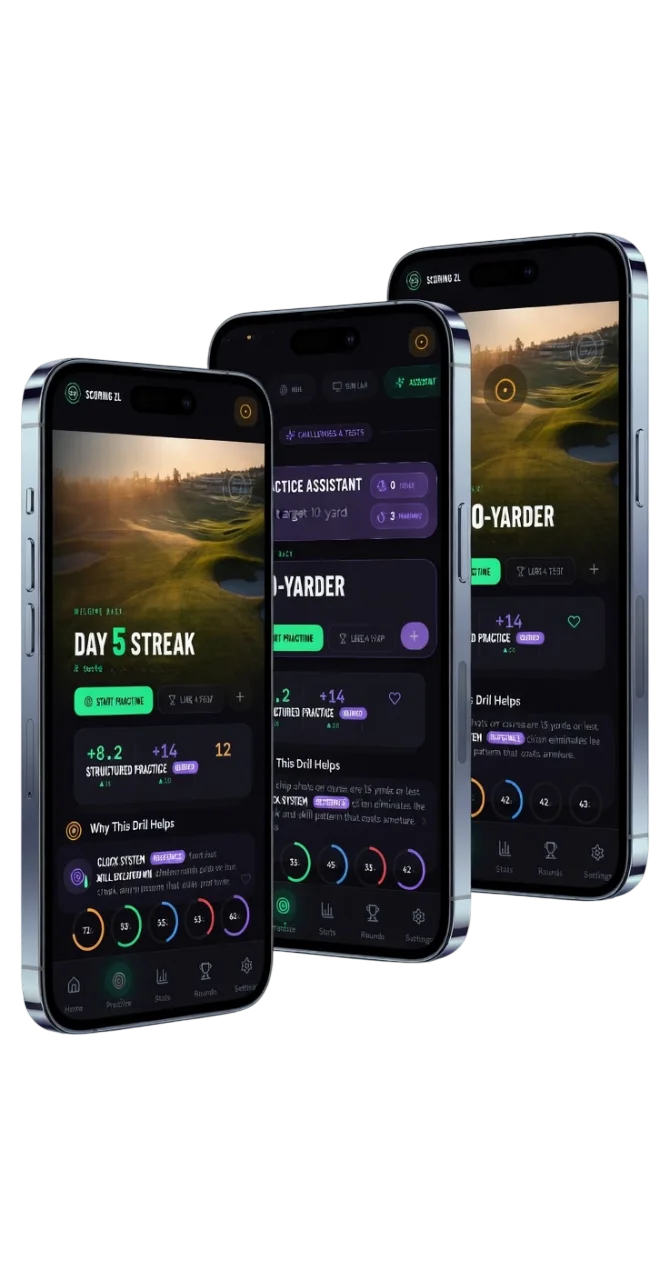
Scoring Zone runs Defstar, Lag King, and The Ten Yarder with built-in scoring, benchmarks against your handicap, and progress tracking over time. The Performance Hub assessment generates a Short Game Handicap and Putting Handicap that show whether your score-improvement work is moving the right numbers — or whether you need to switch focus.
Take the full short game and putting assessment to find your biggest leak.
Performance Hub →The same 4–5 step pre-shot routine on every shot — driver to 4-footer. Behind the ball, target picked, two practice swings, step in, one look, go. 10–15 seconds, every time.
A routine crowds out the noise that costs amateurs strokes on tight tee shots and pressure putts. It’s worth 1–2 strokes per round just by itself.
“Smooth tempo” beats “don’t go in the water.” Your brain doesn’t process negatives. Replace every outcome thought with a process cue and stick to that cue from setup to strike.
This isn’t fluffy. It’s a measurable difference in shot quality on shots that matter — the closing 4 holes of a round, the second shot after a snap-hooked drive, the 5-footer to break 90.
Round-by-round stats showing how your fairways, greens, and putts trend over time.
Round Stats →- Fairways hit (out of 14) - Greens in regulation (out of 18) - Putts (total)
Over 10 rounds, look at the trend. If putts dropped from 36 to 32, your putting work is paying off. If GIR went from 1 to 4, your approach play is responding to the wedge work. The numbers tell you what’s working — and what to switch focus to.
Once you have round stats, compare your numbers to the benchmark for your handicap. A 10-handicapper should be hitting 7–8 fairways, 5–6 GIR, and putting around 32 per round. If you’re materially below those numbers in any category, that’s where the next 2 strokes come from.
Cut three-putts and lock in a reliable wedge from 50–80 yards. The average 15-handicapper loses 4–5 strokes per round to those two areas — more than any other category. Practise scored putting drills from 3–6 feet plus 30+ feet, plus one repeatable wedge swing, and the score drops within 4 weeks.
With structured practice (2–3 sessions per week of scored drills) plus 20+ rounds, most amateurs drop 4–6 strokes from their handicap in 12 months. The fastest improvers get to 8–10 strokes — usually because they fixed a specific weakness (three-putts or chunked chips) rather than working on everything at once.
For amateurs, focus on putting and the wedge game first. Strokes-gained research shows long-game accuracy matters more than people realise — but practising the long game is far harder to do well at home than putting. The fastest gain-to-effort ratio is short game, every time. Once you’re sub-12 handicap, swing accuracy starts to dominate.
Track three numbers per round: fairways hit, greens in regulation, and putts. Add up-and-down percentage if you can. Over 5–10 rounds, the trends will show you what’s improving — and what isn’t. Without numbers, you’ll convince yourself you’re getting better when the score isn’t moving.
Stephen Pickering
3-handicap golfer with 25 years on the course. Built Scoring Zone to bring structure and pressure to short game practice. Writes about what actually works from the practice green, not the press box.
Join golfers using scored drills, the Performance Hub assessment, and round-by-round stats to drop 3–5 strokes from their handicap in 90 days. Free in early access — no payment required.
Download Scoring Zone Free →Full access to all drills, stats, and features. No payment required.
Get Scoring Zone Free →