Short Game
Golf Practice Games App — Scored Challenges That Transfer to the Course
The Games That Build Real Skill Under Pressure
April 10, 2026 · 8 min read · Stephen Pickering
The Games That Build Real Skill Under Pressure
April 10, 2026 · 8 min read · Stephen Pickering
Key takeaway: Scored practice games outperform repetition because consequence creates focus. When missing a putt resets your streak or costs you points, you engage the same mental response you need on the course. The best golf practice games apps score every drill, benchmark against your level, and track progress session over session.
If your practice sessions feel like going through the motions, they probably are. Hitting a bucket of balls without a target, rolling putts without counting, chipping without any consequence — none of it produces the focus that actually builds skill.
A golf practice games app changes the dynamic. When every shot is scored, when missing a target resets your streak, when your performance is benchmarked against a standard — you practise differently. You engage. You feel something when you miss.
This post covers what to look for in a golf practice games app, the specific games that transfer best to on-course performance, and how to structure a session around them. The games are playable whether you’re at a practice green or on a putting mat at home.
Most golfers practise in blocked mode — hitting the same shot repeatedly from the same position, then moving on. It feels productive. It isn’t, not at the rate most people assume.
Blocked practice builds temporary fluency. You improve within the session and feel worse the next time out because the pattern fades without stakes to anchor it. The same shot hit 50 times with no consequence doesn’t train your brain to execute under pressure — it trains you to hit it in a context where nothing matters.
Scored practice solves this. When missing a putt resets your streak from 7 back to zero, your body produces the same hormonal response it does on the course. That’s not a metaphor — the stress response is measurable. Practising in that state builds the neural pathways that handle pressure on the course.
Games keep you engaged. Benchmarks tell you whether you’re actually improving.
Without a benchmark, a score of 8 out of 10 is meaningless — is that good? Average? Worse than last month? With a benchmark tied to your handicap level, you know exactly where you stand and what you’re aiming for.
The best golf practice games apps build benchmarks into every drill. Scratch golfer? Your target is different from a 15-handicapper’s. Progress is measured against your own level, not a single universal standard.
See how scored short game drills work with handicap benchmarks.
Putting Drills →There’s a difference between an app that tracks what happened and one that scores what you’re doing in practice. Round trackers (Arccos, 18Birdies, The Grint) are good at telling you your stats after a round. They don’t help you build skill between rounds.
A proper golf practice games app gives you structured drills with points, targets, and scoring criteria. Each session produces a score. You can compare that score to previous sessions and know, numerically, whether you’re improving.
The challenge with self-directed practice is that most golfers stay in their comfort zone. They practise the shots they’re already reasonably good at and avoid the ones that expose a weakness.
A good practice games app prevents this with a progression system. New challenges unlock as you improve. Difficulty scales. The app nudges you toward your weak areas rather than letting you default to familiar drills.
The hallmark of a great practice game is consequence. A drill that resets on a miss — rather than just noting the miss and moving on — creates pressure because failure costs you something: time, progress, a streak.
Look for apps with streak-based challenges, timed drills, and modes where a single miss triggers a restart. These are the formats that create the on-course focus that standard practice doesn’t.
An app that scores every drill but doesn’t track those scores over time is half an app. You need to see your trend: is your putting benchmark improving? Is your chipping accuracy trending up over six sessions?
Without that data, practice games become entertainment rather than training. The tracking converts engagement into evidence of improvement.
Scoring Zone is built around exactly this — every drill is scored, benchmarked by handicap level, and tracked session over session so you can see the direction of travel, not just the day’s result.
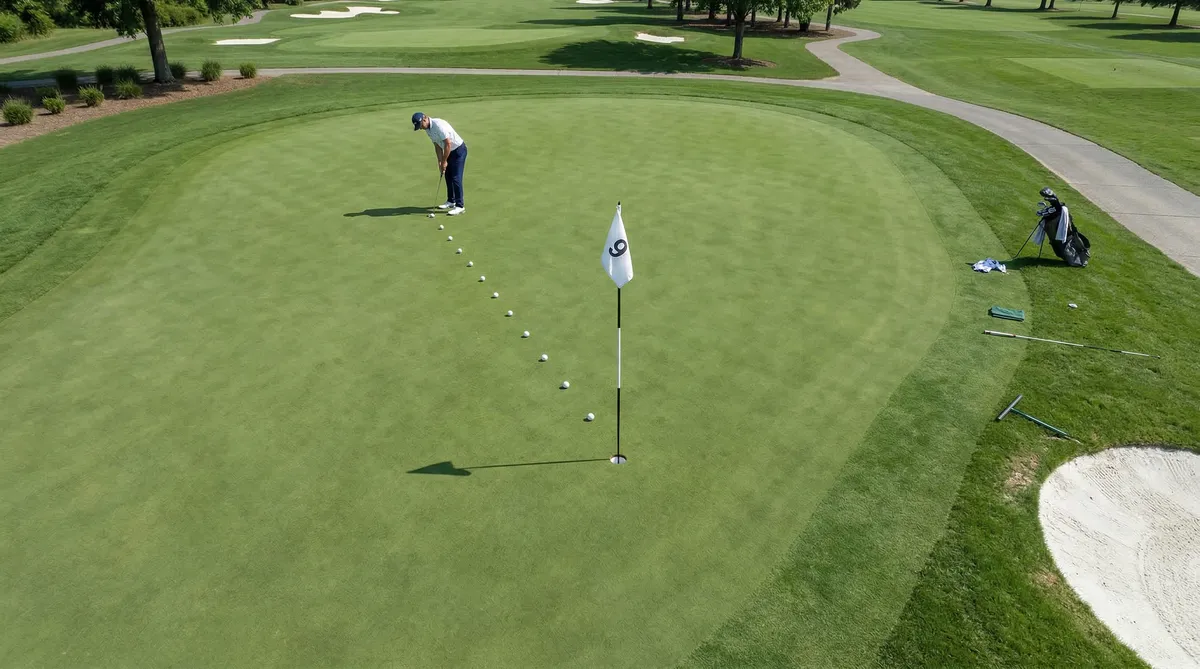
Place the ball 5 feet from the hole. Make 10 in a row to pass. If you miss, your streak resets to zero. A 15-minute timer runs — if it expires, the drill fails.
Your score is the total putts taken. The lower the number, the fewer resets you had. A scratch golfer should complete this in under 20 putts. A 15-handicapper typically takes 25–35.
This drill creates genuine pressure because a miss from 7 doesn’t just cost you one putt — it costs you the streak. The mental toll of reset drills transfers directly to the course.
Place 16 balls around the hole: 4 from 3 feet, 4 from 4 feet, 4 from 5 feet, 4 from 6 feet. Make all 16 consecutively — any miss resets to zero. You have a maximum of 30 minutes.
Record the total putts needed. Most golfers are shocked at how long this takes. A single lapse of concentration from 3 feet when you’re at putt 14 is exactly the kind of error that costs shots on the course — and this drill makes it cost something in practice too.
Hole out = 5 points. Inside 1 foot = 3 points. Inside 3 feet = 1 point. Chip until you reach exactly 21. Go over and you bust.
Record the number of attempts needed to reach 21 without busting. The target of exactly 21 forces decision-making — do you go for the hole out, or play conservatively for the 1-pointer? That choice under a scoring constraint is closer to on-course decision-making than any repetition drill.
Set up 9 different chip shots around the green from varied distances and lies. Try to hole out in 2 or fewer shots — one chip, one putt. No gimmies: even if the chip finishes close, you must putt from at least a putter length away.
Count how many pars (2 or fewer) you score out of 9. Target for an 18-handicapper: 5 pars. Target for a scratch golfer: 7+. This is the most directly transferable short game game — it mirrors the exact situation you face on every hole.
Putt 5 balls to the same hole from 30 feet. Scoring: hole = 3 points, within 18 inches past the hole = 2 points, 19–36 inches past = 1 point, short or more than 36 inches past = 0 points. Record total out of 15.
The asymmetric scoring — nothing for finishing short, zero for finishing too far past — replicates the decision calculus you face on long putts. Never up, never in. But three-putt territory if you’re reckless. Getting comfortable managing this trade-off is how you stop leaking shots from 30 feet.
More scored putting challenges with benchmarks and progress tracking.
Chipping Drills →A session built around practice games doesn’t need to be long to be productive. 45 minutes with structure outperforms 90 minutes of aimless repetition.
A simple structure: - Warm-up (10 min): A few minutes of easy lag putts, then a basic chipping warm-up. No scoring yet — this is just getting the feel. - Focused game 1 — Putting (15 min): Choose one putting challenge and complete it properly. Log your score. - Focused game 2 — Chipping (15 min): Choose one chipping game and complete it fully. Log your score. - Pressure finish (5 min): Finish with a streak-based drill under a short time limit. Make 5 putts from 4 feet without missing.
Each game generates a score. The session ends with data. Next session, you have something to beat.
Not all practice games train the same skill. Match the game to the gap:
- Three putting too much? → Five-Foot Circle and Lag King target the two ends of the problem: finishing short putts and controlling pace from distance. - Chipping inconsistent? → Par 2 and 21 Points replicate the scoring pressure of real chip shots better than any repetition drill. - Distance control off? → Speedmaster builds the pace instinct for lag putts. The scoring structure teaches you exactly where “too short” and “too long” cost you. - Struggling under pressure? → Deathstar and Five-Foot Circle are specifically designed to create pressure. Completing these regularly normalises the feeling.
Not sure which category applies to you? Track 3–4 rounds of stats — specifically your three-putt count and up-and-down percentage. Those two numbers tell you where the games should go.
Track your round stats to identify where the games should target first.
Round Stats →The best golf practice games apps are built around scored challenges rather than passive stat tracking. Look for apps with benchmarks per drill, a progression system, and pressure modes that replicate on-course stakes. Scoring Zone is built specifically for this — every short game challenge is scored, benchmarked, and tracked over time.
Yes — specifically because they replace aimless repetition with consequence. When every shot in a practice drill is scored and missing a target resets your streak, you engage differently. That heightened focus during practice transfers to the course far better than blocked repetition. Research consistently backs this: practice with feedback and stakes produces better skill retention than practice without it.
Most short game practice games work indoors with minimal equipment. Putting challenges — like the Five-Foot Circle, Clock Drill, or Deathstar — work on any putting mat. Chipping games like Par 2 or 21 Points need a net or garden space. A good practice games app should support both settings and let you log sessions from wherever you practise.
The most effective method is scoring with consequence. Drills that reset on a miss — like the Five-Foot Circle (10 in a row from 5 feet) or the Deathstar (16 consecutive putts) — create genuine pressure because failure costs you progress. Timed drills add a second layer. Tracking scores across sessions adds the long-term pressure of competing against your own benchmark.
Stephen Pickering
3-handicap golfer with 25 years on the course. Built Scoring Zone to bring structure and pressure to short game practice. Writes about what actually works from the practice green, not the press box.
Scored challenges, handicap benchmarks, and session-by-session tracking — the structure that turns practice into measurable progress. Free for 7 days.
Download Scoring Zone Free →Full access to all drills, stats, and features. No credit card required — then from $4.99/month.
Get Scoring Zone Free →