App Comparison
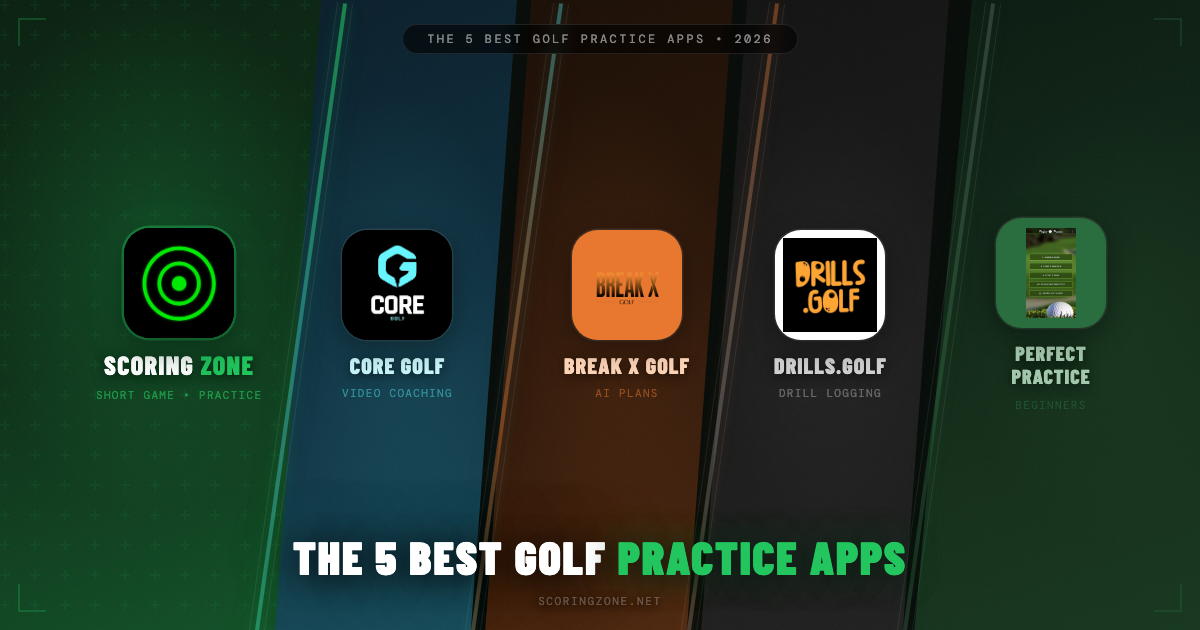
The 5 Best Golf Practice Apps in 2026
April 1, 2026 · 10 min read · Stephen Pickering
April 1, 2026 · 10 min read · Stephen Pickering
Quick verdict: The best golf practice app in 2026 is Scoring Zone — it’s the only app built entirely around scored short game drills with a Short Game Handicap, with a 7-day free trial on every plan. CORE Golf wins for video-led full-game coaching, Break X Golf for AI-personalised training plans, Drills.golf for simple logging, Perfect Practice for beginners at the range.
Top 5 ranked:
Most golfers practise without a plan. They hit balls at the range, roll a few putts, and leave feeling like they did something useful. Then nothing changes. Finding the best golf practice apps can fix that — but only if you pick one that gives you structure, scoring, and accountability instead of just another place to log rounds.
The golf training app market has grown fast. There are now apps for full-game coaching, AI-generated practice plans, short game drills, and simple session logging. Some are excellent. Some are overbuilt. This post breaks down five of the best options in 2026, what each one does well, where each falls short, and which type of golfer each one suits.
Not all practice apps solve the same problem. Before picking one, know what actually matters.
A list of drills you can read is not a practice app — it’s a blog post. The app should score your performance, set targets, and track whether you hit them. Without scoring, you have no way to know if you’re improving or just going through motions.
One session tells you nothing. You need a golf practice tracker that shows trends across weeks and months. Look for apps that visualise your progress and let you compare performance over time — not just session-by-session snapshots.
Too much choice leads to no progress. The best apps give you a plan — either built by a coach, generated by an algorithm, or designed around a specific skill. You should be able to open the app and know exactly what to do in the next 20 minutes.
Roughly 60% of your strokes happen within 100 yards. If the app only covers full swing, it’s ignoring where most of your scoring happens. The best golf drill apps either specialise in short game or give it serious attention within a broader programme.
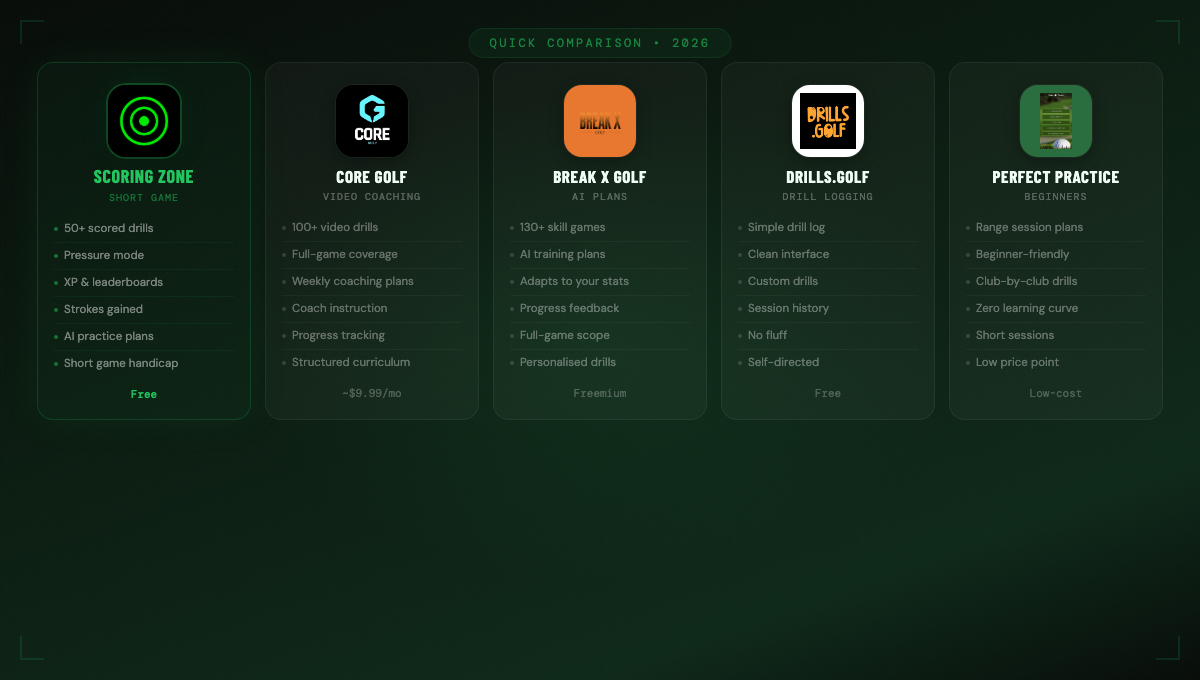
Scoring Zone focuses entirely on the short game — chipping, putting, and pressure tests. Every drill is scored. You earn XP, track streaks, and build a Short Game Handicap that benchmarks your skills against other golfers. The app gamifies practice in a way that makes repetition feel like a challenge rather than a chore.
The pressure simulation drills are a standout. They force you to perform under consequence — miss and you restart, make it and you advance. That mirrors on-course pressure far better than rolling putts with no stakes.
Best for: Golfers who know their short game is costing them strokes and want targeted, scored practice to fix it.
Limitations: No full-swing content. If you want driving range plans or video coaching for your iron play, you’ll need a second app alongside it.
Pricing: Pro is $4.99/month or $23.99/year; Elite adds round logging and Strokes Gained tracking at $9.99/month or $39.99/year. Every plan starts with a 7-day free trial — full access, no credit card required.
See how scored chipping drills work inside the app.
Chipping Drills →CORE Golf takes a coaching-first approach. The app includes over 100 drills across the full game — driving, irons, chipping, putting — each with a video walkthrough from a qualified coach. You follow structured coaching plans that progress week by week, with each session building on the last.
The video quality is high, and the instruction is clear. If you learn best by watching and copying, CORE Golf delivers. The plans feel like having a coach set your weekly homework.
Best for: Golfers who want guided, video-based coaching across their entire game and prefer a structured curriculum over self-directed practice.
Limitations: The subscription cost can add up, and the drill scoring is less detailed than apps built specifically around measurable performance. It’s a teaching tool more than a testing tool.
Break X Golf uses your performance data to generate personalised training plans. Log your stats, and the app adapts your practice schedule to target your weakest areas. With over 130 skill-based games, there’s enough variety to keep sessions fresh over months of use.
The AI-driven personalisation is the main draw. The app doesn’t just give you a static plan — it adjusts as you improve. For golfers who track their stats religiously, this feedback loop is powerful.
Best for: Data-driven golfers who want an AI-personalised practice plan that evolves with their game.
Limitations: The personalisation depends on you feeding it accurate data. If you don’t log rounds consistently, the recommendations lose their edge. The sheer number of games can also feel overwhelming without a clear starting point.
Drills.golf keeps things minimal. It’s a practice log — you pick a drill, do it, and record your results. No AI plans, no video coaching, no gamification. Just a clean interface for tracking what you practised and how it went.
That simplicity is its strength. If you already know what drills you want to do and just need somewhere to log them, Drills.golf does the job without getting in the way.
Best for: Self-directed golfers who already have a practice plan and want simple, no-frills drill logging.
Limitations: No structured plans, no scoring benchmarks, no progress analytics. You bring the structure — the app just records it. For golfers who need guidance on what to practise, this won’t be enough.
Perfect Practice Golf targets golfers who show up at the range and don’t know what to do. It provides structured session plans for range practice — telling you which club to hit, how many shots, and what to focus on. The sessions are short, clear, and designed for golfers who are still building basic habits.
The low price point makes it accessible, and the simplicity means there’s almost no learning curve. Open the app, pick a session, and go.
Best for: Beginners and high-handicappers who want to add structure to their range time without complexity.
Limitations: Limited short game content. The sessions are fairly basic and won’t challenge intermediate or advanced golfers. There’s no scoring or benchmarking — you follow the plan, but there’s no feedback loop to measure improvement.
Want to see how your short game stacks up? The Performance Hub calculates your Short Game Handicap from a full assessment.
Performance Hub →| App | Best For | Scored Drills | Short Game Focus | Pricing |
|---|---|---|---|---|
| Scoring Zone | Short game practice | Yes — every drill | 100% | From $4.99/mo |
| CORE Golf | Video-led coaching | Limited | Partial | Subscription |
| Break X Golf | AI personalisation | Yes | Partial | Subscription |
| Drills.golf | Simple logging | No | Partial | Free / paid |
| Perfect Practice Golf | Beginner range plans | No | Limited | Low-cost |
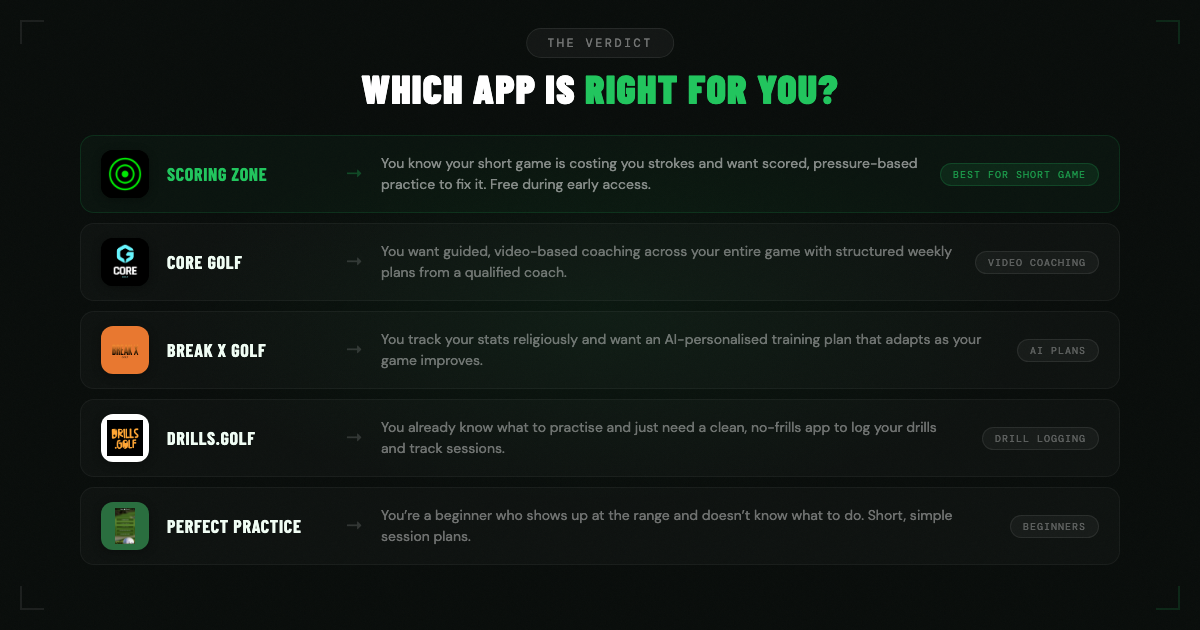
Here’s the short version, broken down by what you need:
Your short game is costing you strokes and you want scored, gamified practice: Scoring Zone. It’s the only app on this list built entirely around chipping, putting, and pressure drills. Take the 7-day free trial.
You want a coach-led programme covering your full game: CORE Golf. The video-led plans are the closest thing to having a coach assign your homework each week.
You want an AI that adapts your practice to your stats: Break X Golf. If you log data consistently, the personalised plans are hard to beat.
You just need a place to log your drills: Drills.golf. Minimal, clean, and stays out of your way.
You’re a beginner who needs range session structure: Perfect Practice Golf. Low cost, low complexity, and gets you off the “hit balls aimlessly” treadmill.
Most golfers will benefit from combining two of these — one for short game work and one for full-game structure. The worst option is no app at all, because that usually means no plan.
Already know your putting needs work? Start with scored putting drills that track your progress automatically.
Putting Drills →Yes — if the app gives you structured drills with measurable targets. The key is scored practice with feedback, not just logging reps. Golfers who follow a golf drill app with clear benchmarks improve faster than those who practise randomly.
Scoring Zone has a 7-day free trial on every plan, with no credit card required. It focuses exclusively on short game practice, and a 7-day free trial unlocks the full drill library and Short Game Handicap. For free drill logging, Drills.golf also offers a no-cost option.
Not entirely. A golf training app is best at giving you structure, tracking progress, and holding you accountable between lessons. A coach diagnoses swing faults and builds long-term development plans. The best approach is using both — let the app handle daily practice, and let the coach handle technique.
Three to four sessions per week of 20–30 minutes beats one long session. Consistency matters more than volume. A good golf practice tracker will show you trends over weeks, which is where real improvement becomes visible.
Compare every golf practice app in one place.
Best Golf Apps Guide →Stephen Pickering
3-handicap golfer with 25 years on the course. Built Scoring Zone to bring structure and pressure to short game practice. Writes about what actually works from the practice green, not the press box.
Join golfers already scoring better with structured, scored practice. One session is all it takes to see the difference.
Start Free Trial →7-day free trial. No credit card required. Cancel anytime.
Start Free Trial →