App Reviews
Best Golf App for Scoring in 2026: What Actually Lowers It
Score Recording vs Score Improvement — an Honest Comparison
April 12, 2026 · 8 min read · Stephen Pickering
Score Recording vs Score Improvement — an Honest Comparison
April 12, 2026 · 8 min read · Stephen Pickering
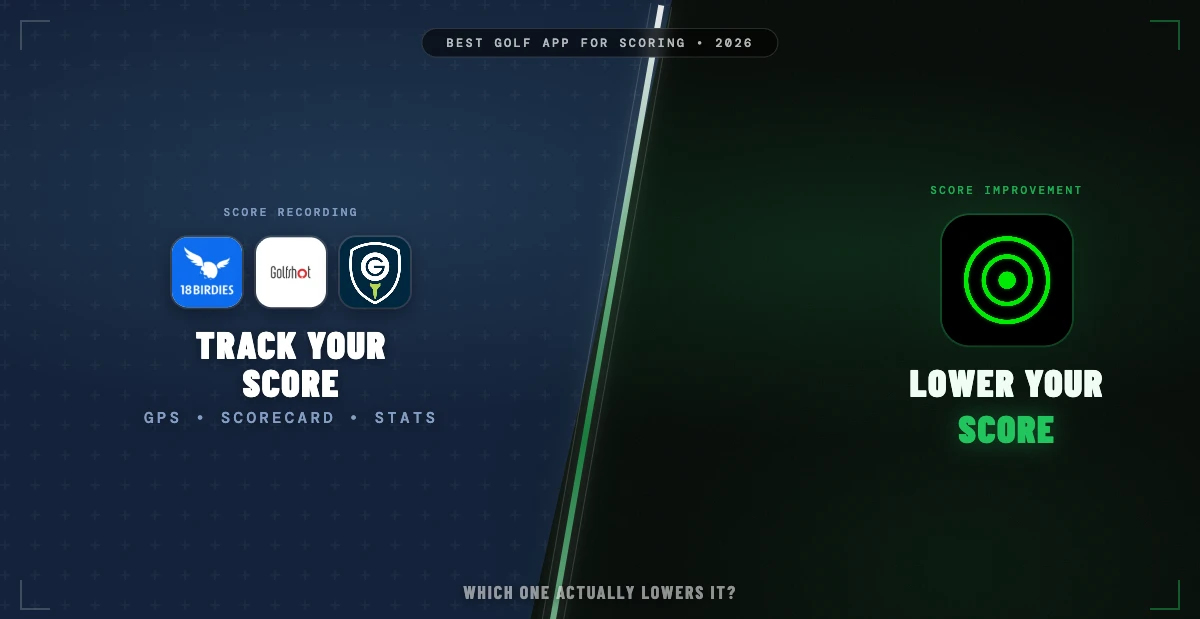
Key takeaway: There are two types of golf scoring app: ones that record your score, and ones that improve it. GPS apps like 18Birdies and Golfshot are excellent on the course. But the data they produce only matters if you do something with it — and the doing happens in a practice app, not a GPS tracker.
There are two types of golf app that claim to help with scoring. The first records your score — hole by hole, fairways hit, putts per round. Useful on the day. The second actually improves it — structured practice, benchmarks, performance data that changes what you do between rounds.
Most golfers searching for the best golf app for scoring want the second one. They want to shoot lower numbers. The problem is most apps in this category are really the first type wearing the second type’s clothes. They track data but don’t give you the tools to act on it.
Here’s an honest breakdown of what’s actually available, what each type does well, and which one belongs in your bag if you’re serious about dropping strokes.
These apps are built around your round. GPS distances, digital scorecard, stat logging. You enter your fairways, greens in regulation, putts, and the app gives you a summary at the end. Some, like Arccos or Shot Scope, add automatic shot detection with sensors.
They’re genuinely useful. Knowing you average 36 putts per round or that you miss approach shots left 70% of the time is valuable data. Strokes gained methodology — popularised on the PGA Tour — has taught golfers to understand exactly where shots are being lost.
The limitation: the data tells you what happened. It doesn’t help you fix it.
These apps exist between rounds. Structured practice sessions. Scored drills with benchmarks. Performance tracking that shows whether you’re actually improving or just staying the same. They’re built around the practice green and the short game area, not the GPS on the 7th hole.
The distinction matters because 60% of golf shots happen inside 100 yards. That’s where the scoring is. A 15-handicapper loses around 4–5 strokes per round compared to a scratch golfer purely inside 50 yards. Shot Scope’s data shows the average 15-handicapper makes up-and-down only 14% of the time compared to 50% for scratch. Fix that gap and your scores improve — not because you hit the ball better, but because you stop wasting shots around the green.
18Birdies is arguably the most polished GPS and scoring app available. Clean UI, detailed course maps, social features, and a solid free tier. If you want accurate yardages and a clean digital scorecard, it’s excellent. The stat tracking gives you a picture of your game round by round.
Where it falls short: the practice section is thin. There are some swing tips and videos, but no structured drill system with benchmarks. It tells you how many putts you took — not how to take fewer.
Golfshot is strong on GPS accuracy and course coverage. The Apple Watch integration is well built. For on-course use, it’s one of the most reliable options available on iOS.
Same limitation as 18Birdies: the data tells you what happened, but there’s nothing on the practice side to change what happens next round.
Arccos is the most data-rich option in this category. Automatic shot detection via sensors in your grips, combined with AI caddie recommendations, gives you a level of analysis that’s genuinely impressive. If you want to understand your ball striking tendencies and on-course decision making, Arccos is hard to beat.
The gap: all of that data is on-course data. The improvement still happens between rounds — on the practice green, in the short game area, in structured sessions. Arccos tells you what to work on. The work still has to happen somewhere else.
See how scoring apps and practice apps work together in the full comparison.
Golf Practice App vs Coaching Lessons →Hitting chips and putts without a target doesn’t build skill. You need a drill that scores every shot, sets a standard to beat, and tells you whether you’ve hit it. Without benchmarks, you can’t tell if you’re improving or just going through the motions.
The best practice apps build this in from the start. Every drill has a measurable outcome — a score, a proximity target, a completion standard — so you know exactly where you stand.
Round stats from GPS apps show putts per round, but that’s a crude metric. What matters is up-and-down percentage from different distances, first-putt proximity at different distances, sand save rate. The apps that track this properly give you the data to decide what to practise next — not just what went wrong last round.
Here’s the part most apps ignore completely. The practice green is low stakes. The course is high stakes. Most golfers practise in the first environment and wonder why the improvement doesn’t transfer to the second.
Drills that add pressure — resets when you miss, target scores to hit consecutively, time limits — simulate the same cognitive state as competition. That’s how practice transfers to scoring.
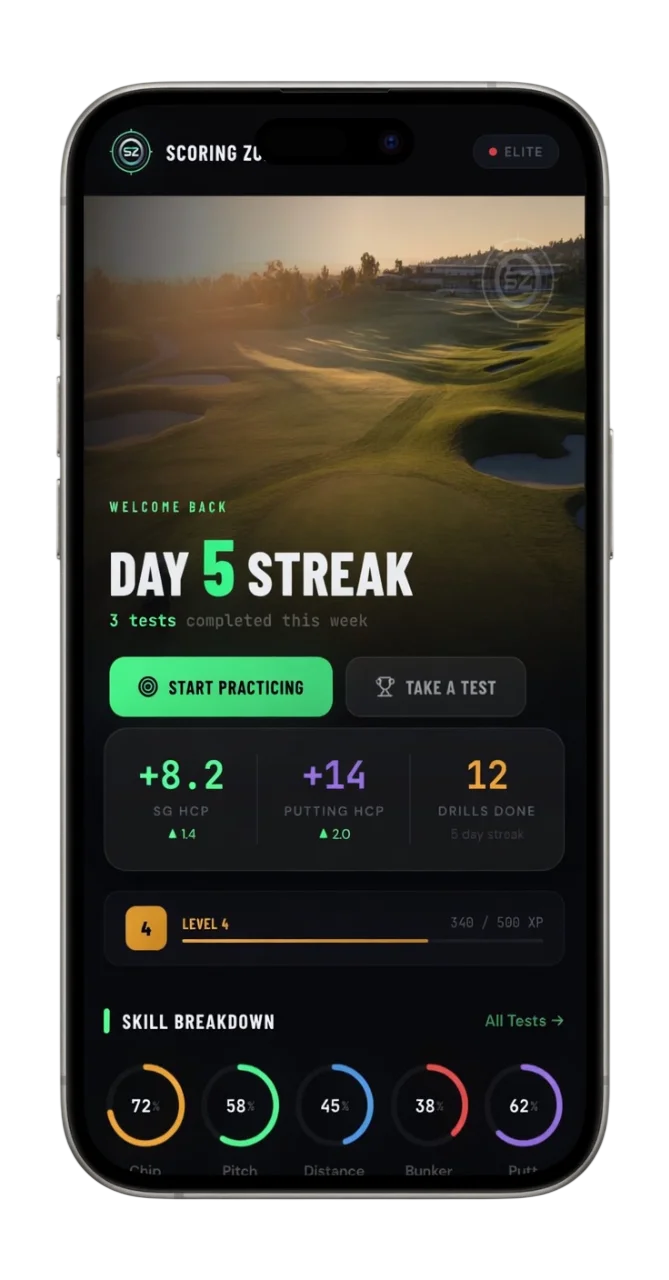
Scoring Zone is built around this. Scored short game and putting challenges with benchmarks, a Short Game Handicap that drops as you improve, and pressure modes that mirror what it feels like when something is on the line. It’s the practice structure that sits alongside your GPS app — and does the job the GPS app can’t.
Start your short game performance test — see your Short Game Handicap in one session.
Performance Hub →The best setup for most golfers is a GPS/scoring app on the course, and a practice app between rounds. They’re not competing — they’re doing different jobs.
Use 18Birdies or Golfshot for distances, scorecards, and round stats. Use a structured practice app to work on the short game skills that GPS data tells you are costing you strokes.
If you only want one app — and you want to actually shoot lower scores rather than just record higher ones — the practice app wins. The data from tracking your round is only useful if you do something with it. The practice app is where the doing happens.
Not sure what to work on first? The practice assistant builds the session for you.
Practice Assistant →18Birdies, Golfshot, and TheGrint all offer free score recording. For actually improving your score, Scoring Zone is free for 7 days — it gives you structured short game drills, benchmarks, and performance tracking at no cost.
A scoring app that only records your round shows you what happened — it doesn’t improve anything. Apps that structure your practice with scored drills and track your short game performance between rounds are the ones that move the needle. Data without action is just history.
The best app for lowering your handicap is one that targets your short game — the area where most amateur golfers lose the most shots. A 15-handicapper loses 4–5 strokes per round inside 50 yards compared to scratch. An app with structured short game drills and benchmarks addresses the biggest scoring gap.
Use both for different jobs. GPS apps like 18Birdies or Golfshot are excellent on the course for distances and score recording. Practice apps are for between rounds — structured drills, performance tracking, and benchmarks that improve the skills you’ll use next time you play. They serve different purposes.
Stephen Pickering
3-handicap golfer with 25 years on the course. Built Scoring Zone to bring structure and pressure to short game practice. Writes about what actually works from the practice green, not the press box.
Scoring Zone gives you the practice structure that GPS apps don’t. Structured drills, Short Game Handicap, and pressure modes — all free for 7 days.
Download Scoring Zone Free →Full access to all drills, stats, and features. No credit card required — then from $4.99/month.
Get Scoring Zone Free →