Short Game
Indoor Golf Practice Ideas That Actually Transfer to the Course
What Works, What Doesn't, and How to Build a Proper Session
April 12, 2026 · 8 min read · Stephen Pickering
What Works, What Doesn't, and How to Build a Proper Session
April 12, 2026 · 8 min read · Stephen Pickering
Key takeaway: Putting transfers almost perfectly from a mat to the course — the mechanics are identical, and it’s 40% of your shots. Consequence-based drills like the Five-Foot Circle and Deathstar build real pressure indoors. Short, structured, scored sessions outperform long aimless ones every time.
Winter, wet weather, a busy week, an apartment with no garden — there are plenty of reasons a golfer can’t get to the range. The question is whether indoor practice is worth doing at all, or whether you’re just going through the motions.
The honest answer is it depends entirely on what you practise. Some indoor golf practice ideas transfer directly to on-course performance. Others feel productive without building any skill that shows up when it matters.
This guide covers what works, what doesn’t, and how to structure indoor sessions so the reps count. Most of it requires nothing more than a putting mat, a net, and a floor with enough clearance to make a half-swing.
Putting transfers almost perfectly from indoors to the course. The mechanics are the same on a putting mat as on the green — face angle at impact, stroke path, tempo, and pace judgment all apply. Since putting accounts for roughly 40% of your total shots per round, an indoor putting practice habit is one of the highest-ROI things a golfer can do.
Chipping transfers well with the right setup. A net and a half-mat give you a realistic contact training environment. You won’t get green-reading feedback, but club path, face angle, and ball contact — the technical components — are all trainable indoors.
Alignment, grip, and pre-shot routine transfer completely. These are purely mechanical and cognitive skills. You can improve all three without a ball in sight.
Full swing mechanics are harder to train indoors without ball flight data. You can swing into a net and feel the motion, but without knowing where the ball went, you lose the feedback loop that makes practice meaningful. If you’re working on a specific swing change with a coach, indoor swings with a mirror or video might add value — but unguided full swings into a net are low transfer.
Distance control for pitching and approach shots needs real carry distances to calibrate properly. A launch monitor changes this equation — with a Garmin R10 or Flightscope Mevo you get ball flight data indoors. Without one, longer shots are harder to practise meaningfully.
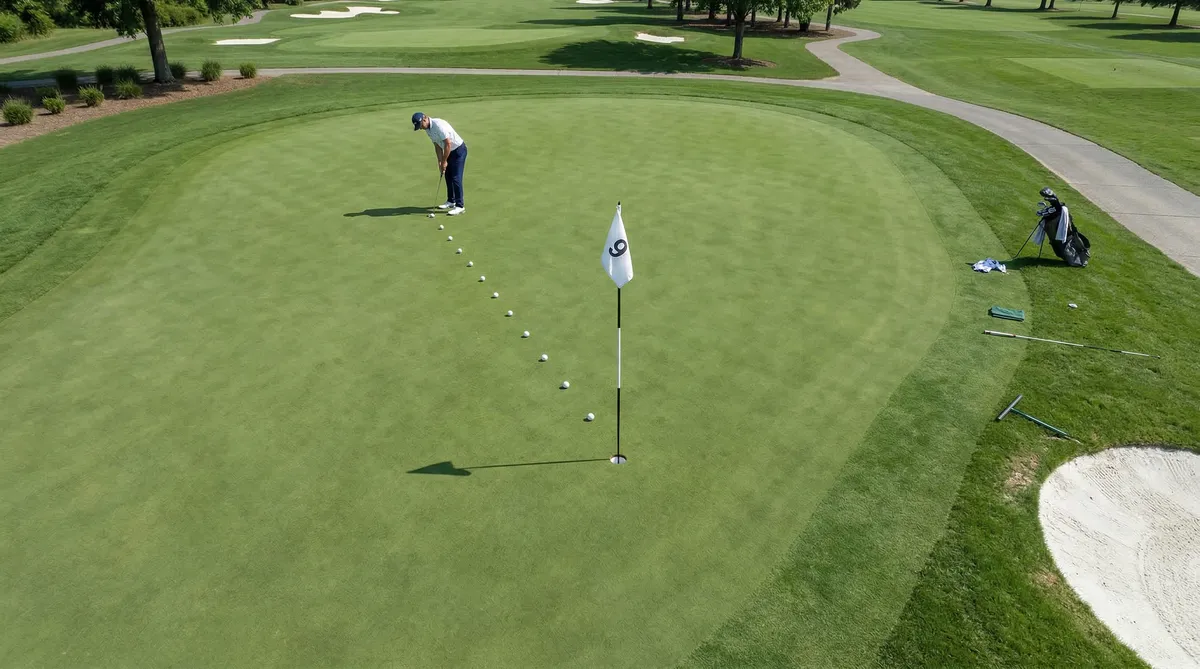
Place the ball 5 feet from the hole. Make 10 in a row to pass. Any miss resets your streak to zero. A 15-minute timer runs — if it expires before you complete the run, the session fails.
Your score is total putts taken. The lower the number, the fewer resets you had. This drill works on a putting mat because the 5-foot range is repeatable and the streak mechanic creates the same pressure response as a crucial putt on the course. Scratch golfers complete it in under 20 putts. A 15-handicapper typically needs 25–35.
Place 16 balls around the cup — 4 from 3 feet, 4 from 4 feet, 4 from 5 feet, 4 from 6 feet. Make all 16 consecutively. Any miss resets to zero. Maximum 30 minutes.
This is the best pressure-based drill for a putting mat because it exposes the exact moment where concentration lapses — usually somewhere between putts 10 and 14. The accumulating tension is exactly what you feel standing over a 4-footer to save par. Practise it regularly and the feeling becomes familiar rather than paralysing.
Place 8 balls in a circle, each 6 feet from the hole. Make all 8 without missing. Record the total number of putts to complete the circle.
This is simpler than the Deathstar but trains the same skill — consecutive pressure putting from a repeatable distance. If your putting mat is narrower than a full circle allows, reduce to 4–6 balls in a semicircle. The mechanics are the same.
More scored putting challenges with benchmarks for every handicap level.
Putting Drills →A freestanding net (typically 7–8 feet wide) with a half-mat in front is enough for chipping practice. The mat gives you a consistent contact surface. The net catches the ball. You lose green feedback — you won’t know where the ball lands — but you keep the contact training, which is usually where chipping breaks down under pressure anyway.
For the most realistic setup, position the net at your typical chip-shot distance and aim at a specific spot on the net face rather than just swinging freely. Deliberate targeting makes the practice transferable.
Club-to-ball contact is the highest-value focus. Specifically: weight forward, hands ahead of the ball, consistent shaft lean at impact. If you’re recording video from the side, you can self-coach face angle and path without a ball-flight view.
For variety, change your lie angle on the mat — ball slightly below or above your feet — to simulate the uneven lies you actually face on the course. Chipping from a perfectly flat surface every rep builds a skill that doesn’t fully transfer.
Scoring Zone’s putting challenges — the Five-Foot Circle, Deathstar, Clock Drill, Speedmaster — all run perfectly on a putting mat at home. Every drill is scored and benchmarked against your handicap level, so you know exactly whether the session moved the needle. The practice notepad in the Practice Assistant lets you log what you worked on so there’s a continuous record across sessions, whether you’re at home or the practice green.
Build a structured indoor putting session with a warm-up, scored drills, and a pressure finish.
Practice Assistant →Grip pressure is one of the most overlooked short game skills. Most golfers grip too tightly under pressure, which kills feel and produces thin chips. A simple indoor drill: hold your putter or wedge at what feels like 3 out of 10 grip pressure. Walk around, sit down, get distracted — then check your grip pressure again. Most golfers jump to 6 or 7 without noticing.
Doing this repeatedly indoors — with no ball, just grip awareness — trains the relaxed hold that transfers directly to short game touch.
Pre-shot routine is entirely trainable without hitting a shot. Stand at a specific spot, go through your alignment check, your mental image of the shot, your waggle or trigger. Time it. Aim for 6–10 seconds consistently.
Golfers with a repeatable pre-shot routine perform measurably better under pressure. The routine anchors the nervous system — familiar actions before a shot tell the body this is just practice, even when it isn’t. Practising the routine at home costs nothing and transfers directly.
Stand in front of a mirror in your address position. Check: feet parallel to your target line, hips and shoulders square, hands in the correct grip position. Most golfers are surprised by the gap between how they think they’re aligned and what they actually see.
Doing this 5 minutes a week ingrains correct positions at address. The mirror provides the visual feedback a practice ground provides — but from your living room.
Yes — specifically for putting, alignment, grip, and short game feel. Putting is the highest-transfer indoor skill because the mechanics are identical on a putting mat and on the green, and it accounts for roughly 40% of all shots. Chipping and pitching work well with a net and mat setup. Full swing without ball flight data is harder to practise effectively indoors.
A quality putting mat (8–12 feet) handles most of what transfers indoors. For chipping and pitching, a freestanding net with a half-mat gives you full short game practice in a garage or spare room. A launch monitor (Garmin R10, Flightscope Mevo) adds ball flight data if budget allows, but the mat and net cover most of the gains without one.
30–45 minutes with structure outperforms 90 minutes of aimless repetition. Focus on one or two specific skills per session. A simple structure: 10 minutes putting warm-up, 15 minutes on a scored challenge, 10 minutes chipping if space allows, 5-minute pressure finish. Short, structured, and scored — so you know whether it worked.
Consequence-based drills work best because they replicate on-course pressure. The Five-Foot Circle (make 10 in a row from 5 feet, reset on a miss) and the Deathstar Drill (16 consecutive putts from 3–6 feet) both work on any mat. Scoring each session makes the improvement measurable rather than just a feeling.
Stephen Pickering
3-handicap golfer with 25 years on the course. Built Scoring Zone to bring structure and pressure to short game practice. Writes about what actually works from the practice green, not the press box.
Scored putting challenges, benchmarks for your handicap, and session tracking — everything you need for a proper indoor practice habit. Free for 7 days.
Download Scoring Zone Free →Full access to all drills, stats, and features. No credit card required — then from $4.99/month.
Get Scoring Zone Free →