Golf Apps

18Birdies Free vs Premium: Which One Do You Actually Need?
What Each Tier Costs in 2026, What Premium Unlocks, and How to Pick
July 29, 2026 · 7 min read · Stephen Pickering
What Each Tier Costs in 2026, What Premium Unlocks, and How to Pick
July 29, 2026 · 7 min read · Stephen Pickering
Key takeaway: 18Birdies is free to download, and the free tier covers what most golfers actually use — GPS yardages, scorecard, basic stats, and the social layer. Premium (roughly $60–$90/yr) adds the AI caddie, green-reading slope data, advanced stats, and removes ads. It earns its money if you play 20+ rounds a year and read your stats; otherwise the free tier is enough. Neither tier helps you practise, which is where the strokes actually are.
Most golfers asking about 18Birdies free vs Premium are really asking one thing: am I missing something by not paying? Short answer — probably not. The free tier of 18Birdies is one of the most generous in the GPS-and-scorecard category, and millions of golfers use it for years without ever upgrading. But Premium does add real features, and for a specific type of golfer it earns its money. This is the tier-by-tier breakdown: what each one costs in 2026, what Premium actually unlocks, and how to work out which side of the line you fall on.
18Birdies is free to download on iOS and Android. There is no trial timer, no card required, and no feature that expires after a fortnight. The free tier is the product for most people.
Premium runs roughly $60–$90 per year, depending on which plan you pick and whether you catch one of the seasonal promotions. A few things worth knowing before you pay:
| Free | Premium | |
|---|---|---|
| Price | $0 | ~$60–$90/yr |
| Ads | Shown | Removed |
| GPS distances (front/centre/back) | Yes | Yes |
| Digital scorecard | Yes | Yes |
| Basic stats (FIR, GIR, putts) | Yes | Yes |
| Social rounds, side games, leaderboards | Yes | Yes |
| Apple Watch support | Yes | Yes |
| AI caddie + club recommendations | No | Yes |
| Green reading / slope data | No | Yes |
| Advanced stat breakdowns | No | Yes |
| Scorecard history | Limited | Unlimited |
The annual plan is cheaper per month than paying monthly, and the price moves with promotions — the figure you see in January is often not the figure you see in July. Check the in-app price before you commit to anything.
Strip out the marketing and Premium adds four things that matter.
Club recommendations based on your distances, the hole, and conditions. It is genuinely decent once it has enough rounds to learn from. It is also solving a problem most amateurs do not have — if you are losing shots because your 7-iron goes anywhere between 140 and 165 yards, being told to hit 7-iron does not help.
Slope data on the greens. Useful. Also the feature most likely to be restricted in competition play, so check your club’s rules before you rely on it.
Deeper breakdowns than the free tier’s fairways, greens, and putts. This is the one with real value — if you actually read it. Most golfers do not.
Underrated. If you use the app every single round, the ad-free experience alone is worth something.
A full breakdown of what 18Birdies does well and where it falls short.
Read the full 18Birdies review →Forget the feature list for a second. The honest test is how you actually play.
You play fewer than 15 rounds a year. You mainly want yardages and a scorecard. You do not look at your stats between rounds. You play in competitions where slope readings are not permitted anyway. For this golfer the free tier covers everything you will genuinely use, and paying is buying features you will open twice.
You play 20+ rounds a year, open the app every round, and actually read your stats afterwards. You play a lot of unfamiliar courses where green reading earns its keep. The ads bother you. If three of those four are true, Premium pays for itself.
Neither tier makes you better at golf. That is not a dig at 18Birdies — it is not what the app is for. It records what happened and tells you the yardage. Both tiers are on-course tools.
Which matters more than it sounds, because around 60–65% of your shots happen inside 100 yards, and that is precisely where an on-course GPS app has nothing to offer. It will tell you that you got up and down 3 times out of 10. It will not tell you why, and it will not give you anything to practise.
Here is the pattern I see constantly. A golfer pays for Premium, gets better data about their rounds, and shoots exactly the same scores. The data was never the bottleneck. The practice was.
A 15-handicapper loses roughly 4–5 shots a round to a scratch golfer inside 50 yards. No amount of GPS accuracy touches that number. You close it by practising the short game with actual structure — scored drills, real targets, benchmarks you can measure against.
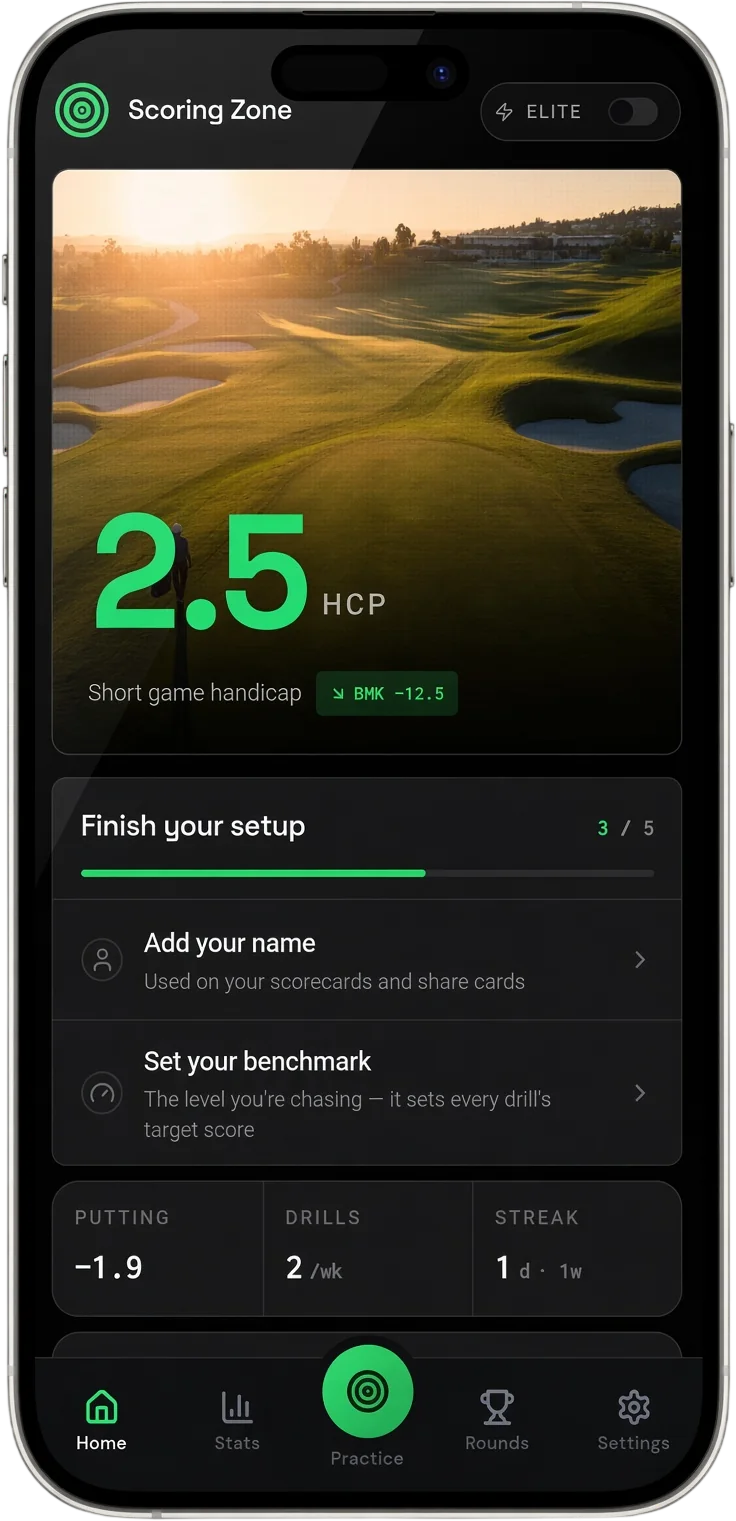
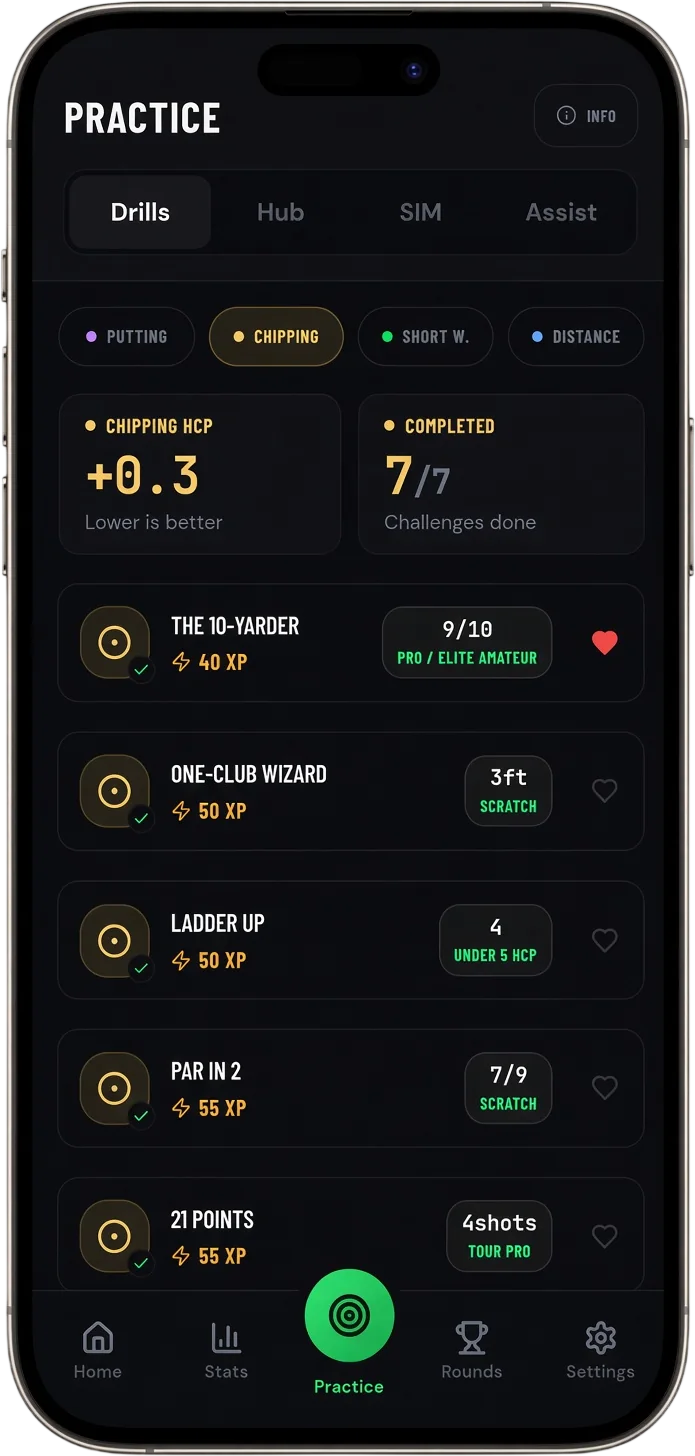
That is a different job from what 18Birdies does, and it is worth being clear about: run the free tier of 18Birdies for your yardages and scorecard, then use something built for practice between rounds. Scoring Zone benchmarks your chipping and putting against your handicap and gives you a Short Game Handicap that drops as you improve. It is free for 7 days, which makes the maths on “should I pay 18Birdies $80” a lot more interesting.
Full short game assessment — calculates your Short Game Handicap and Putting Handicap.
See the Performance Hub →18Birdies free for on-course yardages and scoring. Scoring Zone for the 60% of shots inside 100 yards. Total cost: nothing. That covers more ground than 18Birdies Premium alone, and it puts the effort where the strokes actually are.
How 18Birdies, Golfshot and TheGrint compare head to head.
18Birdies vs Golfshot vs TheGrint →No. 18Birdies is free to download and the free tier is genuinely usable — GPS yardages, a full digital scorecard, basic round stats, and the social features all cost nothing. You only pay if you want Premium, which runs roughly $60–$90 per year depending on the plan you pick and whether you catch a promotion.
Premium sits at roughly $60–$90 per year. The annual plan works out cheaper per month than paying monthly, and 18Birdies runs seasonal discounts — so the number you see in January is often not the number you see in July. Check the in-app price before committing.
The free tier gives you GPS distances, scorecards, basic stats, and the social layer. Premium removes ads and adds the AI caddie with club recommendations, green-reading slope data, advanced stat breakdowns, and unlimited scorecard history. Nothing in Premium changes how you strike the ball — it changes how much information you get while you play.
Usually not straight away. If you are losing shots around the green, the AI caddie and slope readings are solving a problem you do not have yet. A high handicapper gets more from the free tier plus structured short game practice than from paying for on-course data they cannot act on. Get the short game handicap down first, then revisit whether you need the extra on-course data.
7 days free
Then from $4.99/month · Cancel anytime
Start your 7-day free trial
35+ drills & tests · Short Game Handicap · Performance tracking