Golf Basics
What percentage of golfers break 90?
The real numbers for 100, 80 and par, and where the famous 26% came from

The real numbers for 100, 80 and par, and where the famous 26% came from
Key takeaway: Of US golfers who keep score, 38% average under 90, 69% average under 100 and 11% average under 80 (National Golf Foundation, 2024). The “26% break 90” figure you see everywhere can’t be traced to any published study. To average under 90 on a par 72 you need a Course Handicap of roughly 14 or better.
Search this question and you’ll get the same answer on site after site: about 26% of golfers break 90. We used to say it on this site too.
So I went looking for where it came from. The earliest trace I could find is a 2008 forum post quoting a Yahoo Answers reply about a 2005 survey. Nobody links the survey itself, and I couldn’t find it.
That’s the number half the internet is built on.
There is better data now, and it’s kinder to you than the old figure. Here’s what it actually says, score by score, and what it means if you’re stuck in the 90s.
In August 2024 the National Golf Foundation asked US golfers who keep score what they usually shoot. Their average score broke down like this:
Add those up and 38% of score-keepers average under 90, and 69% average under 100. The overall average was 94: 93 for men and 99 for women.
Two honest caveats. First, these are averages, not best rounds. A golfer who averages 92 will break 90 on a good day, so more people have broken 90 at least once than these numbers show. Second, 23% of golfers told the NGF they don’t keep score at all, and they’re mostly the occasional players. The NGF’s own view is that the true average golfer is “closer to triple figures than the mid-90s.”
So if you average in the low 90s and keep a card, you’re right in the middle of the golfers who take it seriously. Not behind.
This is where most golfers get it wrong. Your handicap is not your average score.
Under the World Handicap System, your Handicap Index is the average of your best 8 of your last 20 score differentials. It measures what you can do on a good day. The USGA has long said golfers play to their handicap only about 20 to 25% of the time.
Golf statistician Lou Stagner, working from Arccos data, uses a simple rule: your scoring average is about three shots higher than your Course Handicap. So to average under 90 on a par 72, you need a Course Handicap of roughly 14 or better. To break 90 now and again, you can be a fair bit higher.
Here’s how US golfers with a Handicap Index are spread, from the USGA’s handicapping statistics (year-end 2025):
| Handicap Index | Men | Women |
|---|---|---|
| Plus (better than scratch) | 2.0% | 0.9% |
| 0 to 4.9 | 8.2% | 1.5% |
| 5 to 9.9 | 19.6% | 2.5% |
| 10 to 14.9 | 26.5% | 5.2% |
| 15 to 19.9 | 22.2% | 10.3% |
| 20 to 24.9 | 12.4% | 15.8% |
| 25 and above | 9.1% | 63.8% |
The average Index is 14.0 for men and 28.8 for women. Add up the rows under 15 and about 56% of male Index holders are in the range where averaging under 90 is realistic.
Keep in mind who’s in that table. About 3.7 million Americans hold a Handicap Index, out of 29.1 million who played on a course in 2025. That’s roughly one golfer in eight, and it’s the more committed eighth.
69% of score-keepers average under 100 (73% of men, 52% of women), per the NGF. Breaking 100 is the first real milestone, and most golfers who keep a card have passed it.
Nobody publishes it. The NGF data comes in ten-shot bands, so the honest answer is somewhere between 38% and 69%. Anyone giving you a precise figure for 95 is estimating.
11% of score-keepers average under 80. The NGF checked that against USGA data: almost 11% of male Index holders are 4.9 or better, which lines up.
About 2% of male Index holders and under 1% of female Index holders carry a plus handicap, meaning their best rounds are better than scratch. That’s the closest real number to “golfers who break par”. Remember the handicap is built on their good days, so even they don’t do it every week.
There’s no amateur dataset for it. For a sense of scale: in the entire history of the PGA Tour, only 16 rounds have been under 60, starting with Al Geiberger’s 59 in 1977. Jim Furyk’s 58 in 2016 is still the only one.
Most golfers in the 90s blame their driver. Look at what happens around the green instead.
Shot Scope’s data on getting up and down from inside 50 yards:
| Handicap | Up and down from inside 50 yards |
|---|---|
| Scratch | 54% |
| 10 handicap | 39% |
| 15 handicap | 35% |
| 20 handicap | About 30% |
A golfer in the 90s misses most greens, so this shot comes up again and again. Over ten attempts, going from 3 to 4 is a shot saved, from one skill, without touching your swing.
One caveat, because it matters. The long game is still the bigger gap. Mark Broadie, the Columbia professor behind strokes gained, found approach shots account for 4 of the 10 strokes between a 90-shooter and an 80-shooter. But you can’t rebuild your iron play in a 30-minute session. You can measurably improve how often you get up and down.
For the short game drills that cut strokes fastest, with scoring targets for each:
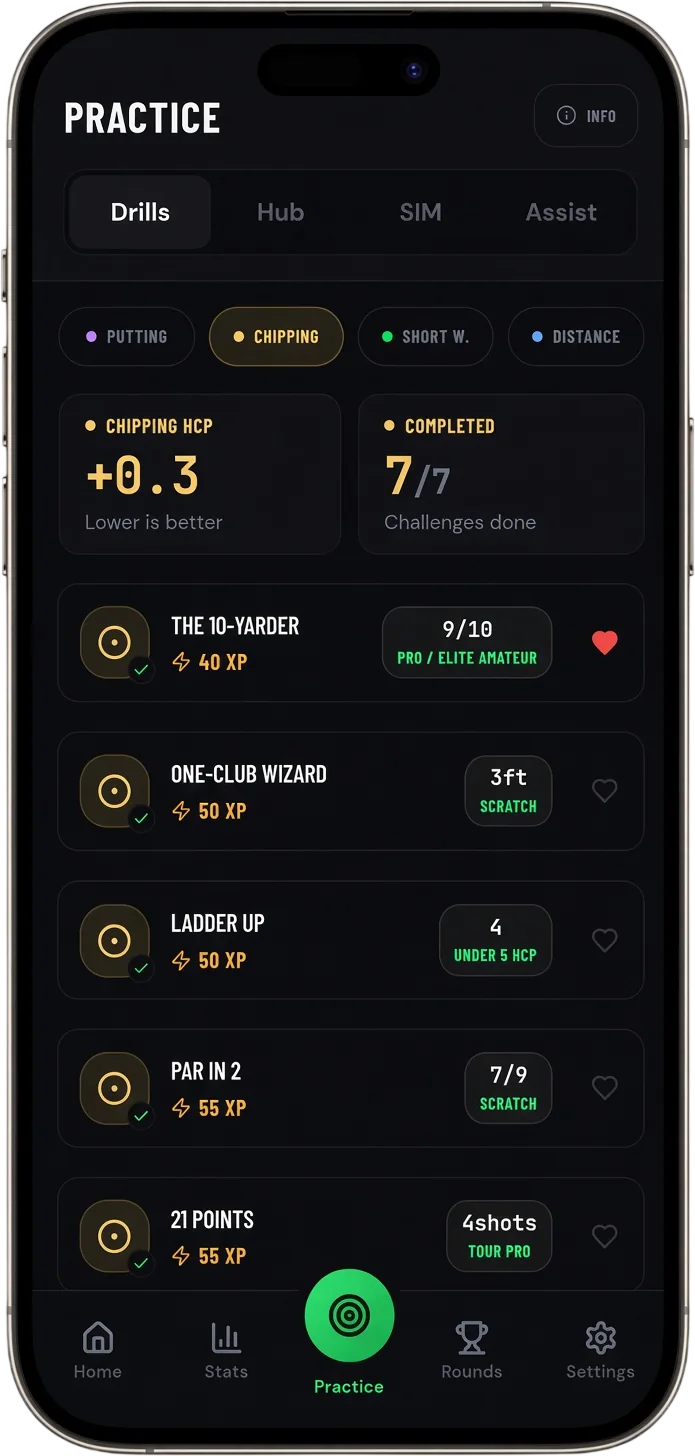
How to Improve Your Golf Short Game →Set up nine different chips around the green: different lies, different distances. From each one, try to get down in two, a chip and a putt. Count your pars out of nine.
The benchmarks we use in Scoring Zone are 7 for a scratch golfer, 4 for a 9 handicap, 3 for an 18 handicap and 2 for a 24 handicap. If you’re scoring 2 and you want to break 90, getting to 4 is the job.
Hit 10 putts from 30 feet or more and count how many finish within three feet. Speed only, forget the line.
Our benchmarks: 5 out of 10 for a 9 handicap, 3 for an 18 handicap, 2 for a 24 handicap. Every lag that finishes inside three feet is a three-putt you didn’t have.
Write your scores down every time. Scoring Zone does that for you and compares them to your handicap, but a notebook works if you’re honest about the gimmes.
Breaking 90 isn’t the rare achievement the old numbers made it out to be. Plenty of golfers get there. The ones who do it most weeks aren’t hitting it further. They’re wasting fewer shots from 50 yards in.
Stephen
38% of US golfers who keep score average under 90, according to the National Golf Foundation’s 2024 survey. More than that have broken 90 at least once, because a golfer who averages 92 will break 90 on a good day. The widely quoted 26% figure can’t be traced to any published study.
69% of golfers who keep score average under 100: 73% of men and 52% of women (National Golf Foundation, 2024). Golfers who don’t keep score, about 23%, tend to score higher, so the figure across all golfers is lower.
11% of golfers who keep score average under 80 (National Golf Foundation, 2024). That matches USGA data showing almost 11% of male Handicap Index holders are 4.9 or better.
About 2% of male and under 1% of female US Handicap Index holders carry a plus handicap (USGA, year-end 2025). A Handicap Index reflects a golfer’s better rounds, so even plus handicappers don’t break par every time they play.
To average under 90 on a par 72, you need a Course Handicap of roughly 14 or better, because most golfers average about three shots above their Course Handicap. To break 90 occasionally, a higher handicap is fine. Your Handicap Index is the average of your best 8 of your last 20 rounds, not your average score.
7 days free
Then from $4.99/month · Cancel anytime
Start your 7-day free trial
35+ drills & tests · Short Game Handicap · Performance tracking