Tracking Your Scores Isn’t Improving Them.
7 days free
Then from $4.99/month · Cancel anytime
Start your 7-day free trial
35+ drills & tests · Short Game Handicap · Performance tracking
Match the Tool to the Problem You’re Actually Trying to Solve
2026-05-07 · 8 min read · Stephen Pickering
Quick verdict: The best Shot Scope alternative depends on what you’re actually replacing. Arccos for sensor-based tracking with AI Caddie features (subscription). TheGrint or 18Birdies for manual stat tracking without hardware. Scoring Zone for short game improvement — 7-day free trial, no sensors. Match the tool to the problem.
Shot Scope is a legitimate Sensor-Based Shot Tracking System. If you’re looking for a Shot Scope alternative, it’s worth being precise about what you actually want to replace — because Shot Scope does several things, and different alternatives solve different parts of the problem.
Are you trying to replace GPS watches and club tags that automatically log every shot for strokes gained analysis? The cost? The platform? Or are you looking for something Shot Scope never offered in the first place: structured practice between rounds?
Each of those is a different problem with a different answer. This guide breaks it down by use case so you can match the tool to what you actually need.
No-subscription sensor-based shot tracking. The V5 watch + 16 tags gives you full strokes gained data, GPS yardages, and 100+ stats per round at a one-time hardware cost — strong long-term value.
For a lot of golfers, that’s enough. The question is whether you’re one of them — or whether the gaps below matter for how you actually play and practise.
Shot Scope requires a wrist-worn GPS watch and tags screwed into every grip. If you'd rather play without a wearable — or you change clubs frequently and don't want to manage tag installation — that's a real friction point.
The watch occasionally needs mid-round charging on 36-hole days. Some golfers find the sensor management — keeping things charged, dealing with connectivity issues — more friction than they want from a tracking system.
Shot Scope tells you that you're losing 2.4 strokes per round around the green. It doesn't give you the practice system to fix it. Like Arccos, it's an analytics tool — useful for identifying where to work, useless for the actual work.
Arccos is the closest hardware competitor. Grip-end sensors instead of a watch, AI Caddie real-time recommendations, polished analytics dashboard. Higher total cost than Shot Scope (~$300 first year, ~$130/yr after), but the software is more actively developed and the AI features are stronger.
Both let you log shots manually during a round and produce stat summaries afterwards. You lose Shot Scope's automatic detection, but you also skip the hardware investment. For golfers diligent about manual entry, the data output is workable.
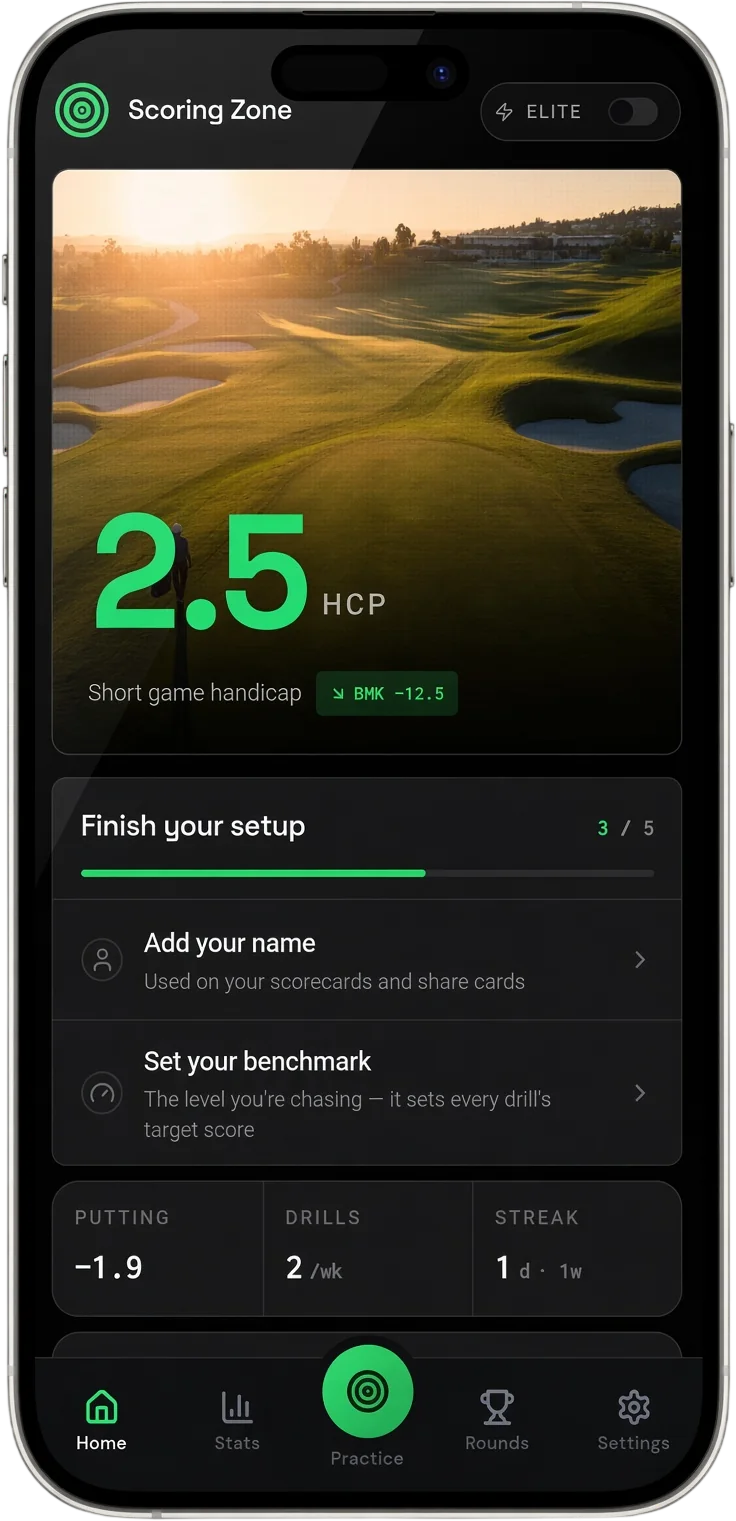
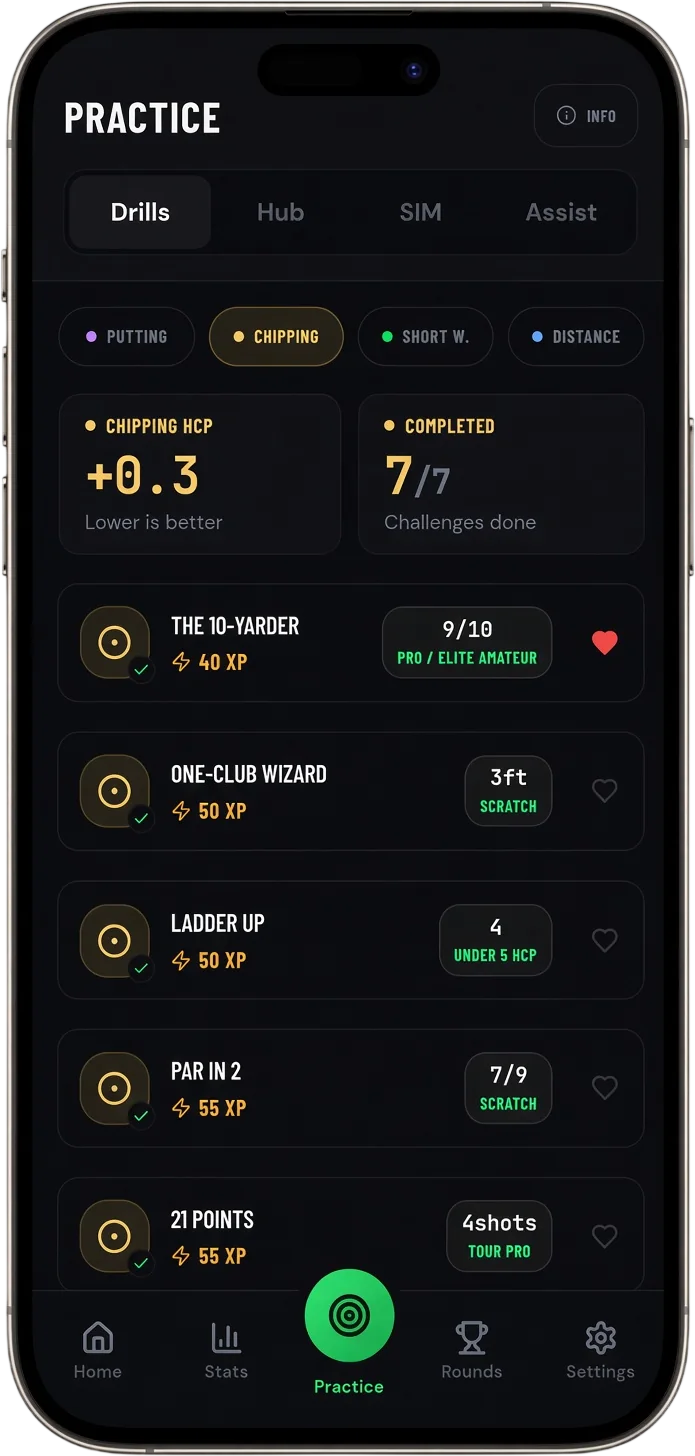
If the issue with Shot Scope isn't the hardware but the gap between knowing what's wrong and fixing it, Scoring Zone fills the practice side. Scored short game drills, Short Game Handicap from a structured assessment, session-by-session trend tracking. No sensors or hardware — start with a 7-day free trial of the full app.
See the structured short game drill library.
Chipping Drills →There’s a pattern in how golfers use most apps in this category. They run them for a few months, build up some data or play a lot of rounds, and discover — almost without exception — that they’re losing shots around the green. The diagnosis is clear. The problem is identified.
Then the app continues doing what it does, and the numbers don’t change. Because tracking the problem and training to fix it are fundamentally different activities. One happens on the course. The other happens on the practice green.
The golfers who close that loop — who use round data to identify weaknesses, then deliberately practise those weaknesses with structure and scoring — improve measurably. The ones who just keep tracking the same pattern don’t.
It’s not hitting chip shots until you feel better. It’s a scored drill with a benchmark — a target you’re either above or below. It’s a pressure challenge that resets when you miss, so there’s something at stake. It’s a session that ends with a number you can compare to last week.
That feedback loop — score → benchmark → trend — is what converts practice time into on-course improvement. Without it, repetition at the practice green is indistinguishable from going through the motions.
Track your round stats alongside your practice scores to close the loop between what you track and what you train.
Round Stats →Yes — they're the two main sensor-based competitors. Arccos uses grip-end sensors paired with your phone. Shot Scope uses a GPS watch + tags. Arccos has a slightly more polished AI Caddie and ongoing software updates from the subscription model. Shot Scope wins on long-term value with no recurring fees. Pick on subscription preference.
Yes — for round-level basics (fairways, GIR, putts, score), apps like 18Birdies, Hole19, or TheGrint let you log stats manually. For strokes gained data without sensors, you'd need to log every shot location manually, which is workable but tedious. The reason Shot Scope and Arccos exist is to automate that.
No. Shot Scope is a round-tracking and analytics tool. It identifies which parts of your game are losing strokes, but it doesn't provide drills, scored practice, or session-by-session improvement feedback. To act on the data Shot Scope produces, you need a separate practice tool.
Scoring Zone is the natural complement. Shot Scope tells you you're losing strokes around the green; Scoring Zone gives you the structured drills to fix it. No hardware needed, with a a 7-day free trial, on the iOS App Store or as a PWA on iOS or Android.
7 days free
Then from $4.99/month · Cancel anytime
Start your 7-day free trial
35+ drills & tests · Short Game Handicap · Performance tracking